Showing posts with label faith. Show all posts

11 June 2023

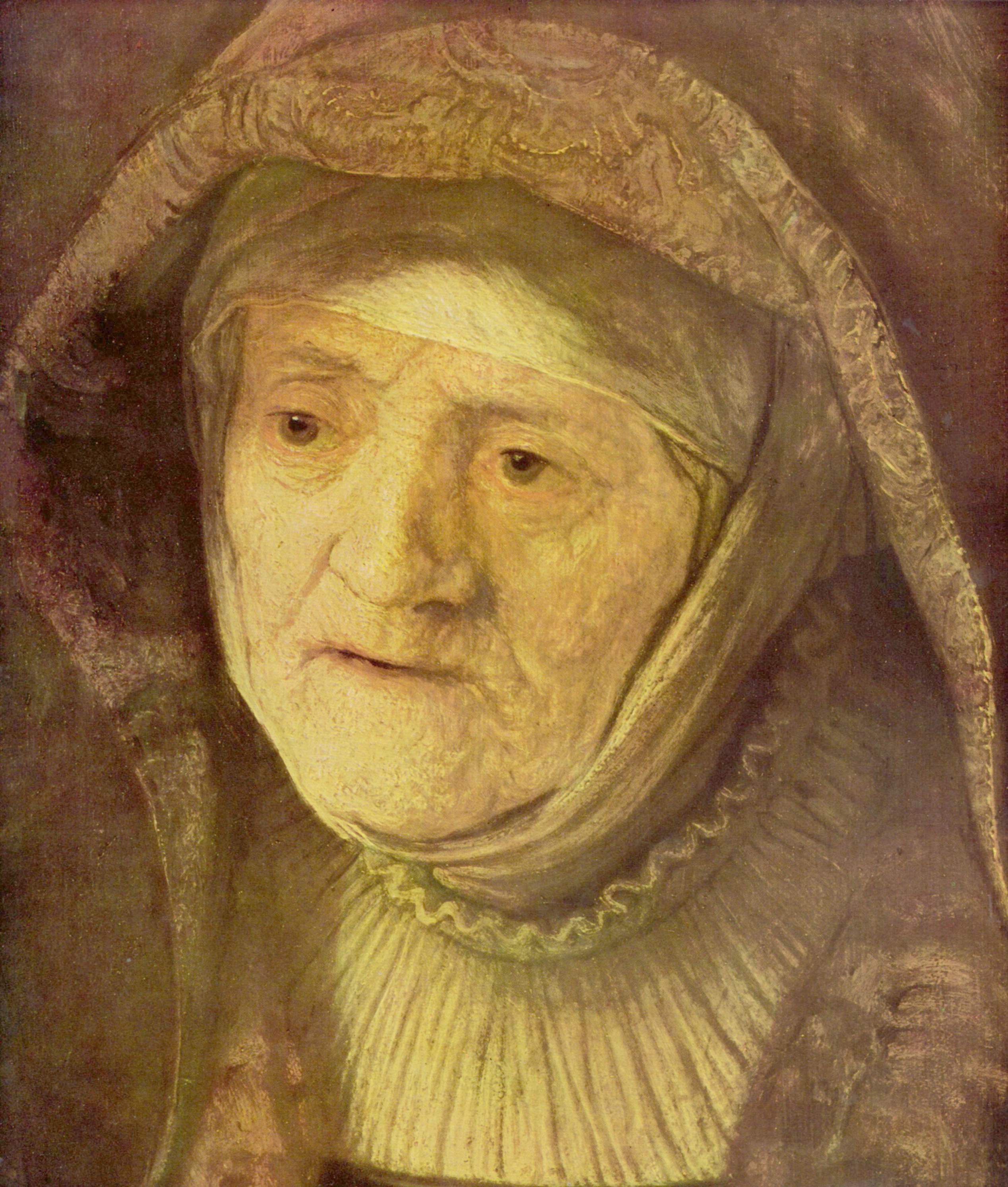
Psalmist's Mother: My God, my God

 Psalm 22

"Yet it was you who took me from the womb; you kept me safe on my mother’s breast. On you I was cast from my birth, and since my mother bore me you have been my God. Do not be far from me, for trouble is near and there is no one to help." (Ps 22:9-11)


"My God, my God"
I moaned, I cried
and then he was out,
delivered.

Then there I was
swamped with feeling,
a tiny purple thing
latched to my breast
overwhelmed with love.

My child, my child,
how can I love you
how shall I protect you
from the baying dogs
and the charging bulls,
from people who will laugh
and scorn and abuse,
from death that lurks
for us all in the end
who am I
to take you by the hand
in this world where I have no control
helpless
just like you?

My God, my God,
I cast him onto you
for what else can I do?
When I am too weak
when I am too small
when one day I am gone
You will be there.
A Love even greater
than the one that's threatening
to tear my heart in two.
My God, my God
never forsake him,
do not be far from him
in his time of need.

Can a mother forget her child?
Never.
And neither can you.

___________________________

[11. June 2023]

Reading through the Psalms right now and found out Ps 22 mentions a mother and a birth scene and I was inspired.

In my daughter's first night I looked at her at one point and just had to burst into tears ober the realisation that God loves her with a love even greater than I could ever have. For me as a mother, knowing that God is there when I can't be is such a great help with so many things in motherhood and in life just not being in my control.

Ps 22 is the famous "My God, my God, why have you forsaken me?" Psalm that Jesus quotes on the cross. Having this little scene of the mother entrusting her child to God in the middle of it for me is a reminder of how we are dependent on God from the beginning. These verses set a contrast to the negative beginning. But also emphasises again the question: Where is God now in my suffering?

The Psalm ends with the experience that God is still there and does not really turn away or abandon anyone. The lament of the first half abruptly turns into praise. God can be trusted. I wanted to make this poem less about the lament (though I picked up some elements from the Psalm) and more about the trust, and that decision to entrust one's child to God because we can't do this parenting thing alone.

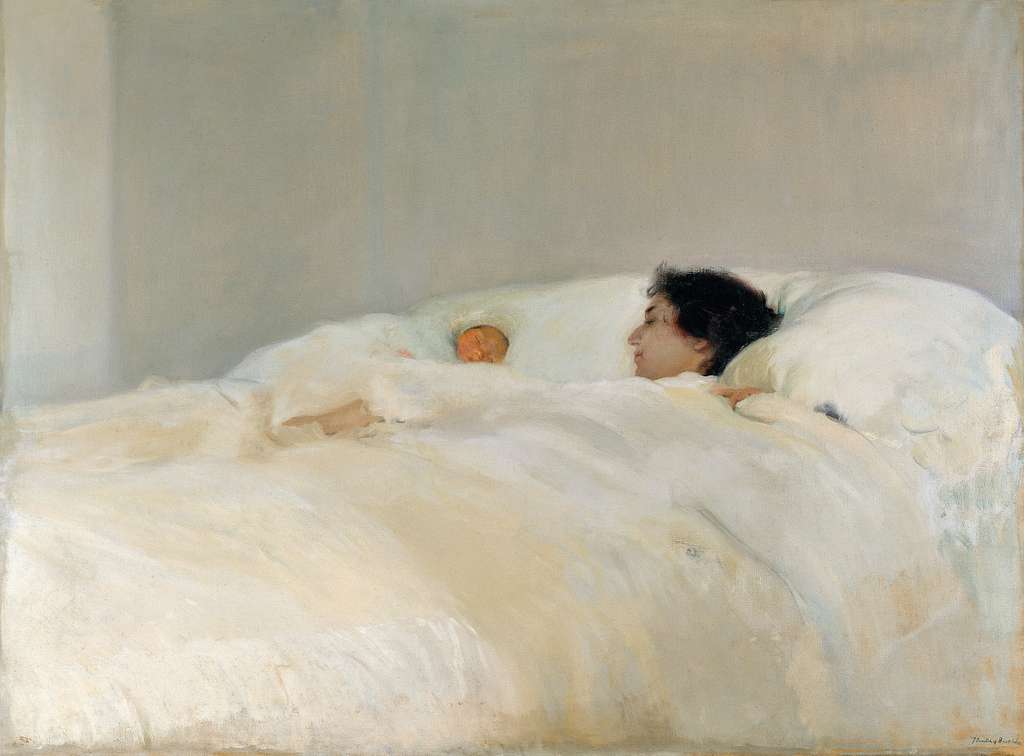
Picture by Joaquin Sorolla y Bastida

23 January 2022

Widow of Zarephath: My Cup Overflows

1. Kings 17

I am alone
but my cup overflows.
No husband to support me
but my cup overflows.
Sole provider for my child
but my cup overflows.
Troubled are our times
but my cup overflows.

Your abundance
comes flowing down
covering our needs.
My cup overflows.
All the strength that I needed
to live through this time,
endurance and joy,
my cup overflows.

Faced with starvation
but my cup overflows.
Faced with illness
but my cup overflows.
Faced with loss
but my cup overflows.
In all adversity
my cup overflows.

All your riches,
your luxurious love,
pouring into our lives,
more than enough.
My cup overflows
enough to share
with hungry prophets
and weary guests.
My cup overflows.

_____________________________________________________

[23. January 2022]

The other day I randomly pondered whether there were any single mothers in the Bible. Of course there are quite a bunch. This is one of them and the first who came to mind.

Her story really spoke to me in the moment that I thought about her. She is a single mother like me. She lives in challenging times like we do currently (for her: drought and famine, for us: pandemic). She experiences miraculous provision - which I have been experiencing too ever since the separation. Oil in the Bible is a symbol of joy and abundance. She experiences the miracle of her tiny remainder of oil never being used up. What if we read this not only as the literal kitchen ingredient never running out, but as God providing all she needs? Personally these past few months I have somehow always had the strength and courage to get through all the challenges of becoming a single mother. Reading the widow's story, the "oil" in my life is these things.

So yes this is one of those cases where I write a poem for a woman of the Bible from the perspective of my own current experience. This story is an encouragement to me.

I also find it interesting how the whole thing connects to hospitality. The widow has too little for herself and her son, then suddenly has a guest on her hands when Elijah basically invites himself. It is in this situation that the oil and flour never run out. The widow dared to be hospitable - and it paid out. I have also made this experience that sometimes when I'm going through a hard time, helping others actually helped me. Weird maybe, but it happens - miracles of provision I think are more common than we might expect.

"My cup overflows" from Psalm 23:5 jumped into my head for this one, and I decided on the repetitive pattern to emulate the "his love endures forever" refrain in Psalm 136.

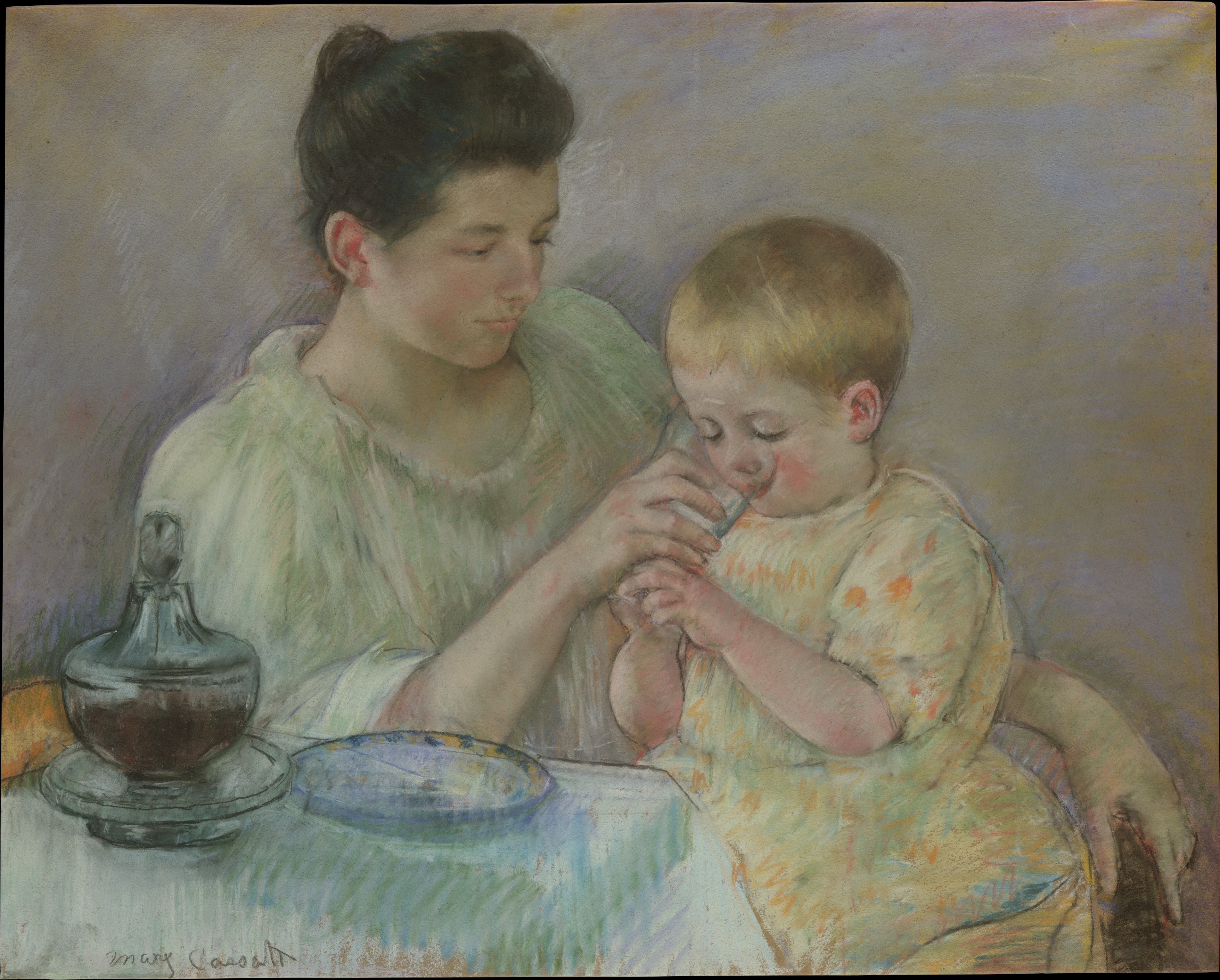
Picture by Mary Cassatt

13 September 2021

Hiobs Frau: Fluche Gott, und stirb!

Und seine Frau sprach zu ihm: Hältst du noch fest an deiner Frömmigkeit? Fluche Gott und stirb! (Hiob 2,9)


Fluche Gott
und stirb!
Was ist der Sinn
weiterzugehen?
Er hat alles genommen.
Was ist der Sinn
an ihm festzuhalten
wenn das der Lohn ist
für all deinen Glauben,
für all deine Treue.
Wenn sogar Gottlosigkeit mehr bringt,
warum noch glauben?
Warum noch leben
wenn er uns schon verflucht hat,
das Leben zur Hölle gemacht,
nicht mehr lebenswert?

Gott.
Ich verstehe nicht.
Ist das was du Liebe nennst?
Ist das wie du uns verdankst
für Glauben und Treue?
Ist das was wir verdient haben?

Was soll ich tun
mit diesem Loch in meiner Seele?
Ich klage an
gegen den Himmel,
rüttle an deinen Thron,
denn ich kann nicht mehr,
kann nicht verstehen,
kann nicht glauben,
ich mag nicht.

Wer hört meine Geschichte?
Wer heilt meine Wunden?
Wer lässt mich weinen, und tröstet mich?
Wer lässt mich fluchen und klagen
so viel wie ich muss
bis das Gift raus ist?
Wer
wenn nicht du?

Oh Gott,
der Gott der mich verwundet,
der Gott der mich heilt –
ich verstehe dich nicht,
kann dich manchmal nicht einmal leiden,
und doch
bist du mein Gott
den ich suche
sogar wenn ich dich hasse.

Ich kann nicht vergeben
was du getan hast –
hilf mir, zu vergeben.
Ich kann dich nicht lieben
weil du das zugelassen hast –
hilf mir, zu lieben.
Ich kann nicht vertrauen
der Hand, die mich fallen liess –
hilf mir, zu vertrauen.

Ich kann nicht glauben
an einen "Gott der Liebe"
der dieses Leid zulässt –
hilf mir,
Gott der Liebe,

an dich zu glauben.

Wenn ich es nicht alleine kann,
wenn ich ertrinke in der Finsternis
meiner Trauer und Wut,
rette mich vor mir selbst
und mach mich wieder dein.

______________________________________

[Übersetzung: 13. September 2021, Original: Job's Wife]

Wir haben im Konfirmandenunterricht heute Abend das Thema "Warum müssen Menschen leiden?" und ich dachte, eventuell baue ich dieses Gedicht irgendwo ein, und so habe ich es jetzt schnell übersetzt. Keine Ahnung ob ich es jetzt in der Stunde verwende oder nicht, aber jetzt ist es zumindest mal übersetzt. XD

Was mir wichtig ist aus dem Hiobsbuch: Es gibt keine Antwort zur Frage, warum Menschen leiden müssen - Gott gibt uns keine Antwort. Aber wir dürfen klagen. So habe ich auch dieses Gedicht geschrieben: wir dürfen klagen, dürfen Gott anklagen, dürfen fluchen, dürfen auf Gott wütend sein, vielleicht hassen wir Gott auch zeitweise wenn wir mitten im Leid sind. Gott hält das aus. Oft haben wir gelernt, solche Gefühle nicht auszudrücken, nicht nur nicht gegenüber Gott sondern auch gegenüber Mitmenschen. Lieber still in sich hineinfressen. Was nicht wirklich so gesund ist. Gerade die Geschichte von Hiob zeigt uns aber, dass wir klagen dürfen. Von Hiobs Frau lesen wir wirklich nur diesen Satz, Hiob selbst lässt aber so einiges raus, was wir uns vielleicht nicht getrauen würden, Gott zu sagen. Aber Gott hält es aus! Gott kommt damit klar, und er ist es auch, der uns trösten kann und mit der Zeit auch wieder zu sich führen kann. Aber wenn wir im Moment auf Gott wütend sind dann glaube ich dürfen wir das. Gott hält das aus.

Vom Buch Briefe die ich niemals schrieb von Ruth van Reken habe ich den Gedanken aufgenommen, dass wir manchmal "Gott vergeben müssen". Wenn man so aufgewachsen ist wie ich, dass Gott doch nie Fehler macht usw., dann kann das ein fremder Gedanke sein. Aber auch wenn Gott keine Fehler macht: vielleicht habe ich  mal Mühe mit etwas, das Gott zugelassen hat. Da kann es mir guttun, wenn ich Gott sagen kann: Ich fand das nicht richtig. Und da kann es entlasten, wenn ich Gott vergeben kann. Mehr als wenn ich das Ganze in mich hineinfresse in der Meinung "Gott macht ja keine Fehler usw". Das schadet der Beziehung zu Gott finde ich mehr als wenn ich das wie einen Fehler behandle. Gott kommt damit klar. Ich denke Gott hält in der Beziehung mit uns so viel mehr aus als wir oft meinen. Bei Hiob hat er ganz viel Klage und Anklage ausgehalten und Hiob am Ende recht gegeben.

Wir verstehen zwar nicht, warum Menschen leiden müssen, und Gott gibt uns keine Antwort. Aber wir dürfen klagen. Wir dürfen anklagen. Wir dürfen wütend und traurig sein. Und Gott ist in dem allem bei uns. Für mich ist Gottes Antwort auf das Leiden das Kreuz: Gott der mitleidet. Gott der mitten in das Leiden hineinkommt, es selber am eigenen Leib erlebt, und unsere Klage zur seinen macht, "Mein Gott, mein Gott, warum hast du mich verlassen?" Für mich ist das die "christliche Antwort auf das Leid", und das ist wohl keine Erklärung aber mir gibt es Kraft, wenn ich leide.

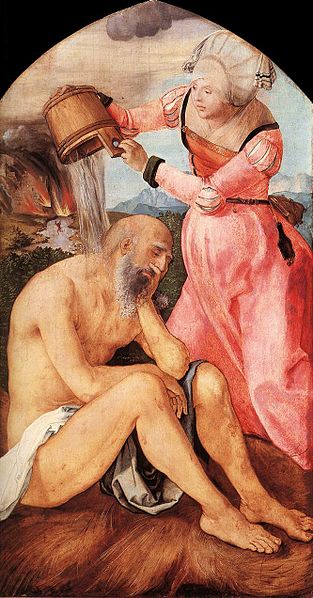
Bild von Albrecht Dürer.

26 May 2019

Widow Jerusalem: I Cannot Save You

Baruch 4:8-28

"But I, how can I help you? 
For he who brought these calamities upon you 
will deliver you from the hand of your enemies." 
(Baruch 4:17-18)

Alone with the pain,
alone without you.
What can I do?
Watching you as you go astray,
watching you fall and be taken away,
away from my loving arms.
What can I do?
What could I have done
to protect my lost sons,
to prevent all this pain?
What can I do
to rescue you,
bring an end to these wounds
you inflict on yourselves?

What can I do?
How can I save you?
What sacrifice
could this mother make?
I'd make them all,
I'd destroy myself
if only
if only
I could rescue you.

But it would be in vain.

What can I do?
I cannot save you.
How important for me
to realise this is true,
to learn to let go
and wait from afar,
not break myself
against your rocky hearts.
I cannot save you,
I'm allowed to let go,
let go and let God
who can do what I can't.

What can I do?
I can cry to the Lord,
day and night, all my life,
cry out for you.
I can watch, I can pray,
I can hope, as I wait,
encourage you with my faith
that you'll yet be saved.

Alone with the pain.
Alone without you.
I cannot save you -
and yet
there's still much I can do,
as I let you go
into the hands of God,
as I let him do
what I can't.
I will pray,
I will hope,
I will trust
until at last
the day comes
when I will have you back.

_____________________________


[26. May 2019]

I'm currently reading the Apocrypha (books excluded from the Bible during the Reformation, which were part of the Bible of the early church and are still in the Catholic Bible) and stumbled upon this personification of Jerusalem as a widow mourning her children. I loved this depiction and especially v. 17-18: "How can I help you? For he who brought these calamities upon you will deliver you from the hand of your enemies." As someone who has had to work through co-dependency, that really spoke to me.

Mother Jerusalem is struggling with the loss of her children who have been taken into exile. They have had to feel the consequences of their actions. As their mother she wants to rescue them - and co-dependent people tend to try to "save" others, to their own detriment. Trying to save other people is pointless, though - often our attempts are counter-productive. Often we end up protecting people from the consequences of their own actions so that they can never grow, at the same time breaking ourselves and losing ourselves. It is so very important to realise that we cannot save other people. The first of the 12 steps in Al-Anon (programme for loved ones of alcoholics) is to realise we are powerless over alcohol - i.e.: to realise what Mother Jerusalem is realising here. "How can I help you? - Only God can."

Realising we can't save people helps us give ourselves permission to let go. We co-dependents often feel we have to save the people we love. Realising we cannot gives us the freedom to let go and no longer give ourselves a bad conscience when we fail to change the people around us. Step 2 is: "Came to believe that a Power greater than ourselves could restore us to sanity." And that is also what Mother Jerusalem realises in v.17-18: she cannot save her children - but God can. "Let go and let God" is one of the slogans of Al-Anon. Letting go does not mean giving up, but instead giving what I cannot do to someone who can. Mother Jerusalem does this here: in Baruch 4 she keeps emphasising her trust in God, her hope that he will change what she cannot.

These are some of the most important things I learnt about dealing with co-dependency... I cannot save the person I love - however, God can. So I am allowed to let go and no longer try doing what I can't do. Instead I can focus on what I CAN - and trust God with the rest. :-)

12 Steps of Al-Anon
Picture: Mary Jane Peale, "Pearl of Grief"

20 August 2016

The Poor Widow's Offering: Generous

Mark 12:41-44

Generous God,
you have given me
all that I need -
not very much,
but it is enough.
Open my eyes
to see all you've provided -
more than possessions,
a wealth more than wealth.
I want to give thanks
for the riches you've given:
the breath in my body,
enough food to eat,
my beautiful children,
the knowledge of You.

Mysterious God,
it is true
my cup was not always sweet,
and much bitterness
has stained my years.
And I've cried and complained,
not understood your ways -
except this: you are love
and you understand my pain.
I have swallowed the dregs
of loss and poverty,
of loneliness
and a mother's worry.
Daily I struggle,
yet stubbornly believe,
though you lead me rocky ways,
that you care for me.

Bountiful God,
all I have is yours -
that's so easy to say,
yet so hard to do.
Give me the peace
to share generously -
just like You.
Let me live out the love
you have given to me,
with no fear of tomorrow,
with no fear of suffering.
Let me open my hand
knowing that yours
is always open to me.
You have covered my needs -
how can I not seek
to cover those
of others I meet?

Loving God,
I know my gift is small,
disappearingly small
beside the greater gifts
greater people can bring.
It shames me
as they give me looks
as though I were stingy,
whisper of "impertinence"
or say, "The more you give
the more you shall receive."
You see my gift,
worthless in their eyes -
worthy in yours,
for you see my heart
and what this means to me.
So here I bring
everything,
though to them it's nothing,
and I won't be ashamed,
for it's not their approval I seek.

Take my silver and my gold,
not a mite would I withhold -
and if I have no silver nor gold,
take my mite - take them both.

___________________________________________________

[20. August 2016]

Italicised bit at the end is from Frances Ridley Havergal's hymn "Take my life and let it be" (an old favourite of mine).
Parts of this poem were inspired directly by yesterday's "3 minute retreat" from Loyola Press - highly recommended; it's an app too, try it out (Apple / Android)!

A widow gives two small coins as an offering in the temple (the temple offering would probably have been for supporting the Levites / priests working there - they had no land to farm so were dependent upon tithes etc - and upkeep of the temple). Others give a lot more. Jesus, who is watching, says that the widow in fact gave more than those who brought big gifts, because she gave all she had while the wealthy gave just a portion. I believe she is a perfect example of what Jesus taught about giving in Mt 6. She received no admiration for her gift - and yet it was a big move for her (and God saw it).

There's a lot of (false) preachers pushing for congregations to give money. A huge deal is made out of tithing - often with the tagline "give and you will receive". Giving is good - that "tagline" is dangerous. Because if you give in order to get back, you are in fact acting like an idol-worshipper. A principle I have watched often when I grew up in Taiwan was "give and get back". In traditional religion, you give sacrifices so that the god will give his services to you. It's basically a "business contract". I believe this is the "natural" human way of living religion. But Jesus has taught us a new way. Which means giving is no longer part of a "business contract" with God, where God is "indebted" to give us something back, and where God's blessing is in proportion to the size of our gifts. We are in a relationship with God, welcomed to freely give out of love, not because we "must" and not because we "get something" out of it.

And that's how I view this widow's actions here. She gave out of the generosity of her heart (and possibly out of the experience of God's generosity despite her hardships), gave what she had (trusting in God's provision), and was brave enough to give what must have looked pretty measly to onlookers. Generosity is not giving with the hope of getting something back... it's also not something only possible if you have a lot to give. Generosity (not only when it comes to money, but also e.g. in treatment of others, giving time, giving kindness) takes courage - the trust that we are not going to "lose out" by giving to others.

I have discussions with my boyfriend about tithing sometimes (because he doesn't really believe in it, or the way some people do it). If we're tithing because "it's what one does", or because we "ought to", or because we think we'll "get something back", then I believe we are not tithing in the right way. The size of our gifts doesn't matter, the frequency of our gifts doesn't matter, what matters is our attitude. What matters is our relationship with God. So I believe ultimately it's better not to tithe regularly (but e.g. give randomly when we see a need) than to tithe out of a wrong attitude of legalism (just keeping the rules) or because we want to look good to others.

Picture is by Frederick Goodall.

09 March 2016

Esther: Just A Girl

Esther 4

"Who knows? Perhaps you have come to royal dignity for just such a time as this." (Esther 4:14b)

Why me, God?
I'm just a girl,
longing to belong -
why let me be uprooted,
torn from those I love?
Why take me to this foreign place
where I know no one?

Why me, God?
I'm just a girl,
longing to be loved -
why place me in the power
of such a cruel man?
Why take away my freedom,
imprisoned in his hand?

Why me, God?
I'm just a girl,
longing for peace -
why this burden on my shoulders?
Why this responsibility?
Should I pay with my own life
to buy my people free?

It's me, God -
I am a queen
placed here by you
for just this purpose,
for such a time as this.
My life makes sense
in your perfect plan -
so give me strength to do
what you have called me to.

______________________________________________________________

[9. March 2016]

We can look at Esther's story as a "rags-to-riches" story about a girl rising from orphaned nobody to queen of a huge empire (comprising 127 provinces) - or we can read it as the story of a girl who was forcefully taken from her family without any say in the matter, to marry a man who we found out in the first chapter has a rather volatile temper. Esther hardly speaks a word for much of the first part of the book. She has no say in what is happening to her. So despite her rise to queenship, I believe Esther is actually in a situation of suffering. She is practically imprisoned, unable to return to her family (though she is still able to communicate with Mordecai) and (on pain of death) forbidden from approaching her husband on her own initiative, bound into the rules and restrictions of palace life. So I can very well imagine her asking: "Why me?"

One of my favourite parts of the book of Esther is chapter 4, where Mordecai moves Esther to stand up for her people. The Jews are in danger: a day has been set on which they are all to be exterminated. Mordecai wants Esther to use her position with the king to save the Jews. And this is the point where all that has gone before, Esther's separation from her family and her marriage to the king, is given some sense: "Who knows? Perhaps you have come to royal dignity for just such a time as this." (Esther 4:14)

Esther is a very interesting book in that it nowhere mentions God directly. However, God is hinted at in statements like this one. He is active in the background, behind all the occurrences and the actions of individuals, behind some of the things we don't understand. Mordecai explains what Esther has been going through: it has all had a purpose, it has led to this point in which Esther has a vital role to play for her people. She has become queen for a reason, she has been given this responsibility for a reason, and so she should not be afraid to act.

I suppose all this wasn't clear as it was occurring. Esther did not see God's purpose when she was taken away from her adoptive parents. She did not see God's purpose when she ended up married to the Persian king. But sometimes we come into a situation where God's leading hand becomes visible, where things become clear. Often we only see clearly in hindsight.

It's not always wise to tell someone, "Oh, your suffering has a purpose and God has a plan." They might not understand it at the moment. We need wisdom and discernment when it is right to help someone who is suffering to view their suffering in the larger context of God's guidance. But I do believe it can be comforting and helpful to recognise: what has happened to me has a purpose. And from experience I can say that being entrusted with a task is one of the greatest comforts one can be given.

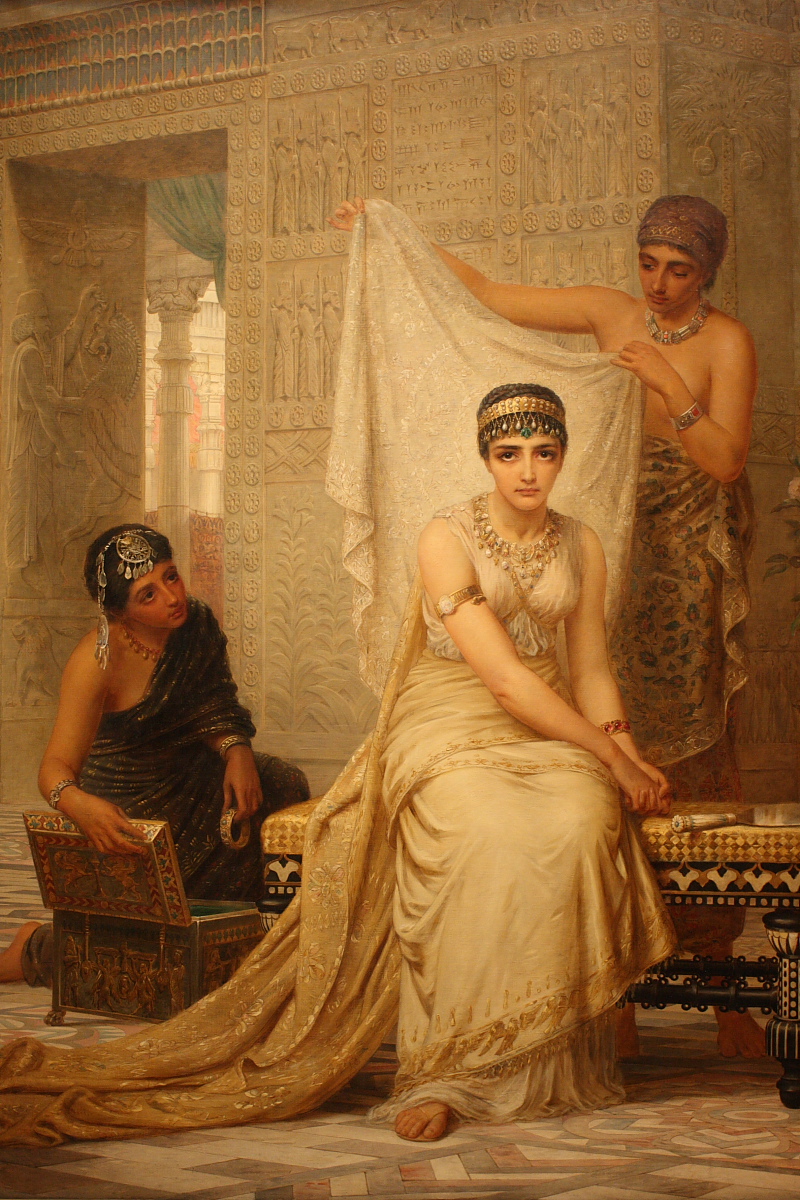
Picture by Edwin Long.

26 February 2016

Anna: An Old Woman

Luke 2:36-38


Lord,
I am an old woman.
My body hurts and aches,
my teeth have all but disappeared,
and wrinkles line my face.
Let this not be a hindrance
as I lift up your praise.

Lord,
I am an old woman.
There is not much I need.
But one thing I must ask of you,
o Father, hear my plea:
Send us the promised Saviour
to set your people free.

Lord,
I am an old woman.
I've known you many years.
I've known you in both joy and pain,
in laughter and in tears,
and so I know your faithfulness
and love will never cease.

Lord,
I am an old woman.
I have seen many things,
but I'd never have imagined
THIS.

You are too wonderful for words,
for you have heard my prayer
and in my arms the Saviour lies:
a poor woman's child,
helpless and small,
beautiful -
not what I'd have thought -
no: BETTER.

People!
I am an old woman,
but hear the words I have to say:
the Saviour has come here today,
meek and mild,
only a child,
the power of God
in weakness revealed.

Thanks be to God.

_________________________________________________________

[January 2012]

Anna sees Jesus when Joseph and Mary bring him to be presented at the temple.

Isn't it sad how old age, and old people, are nowadays being sort of relegated to the edge, as if they don't exist? If you look at magazines, you see no old people. I find old people really beautiful. You know, the really wrinkled faces and the only-two-really-black-teeth smile? I love that. It's much more beautiful than all these painted celebrities caked with make-up.

Anyway, old people still have a LOT to say. And two old people, Simeon and Anna, were among the first to recognise Jesus as Lord and pass it on. I really admire their joy. I recently read Luke 2 and I'm really setting these two old people as my examples now. I keep praying that I'll have joy like Anna.

17 February 2016

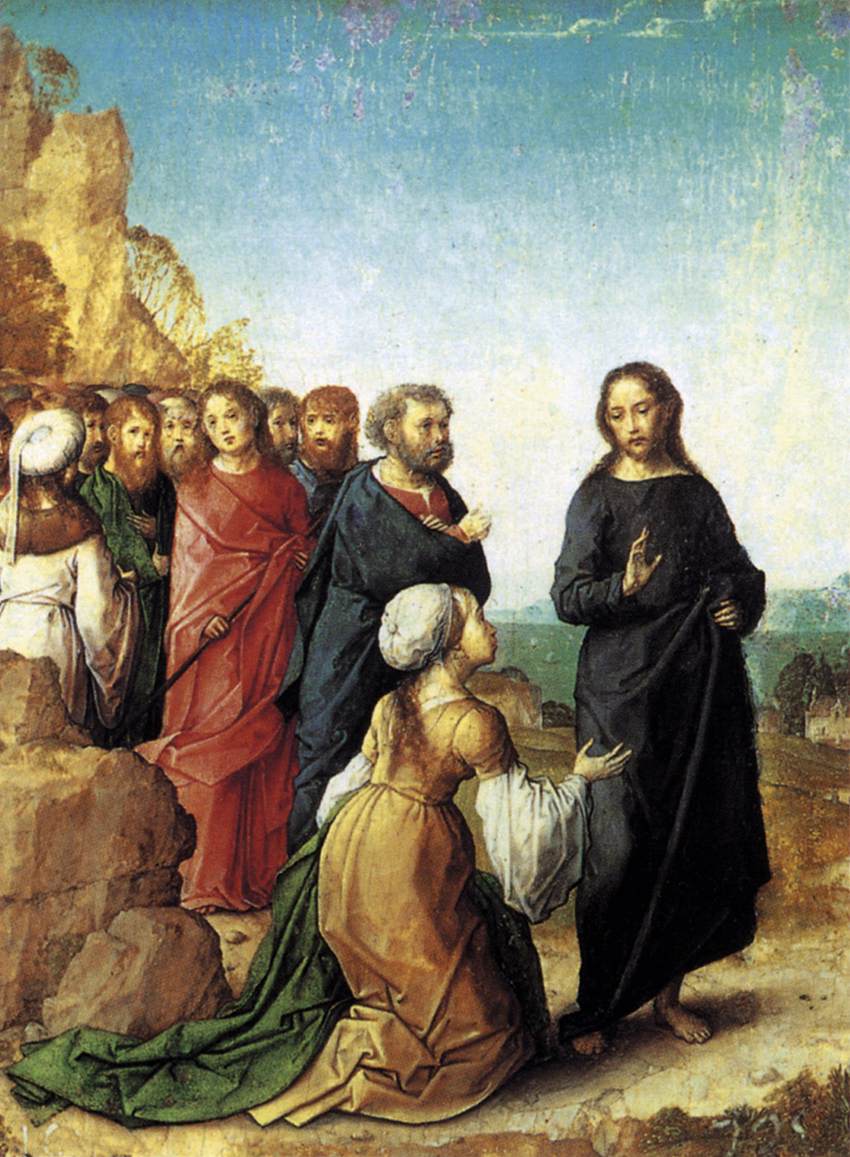
Syrophoenician Woman: I Won't Take No

Matthew 15:21-28

O Lord, have mercy!
Hear me, and help!
Don't walk away -
please listen to me.
O Son of David,
I know who you are:
I know of your power;
I believe in your love.

O Lord, have mercy!
Why this repulse?
You turn me away
and dash my last hope.
Your calling's elsewhere -
my need not your priority.
In the face of such coldness,
can I believe you are love?

O Lord, have mercy!
Why these harsh words?
Though I cannot deny
I have no claim on you,
no right to your help.
And yet, o Lord,
I will desperately believe,
believe despite all that you are love.

Don't go
before you bless me.
Don't go
without dropping
a few crumbs for me,
at my undeserving feet.
I may not deserve you
but still I refuse
to stop knocking on your door,
demanding your love.

O Lord, have mercy!
My faith won't let you go.
I won't take a no
but cling to your grace
and count on your love.

________________________________________________________

[13. February 2013]

With references to Jacob's wrestling with God and the parable of the asking friend in Lk 11.

Last Sunday I heard a sermon on this text; a lot of this is based on what I learnt from that sermon.
Why does Jesus turn the woman away? The pastor pointed out that Jesus had a specific calling to help the people of Israel first. Mission to the gentiles started afterwards. His priority was His calling. But here's what this woman did:

  • She recognised Jesus as the Messiah: she called Him the Son of David. She believed in Him.
     
  • She did not fight against his (absolutely not flattering, even unfriendly) remark where He compared the gentiles to dogs. Instead she acknowledged that she did not have a claim on His help. And I think this is important to realise: that we don't have a "right" to have our prayers answered. We do not actually deserve Jesus at all. So we can't demand anything from Him in that way; He doesn't "have" to give us anything.
     
  • But this woman refuses to give up. She has strong faith: she believes that Jesus will help, even though He rejects her! She refuses to take no for an answer. And such persevering petitions God answers. Because they are an appeal not for something we have a "right" to receive, but to His grace. Because God WANTS us to trust in His grace and see that it is not because of what we are or are not, or what we have done, but only because of His Love that He accepts us and answers our prayers.

All is grace!

Picture by Juan de Flandes.

23 January 2016

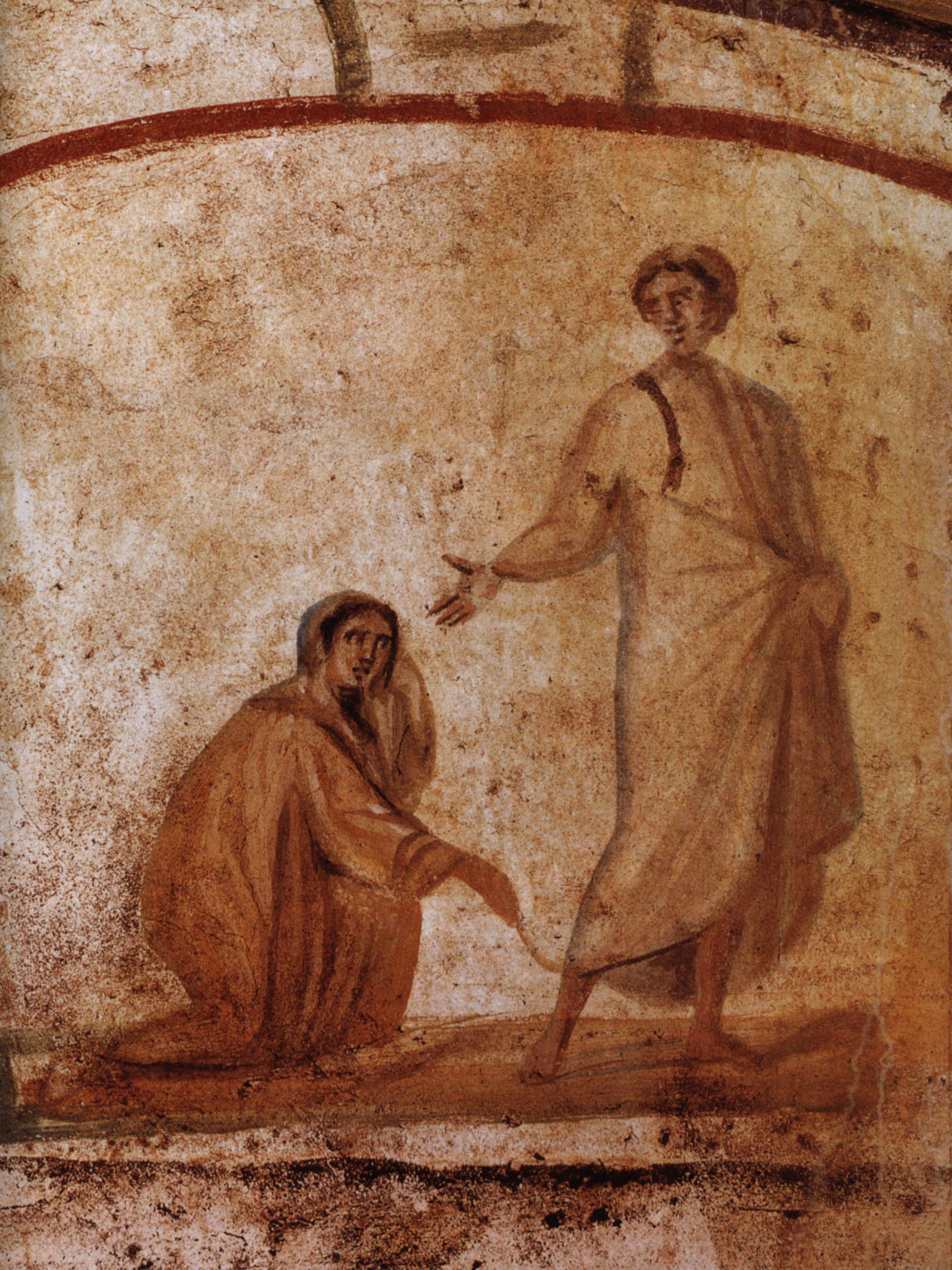
Woman with Issue of Blood: Untouchable

Mark 5:25-34 | Leviticus 15:19-30

I am a walking danger,
infectiously unclean,
can't touch or be touched,
for what I touch
I infect
with uncleanness.

I haven't felt a man's embrace
or stepped inside the temple courts
or hugged a child,
held a friend's hand,
these twelve long years -
untouchable.

I've gone to doctors
and spent all I had
till I'd spent myself dry -
to no avail.
Now here I am, bleeding,
worse than before.
Must I always be
untouchable?

I've heard of you from far away,
they say you heal, set captives free.
Can I believe that what they say
is meant for me?

But I'm unclean,
too unclean for the temple -
I must be too unclean for you.
But in my heart I know it's true
that you, Lord, are my only hope -
and this I know:
you'll heal me.

One touch,
one forbidden touch,
and you
will make me clean.
Jesus.

Can I dare?
I reach out my hand
                              and
                                   touch
                                          you.

___________________________________________________

[January 2012]

Read Leviticus 15:19-30 to see what rules there were concerning menstruation and unusual discharges like in the case of this lady.

It's quite complicated actually. Just try imagining it: every time you have a period, you can't touch anything or sit anywhere or anything! (On the other hand, it could give you a week off school... ^^) It might seem really strict, but in some ways it makes sense. As one of my Judaism handbooks says, it could give women a "time off" from their husbands. And keeping track of bodily fluids and things could keep diseases in check in earlier times when such things were more dangerous.

But such laws could also become very oppressive, especially for this woman who couldn't freely touch people and things without having to watch out, who couldn't even worship God in the temple.

When I first read about those laws concerning menstruation, I noticed that this woman did something really really crazy and risky when she touched Jesus' robe. Because actually, if I understand it correctly, a person touching her would become unclean. But the wonderful thing that happened instead is: Jesus made her clean.

We don't need to be afraid of our problems "damaging" Jesus or bothering Him too much or putting Him off. We don't need to be afraid! Because He can take all those things away. There's no problem too deep to share with Jesus, and no sin too dirty for Him to forgive. Unbelievable but true.

Picture from the Roman Catacombs.

31 December 2015

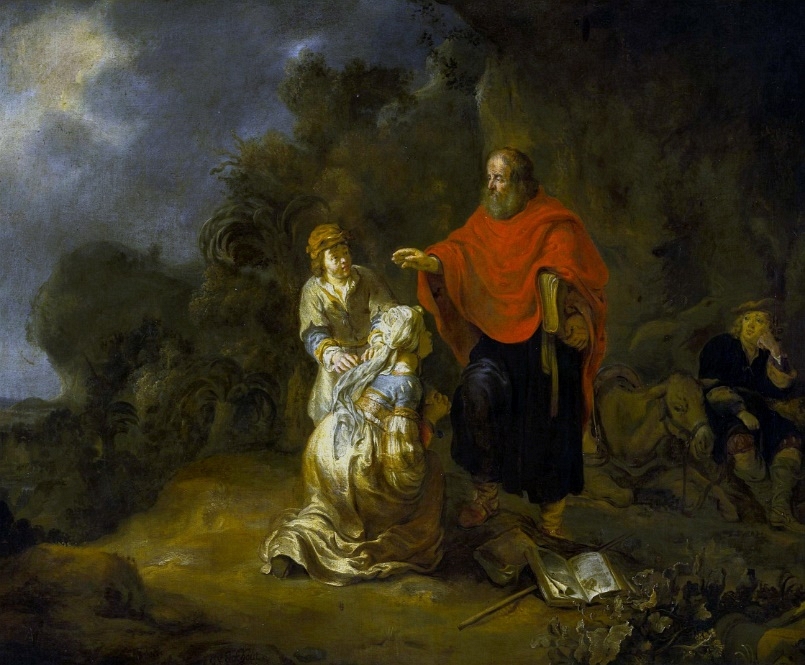
Shunammite Woman: Hoping against Hope


2. Kings 4:8-37

I.
A hole in my womb,
desperate to be filled.
A gap in my heart,
longing to be complete.
A space in my arms,
waiting to hold
a child of my own.

A dream unfulfilled,
turning into a nightmare,
as month after month
my hopes are dashed,
as year after year
my womb remains empty
and my wish retreats
into resignation.

So don't give me false hopes now,
Man of God,
for my faith has been stretched
beyond belief
and I couldn't take
another disappointment.


II.
A quickening in my womb -
the answer to my prayers!
Love in my heart
ready to be shared.
Complete at last,
for lying in my arms:
a child of my own.


III.
An ache in my womb:
childless again.
A stab in my heart
as it tears apart,
as in my trembling arms
he breathes his last:
the child of my own.

Is this the price
for becoming a mother:
to receive this precious gift,
then watch it slip away?
to be granted a miracle,
but only for a while?
to hold my own son,
only to watch him die?

So don't give me false hopes now,
Man of God,
for my faith has been stretched
beyond belief,
and I couldn't take
another disappointment.

And yet
you are the only one
I would still turn to now,
hoping against hope
that the hope you give me
is not false.


IV.
You gave me no false hopes,
Man of God:
Now my faith has been stretched
beyond belief,
as I have seen
miracle after miracle,
received gift after gift,
and in my arms lies again
this child of my own,
returned to me once more.


___________________________________________________

[31. December 2015]

The Shunammite woman was a rich woman who supported Elisha's ministry. Wanting to reward her, Elisha offered to give her what she wished for - she did not tell him directly, rather Elisha's servant Gehazi told Elisha that she wished for a son. I find her answer quite intriguing: "No, my lord, O man of God; do not deceive your servant." (2. Kings 4:16) I based the "don't give me false hopes" bit on that. The first section (I.) is about her barrenness and longing for a child.

The second section (II.) is about how the Shunammite woman's wish was fulfilled, and she had a son. However, one day the boy fell sick or something (he went around crying "My head, my head!", so probably had some pain in his head) and died in her arms (v. 18-21) (III.). His mother went to Elisha - and insisted that he help her, and no one else (though interestingly enough she didn't directly ask for help, but just alluded to something being wrong with her child). I find it interesting how in this story and in the story of Naaman, Elisha does not show very much interest in getting personally involved (he sends his servant instead). But on the woman's insistence, he goes himself. The child comes back to life - actually the second miracle this mother has experienced (IV.).

First she received a child against all hope - then she lost him, and received him a second time against all hope! Quite an experience!
I wanted to combine here the themes of longing for a child, faith when it's hard to believe, the woman's doubts ("do not deceive your servant" / "don't give me false hopes"), loss of a child, and how the woman experienced two miracles - receiving, losing, and receiving again.

Picture by Gerbrand van den Eeckhout - the scene where the woman goes to Elisha and insists on him coming to help.

31 October 2015

The Wise and Foolish Virgins: Soon!

Matthew 25:1-13

I.
Soon, soon!
The bridegroom comes soon!
Grab your lamps,
and leave the oil!
Late is the hour,
the night is short -
he will come any moment,
soon!

Small is your faith
for expecting delay;
a dim light beside
my passionate flame.
Why bring your oil
as though he were far away?
Why settle to wait
when he's at the door?

II.
Soon, soon!
The bridegroom comes soon!
Grab your lamps
and bring your oil!
For who knows the hour?
The night is long.
He will come any moment,
be patient!

Great is your faith,
until faced with delay;
time may soon quench
your fast-burning flame,
while I glow slow and steady
all through the night,
and have my light ready
when he's at the door.

III.
Soon, soon!
The bridegroom comes soon!
Any moment - now
or in a thousand years.
Are you prepared
to receive him this moment?
Are you prepared
for a long, weary wait?
Will your faith sustain you
even in the delay?
Are you ready this moment -
are you ready to wait?

_______________________________________________

[Summer 2015]

I understand the parable of the wise and foolish virgins to be about being prepared for the long haul. In the chapters about his return (Mt 24-25) Jesus emphasises that we have to be ready at all times because we do not know when exactly he will come. He may come any moment, and he wants to find us active, at work, prepared, doing what he commanded us to do (Mt 24:45-46).

Most early Christians firmly believed that Jesus would come again in their own generation - so much so that when Christians started dying before his second coming, Paul had to give some explanations (1 Thess 4:13-18). I believe it is completely correct for people to expect Jesus to come again in their lifetime, in every generation - because Jesus may come any moment! We should be prepared for him to come right now, this very minute. (Not in the sense of doomsday predictions though - Jesus coming is joy and renewal, not destruction and doom. It's a wedding feast we're talking about here, not some looming threat!)

And yet the danger with such thinking (which was also felt in the early church) is that we might lose hope and faith once we have to wait longer than we expected. The church has been waiting almost 2000 years for Jesus to return! Jesus spoke of his second coming as though it was right around the corner - and yet we have been waiting for quite a while! And maybe he'll come tomorrow, and maybe we'll have to wait quite a while longer!

So what I believe Jesus is saying in this parable is that we need to have the faith not just for the short term, but for the long haul - to not lose faith in his promises even if they are not fulfilled within the time we'd like them to or expect them to. We need the faith to endure the waiting time, however short or long it is, so that whether he comes right now or only in a long time, we'll be prepared - like the wise virgins who brought their oil.

Picture by William Blake

23 September 2015

Martha: Aber auch jetzt noch

Johannes 11

Herr, warum
warst du nicht hier?
Wärst du hier gewesen,
mein Bruder wäre nicht gestorben.
Hast du ihn nicht geliebt
als deinen guten Freund?

Herr, warum
warst du nicht hier?
Wärst du hier gewesen,
hättest du ihn heilen können.
Hast du nicht Blinde geheilt,
Lahme aufgerichtet?
Hast du nicht
durch eine Berührung,
durch ein einziges Wort,
sogar aus Distanz
Menschen geheilt?

Herr, warum
hast du uns diesmal
nicht geholfen –
deinen eng geliebten Freunden,
die dich innig lieben?
Bedeuten wir dir nichts?

Herr, warum?

Aber auch jetzt noch
glaube ich.

Ich glaube,
auch wenn ich jetzt nicht schaue.
Ich glaube,
auch wenn ich nicht bekomme
was ich erwartet hab.
Ich glaube,
denn was wirklich zählt,
ist nicht was du für mich leistest,
oder der Nutzen, den ich von dir zieh –
ich brauch alleine DICH.

Du bist
die Auferstehung und das Leben.
Du bist
mehr als Mittel zu meinen Zielen.
Du bist
mehr als Erfüller meiner Wünsche.
Du bist
der Messias,
der Sohn Gottes.

Ja, auch jetzt noch
glaube ich.

________________________________________________________

[17. September 2015]

Habe am letzten Sonntag (20.9.) über Joh 11 gepredigt und das Gedicht in die Predigt integriert (deshalb existiert überhaupt eine deutsche Fassung, weil ich sonst nicht so motiviert bin, zu übersetzen!).

Hauptaussage der Predigt: Jesus "gibt" uns nicht einfach, was wir brauchen, sondern er ist was wir brauchen. Gott erhört unsere Gebete, nicht weil er verpflichtet ist, uns zu geben was wir wollen, sondern weil er uns liebt und gerne erhört. Was wichtig ist, ist nicht was wir bekommen (denn das erfüllt nicht), sondern ist die Beziehung zu Gott!

Gott muss nicht "liefern"; er ist nicht unser Dienstleister, sondern unser Herr und König. Sein Wille geschehe! Und möge unser Glaube so stark sein wie der Glaube der Martha, die auch mitten in der Enttäuschung nicht von Jesus lässt und ihn als Messias bekennt.

18 September 2015

Martha: But Even Now

John 11

Lord, why
were you not here?
Had you been here,
my brother would not be dead.
Did you not love him
as your dear friend?

Lord, why
were you not here?
Had you been here,
you could have healed him.
Did you not heal the blind
and help the lame?
Did you not heal
through one touch,
through one word,
from a distance?

Lord, why
did you not help us
this time?
The close friends you love
and who deeply love you -
did it mean nothing to you?

Lord, why?

But even now
I believe.

I believe
although I do not see.
I believe
although I don't receive
what I expected to.
I believe
because what counts
is not what you can give to me,
or what I can get out of you -
all I need is YOU.

You are
the resurrection and the life.
You are
more than the means to my own ends.
You are
more than the provider of all I desire.
You are
the Messiah,
the Son of God.

Yes, even now
I believe.

_____________________________________________________________

[18. September 2015]

To be honest: this came into existence within something like 2-5 minutes, as part of my sermon preparation for this coming Sunday. ^^; I will be preaching about John 11 (in particular Martha's meeting with Jesus), and it really helps me structure my thoughts to put them in poem form first. So here's the general gist of my (as yet not-quite-existent-yet) sermon.

Jesus, known far and wide as a miracle healer, could have healed Lazarus. He could even have done so from a distance (as he had done in two other cases - the Centurion's slave and the Kanaanite woman's possessed daughter). But he did not. When the news of Lazarus' sickness reached him, Jesus even hung around longer where he was (v.6)!! How might Mary and Martha have felt about that?! Was he forsaking them? I tried to reflect that a bit here.

I find the conversation between Martha and Jesus really powerful. Martha comes straight out with the reproach: "If you had been here, my brother would not have died." (v.21) But then she adds this bit: "But even now..." She still believes that God hears prayer. I don't necessarily read an expectation of Lazarus' resurrection into that. What she's saying is: even though she did not get what she hoped for, she has not stopped believing in God, she has not stopped trusting and loving Jesus. And even if Lazarus only comes back to life at the end of time (v.24), she still holds on to Jesus, and it is enough for her.

Then Jesus says: "I am the resurrection and the life." The phrase I AM is very important in the Gospel of John. Again and again, Jesus makes "I am" statements. I am the door; I am the bread of life; I am the way, the truth and the life. "I AM" - what this shows me is that more important than what Jesus does for us, more important than the things we get from Jesus, is who He is, Himself, His person. In the Gospel of John, the person of Jesus is very important. Jesus is the one who shows us God the Father. As the Word who was with God before anything else was, He knows the Father perfectly. By knowing Jesus, we know the Father.

Jesus does not just "give" us what we need. He Himself IS what we need. As the one who hears and answers prayer, He is more than a power that can fulfill our wishes and demands. I learnt this especially the last time I was back home in Taiwan and saw the way the idols are worshipped there. The natural human way to go about prayer is to bring demands to a god and expect the god to "deliver". In Taiwan, if a god does not deliver, he/she gets "starved" (no sacrifices) or sometimes even beaten or thrown away. Because the god is not "doing his job" if he does not do what you asked him to (especially since the sacrifice is already something like an "advance payment" and the god owes you). With Jesus, it is not like that. Jesus does not have to "deliver". He is our Lord and King, not our "service provider"; it's not my will and my wishes that count, but His. And sometimes His plan may be completely different. But because we know God's character and know that He is good and faithful, we can trust Him with whatever He gives us - even if it's not what we really wanted or expected (as in Martha's case).

Martha makes a great big confession at the end of her conversation with Jesus (v.27). She actually says exactly what Peter said where he confessed that Jesus is the Son of God (literally the same thing)! Martha has understood. She has recognised who Jesus is - and that in the midst of mourning her brother, in the midst of not really understanding why Jesus was not around when she wanted Him to be, and before she even knows that Jesus is going to raise Lazarus back to life. She believes in who Jesus IS, before He has done anything for her.

- Do we want Jesus for the benefits He brings us, or do we want Him for who He is?
- Do we love a significant other for the benefts he/she brings us, or do we love him/her for who he/she is?
- Do we want to be loved for the benefits we bring others, or for who we are?

There's another poem about Martha right here.

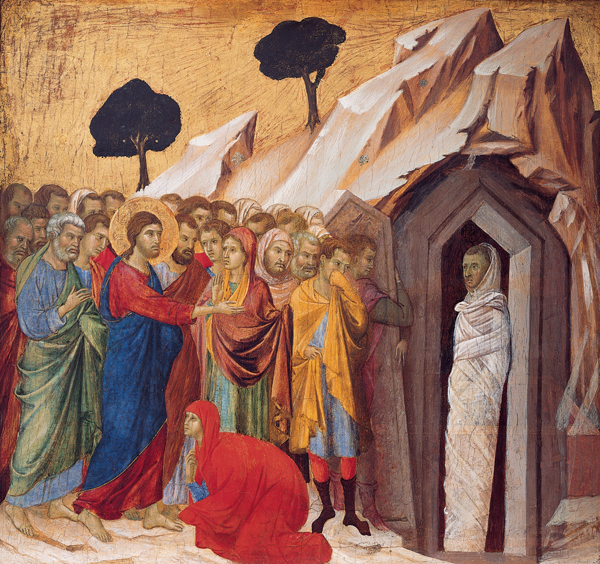
[Es gibt eine deutsche Übersetzung dieses Gedichts, coming soon...]

Picture by Duccio di Buoninsegna
07 June 2015

Asenath: Stranger

Genesis 41:45

He burst into my life,
a stranger
with strange ways
and strange dreams,
a strange story
of a god who led him
through shame into glory -
and I loved him.

He burst into my life,
and brought into question
all the things I held on to,
everything I believed.
He opened the door
to a world I never knew,
frightening and new -
and I loved him.

He broadened my horizons,
stretched my imagination;
he was my piece of foreign land,
here to see,
here to touch,
my very own glimpse
beyond my borders
into the wider world.
And I'll never be the same,
because, with him,

You burst into my life
and turned it upside-down.
You challenged my beliefs,
and drew my love on you -
on you, the strange God,
whom I saw in all he did,
whom I heard in all he said,
whom I loved in loving him.
I love him
but what I love was made by you -
so how could I not love you too?

______________________________________________________________

[15. May 2015]

Asenath was Joseph's wife and daughter of an Egyptian priest (Gen 41:45).

There is an intertestamental / apocryphal book (what I like to call "ancient biblical fan-fiction", because in a sense it is) about Joseph and Asenath, and in particular about her conversion to Judaism (of which we don't read in the Bible). I read it last year - for fun, further study and in preparation of this poem (which has taken me half a year to write...). It's very interesting (the inter-testamental apocryphs all are, if you take them as fan-fiction and not as authoritative like the Bible); you can read it [here] if you like.

What struck me about the apocryphal story - and ended up flowing into this poem - is how it is about someone coming to faith through seeing the life of her husband. The Bible does not mention Asenath ever accepting Joseph's beliefs, but she would have been faced by them. So in this poem I focused on the one hand on the "meeting of cultures" in what was a cross-cultural marriage, and on the other hand on how through knowing Joseph, Asenath may have come to know God.

23 December 2014

Bride of Christ: Vows

Revelation 19:6-8 | Jeremiah 31:3 | Isaiah 61:10

Here,
with you,
before the altar,
words fail.

What joys now lie within my grasp -
but oh what fears
that even now
it could all slip away.

For what vow can I make,
what words can I say?
Nothing is enough.
Only this little handful of love,
a paper boat
that capsizes with every wind.
There will be days
when my trust in you
will be smothered by my useless fears,
days when I will have affairs
with worries and doubts
instead of hiding myself
in your strong arms.

I am not good enugh for this -
my days are doomed
to infidelity
and broken vows
will litter my paths
because I am too weak
to hold your hand.

Here,
with you,
before the altar,
I fail.

But
your love does not,
and you reach out to me,
and hold me where I can't hold you.
Not my vow counts,
but yours alone,
sealed with blood -
your grace is enough.

"I have loved you with an everlasting love;
Therefore with lovingkindness I have drawn you."


I will greatly rejoice in the LORD,
My soul shall be joyful in my God;
For He has clothed me with the garments of salvation,
He has covered me with the robe of righteousness,
As a bridegroom decks himself with ornaments,
And as a bride adorns herself with her jewels.

_______________________________________________________________

[January 2011]

Recently God helped me realise how helpful the bridegroom / bride imagery in the Bible can be. I was fretting again as I usually do, and then wrote this, and then noticed: I should imagine what I'd do if I had a problem and I had a husband. I think I'd want to tell my husband everything instead of spooking around the house at night worrying my head off.
Then why do I not in the same way tell Jesus everything and trust that I'm safe with Him???

More poems connected to the "bride of Christ" imagery here.

03 December 2014

Out in the Desert


Isaiah 43:18-19


"Therefore, I will charm her, and bring her into the desert, and speak tenderly to her heart." (Hosea 2:14 CEB)

"He who believes in Me, as the Scripture has said, out of his heart will flow rivers of living water." (John 7:38 NKJV)

You led me
into the desert,
stripped me
of all but you,
emptied me
till I was dry,
parched.

Out in the desert
I found your living water.
Out in the desert,
when all was stripped away,
I learnt that you are all I need,
all I could want.
Jesus.

You led me
into the desert -
the desert land of my heart.
You showed me
my deepest need
was you -
you alone.

Out in the desert
I found your living water.
Out in the desert
you changed my heart,
became in me a fountain
turning this desert
into a garden
flowering for you.

You lead me
into the desert -
your water-bearer,
to heal dry land
and water hopeless cases
and lead them to you.

Out in the desert
your living water
flows out from my heart.
Out in the desert
flowers are growing,
rivers are spreading,
until the desert
becomes
Paradise.

____________________________________________________

[3. December 2014]

Wrote this during a "prayer night" organised by fellow students.

During the opening worship time, a friend read Isaiah 43:18-21 - some of the prayers afterwards expounded on the image of living water, of the desert blooming and becoming green wherever the water touches it, also quoting John 7:38 and bringing in the thought of reaching "dry people" with the living water of Jesus. Later, we had a text meditation on Hosea 2:16 and the desert image just fit so perfectly! As my "response" to the meditation, I put together all those images that had moved me.

Picture by Antal Ligeti.

27 November 2014

Hannah: The Other Woman


1 Samuel 1:1-2:11

Forgive these tears -
I can't stop them anymore.
My sadness is an ocean
so deep I cannot eat,
so deep I cannot sleep.

Awake at night I hear them
sometimes, in the room next door -
him and her -
the other woman.
It had to be, he said.
And I understand.
But that doesn't help.
You'll always be my first love, he says.
And I believe him.
But that doesn't help either.
For my problem is not jealousy -
my problem is me.

Who is the other woman?
She, or me?
Who of us fulfills her purpose
as woman and as wife?
Who has done her duty -
and who has had to be replaced?
Are her tauntings true?
Sometimes I think they are
and I cry and I cry
and I can't tell him why
because he wouldn't understand.

Am I not more than sons? he says.
Of course he is -
but that doesn't help.
I love you even so, he says.
I know -
but that doesn't help either.
For nothing can help me -
nothing
but YOU.

Lord, you are the island
in my stormy ocean,
the rock I can hold on to,
the only hope for me.
You lift up the weak,
you feed the hungry,
you turn the barren woman
into a mother.
Your power can turn
the world upside-down.

Turn my world upside-down.
Change this sadness into joy,
and my begging into thanks.
Fill my empty rooms
with children's laughter
and give my life purpose again.
But not for me -
no, for your glory,
that your power can be seen
on a small, weak thing like me.
And I will give you all I have,
my greatest treasure,
my most valued gift:
the child
that you are giving me.

________________________________________________________

[January 2012]

I was trying to imagine what it might feel like for Hannah to be one of two wives - especially because she was the one who couldn't have children. In those days, a central part of a woman's life was bearing children. There's still cultures where women mainly exist as "baby machines" (extremely said). I can imagine that Elkanah married Peninnah because Hannah couldn't have children, and sort of "added" her so that he'd have heirs. Anyway, those were my background thoughts to this poem. ^^

I based a lot around Hannah's prayer in 1 Sam 2 - which is very similar to the Magnificat (Mary's prayer) in the Gospel of Luke: God turns the world around, He does things differently from our expectations, He is not like us. To the world, Hannah was a failure: a woman who couldn't fulfill her purpose in life, namely that of bringing children into the world. But God loved her - and He loves all of us too, even if the world does not accept us. God loves broken people - and He can make them whole.

22 November 2014

Queen of Sheba: Drawn by the Light


1 Kings 10:1-13 | Matthew 5:14-16

Nations shall come to your light, and kings to the brightness of your dawn. (Isaiah 60:3)

I saw your light shine from afar,
heard stories of riches,
of wisdom incomparable -
rumours, I thought,
but I could not help
but be drawn,
drawn to your light.

I have come to see
if the rumours are true.
I have come to see
your riches and fame.
I have come to see
if you're as wise as they say.
I have come,
drawn by your light.

And I see that the truth
surpasses wildest rumour,
that the light is even brighter
when seen up close,
and I wish I could take
and keep a little spark,
take it home so it can spread
and envelop the world.

I want to know
more about you,
I want to know
the source of your wisdom,
I want to know
the meaning of this blessing -
I want to know your God.

For He is the one
who put the light in you -
He is the one
who draws all to you -
He is the one
who can light a spark in me -
now I am drawn,
drawn to Him.

__________________________________________________________________

[15. November 2014]

The Queen of Sheba (assumed to be in today's Yemen or Ethiopia) heard about Solomon from far away, and wanted to see for herself whether what she had heard was true. She actually brought riddles and questions to properly "test" Solomon's famed wisdom!! This story made me think of the "light of the world" passage in Mt 5, and also of the "light" passage in Isaiah 60.

When God's light shines in us, when we belong to Him and live according to His will and He lives with us and in us, then other people will (or should) notice something about us. Even without saying anything at all (and maybe even without realising it) we "preach" the Gospel by the way we live, the way God is present in and among us. This can lead to people asking questions, wanting to know why we are different - or, as Peter puts it: wanting to know the reason for the hope in us (1 Peter 3:15).

Being a Christian is not a "private matter"... if we are truly following Jesus, then it will be visible. You can't hide a city that's standing on a hill - even if you try to! Also, people watch us - maybe with a critical eye, maybe with a curious eye. The way we live out our faith can attract people to it. I have heard of families in East Asia, where after one person became a Christian, the rest of the family was at first very sceptical, until they saw how that person's life changed for the better, and that either made them accept his decision, or seek out Christianity themselves!

So let us live out our faith and follow Jesus in such a way that people will ask questions! They might be like the Queen of Sheba and ask riddles and "trick questions" first. ;) But that can lead on to them realising the truth about Jesus, and praising God like the Queen of Sheba did at the end of her visit!


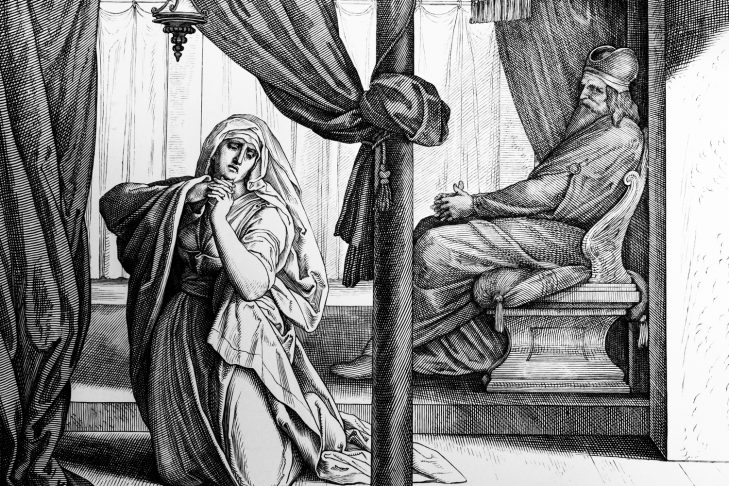
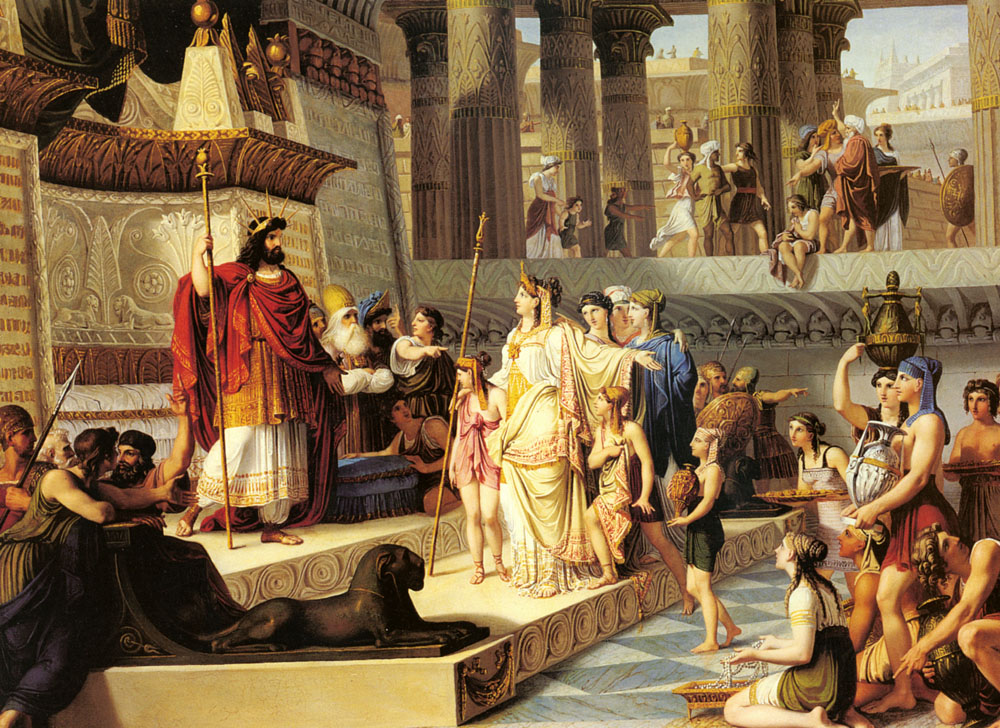
Picture by Giovanni Demin.

04 September 2014

Damaris: Foreign God


Acts 17:16-24

What is this message that you bring,
what is this "good news" that you preach?
Who is this strange God from afar -
and what should it matter to me?

We are Greeks - we have our gods,
enough gods,
more gods than you.
What's a foreign god to me?
Your story's nice -
but what's it to me?

But you say
this God
was always there,
even when I did not see Him.
This God
has always cared
for all the world
even though we did not know Him -
for this God
is the creator
and all mankind is His -
this God
is the sustainer,
who provides for all that is.
This is no foreign God
but the one true God of all -
and that's why it matters to me.

This God
is the one who made me.
This God
is the one who knew me
before I even knew myself.
This God
cares not only for one people -
for all the peoples on earth are His.
In Him we live,
in Him we move,
in Him we have our being -
this God
is the true God
of all.

____________________________________________________

[July 2014]

Damaris was one of the people who came to faith in Athens after Paul preached there.
Reading Acts I've been noticing how the Apostles often emphasised the fact that their message was not a strange new message, but a continuation and fulfillment of the first covenant with Israel, and a message relevant also for non-Jews because God is the true God of the whole world. When speaking to non-Jews, Paul would speak especially of God as creator: because God created everything and everybody, and still keeps on sustaining and providing for the whole world, His message is relevant for everybody.

Today, there are still many cultures in which the principle "to be (x nationality) means to be (x religion)", and that often makes it hard to reach them with the Gospel, partly because they believe that makes Jesus irrelevant to them ("it's a foreign religion"), and partly because it leads to difficulty for anyone who decides to be a Christian (they get treated like a traitor not only of their religion, but of their culture, tradition and family). So I see the relevance of Paul's method for today.

In Athens, the philosophers thought Paul was bringing them a foreign God and was bringing them something new and strange. What Paul did in his sermon, though, was point out that God is not a foreign God, but, as the creator, is everybody's God. He is not tied to one nation, but the God of all people, because all people - being created by Him - belong to Him already.

Picture by Raphael. Note the lady in the far right corner.