Judges 4:1-16
When men run and hide
their heads in the sand
I'll fight like a girl.
When men stand and falter,
their hearts in their pants,
I'll fight like a girl.
When no man will rise
and take up the sword
I will arise
and fight like a girl.
And I will advise
and I will encourage,
steady their shaking legs
because a mother
knows how to teach little boys to walk.
And I will be there
to hold sweaty hands,
give that little push
into the right direction
because a wife knows the words
a man needs to hear.
Why should I not teach,
correct and encourage?
Why should I not lead
or show them the way?
Why should I not heed
God's call above culture?
Why hide my gifts
in the face of need?
Even if men did not
hide their heads in the sand,
I'd fight like a girl.
Even if men would rise
and take up the sword,
I'd fight like a girl.
Because God called a girl,
so a girl will answer,
and fight and lead
and teach and encourage
as God commanded her to.
___________________________________
[31. October 2018]
It's unbelievable that even today there are still people who, based on two verses in the Bible, believe women can't be pastors or, going even further, can't teach or lead or have any authority whatsoever over men.
Reading her story again (Judges 4) I feel Deborah pretty much does the job of a woman pastor. She advises Barak, passes on messages from God, she accompanies him when he doesn't want to go into battle without her, as something of a "pastoral presence" to encourage him. Deborah is not even the only example of a prophetess / teacher / female leader / woman in authority in the Bible. There are no good biblical arguments for excluding women from positions of authority and many good biblical examples of women who were called by God to lead.
Go Deb!
And people who say the Bible is rough on women have no idea either - so many strong women, so many women depicted as way stronger than the men in the story. The Bible is what makes me feminist, and especially the Old Testament stories are very empowering in my opinion.
Picture by Otto Semler
Showing posts with label "biblical womanhood". Show all posts
31 October 2018
13 October 2017
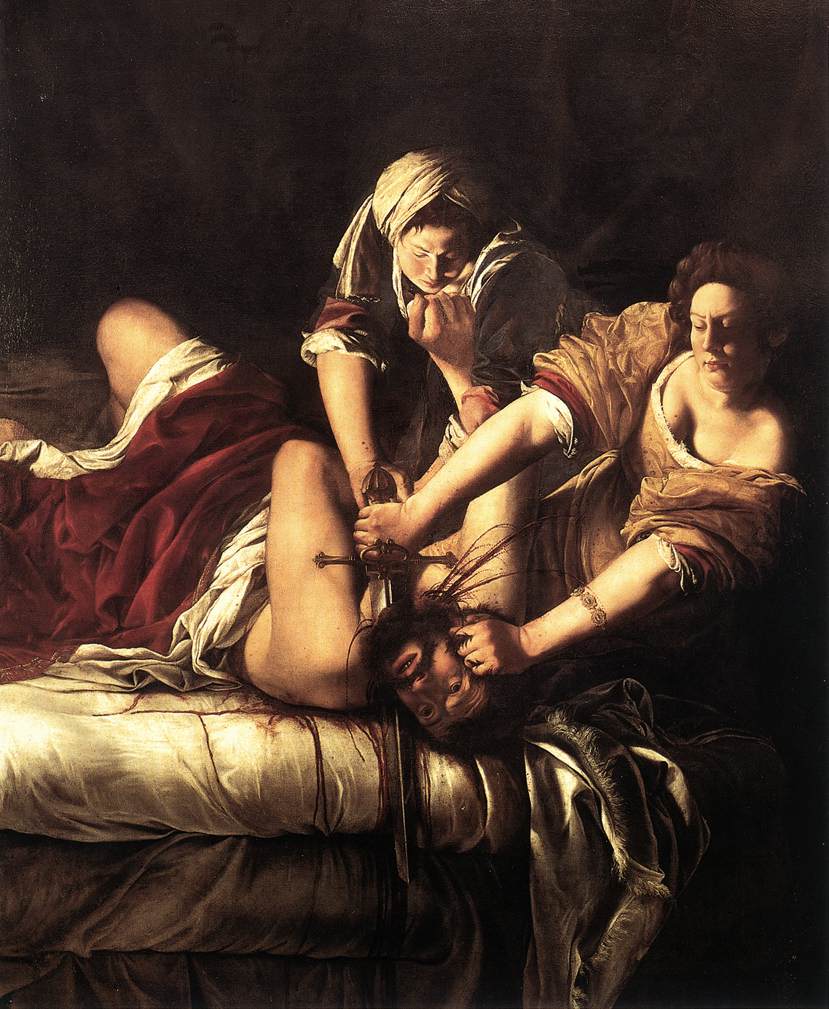
Judith: Black Widow
"Bring to pass, O Lord, that his pride may be cut off with his own sword." (Judith 9:12) You see me - you see flesh,
a thing to devour,
to use for your pleasure.
You are used to power,
getting all you desire.
Am I but a fly
caught in your web?
Is this how low
a woman must fall,
giving her all
to a ravenous brute,
submitting to your desire,
letting myself be used
by the oppressor of my people,
flirting with abuse?
Am I but a fly
caught in your web?
You wish.
Fall down, o predator,
for you are now prey.
Fall down, o power,
for you have been conquered
by the one you thought the weaker sex.
Fall down, o mighty one,
and face your death
at the hands of Woman,
at the hands of your prey.
I have turned your lust
into my own weapon,
I have used your desire
to ensnare you in my trap.
You are a fly
caught in your own web.
Fall down, o power
and face the Lord
who chooses the weak
to dominate the strong.
________________________________________________________
[13. October 2017]
I wrote this really quickly... I'm a very lazy poet.
The story of Judith is part of the Apocrypha, i.e. late Old Testament texts which the Catholic Bible has, but Protestants generally leave out due to the Reformers thinking they had less value than the others due to being written in Greek and not Hebrew (bad reason, seriously...). Martin Luther did say, though, that the Apocrypha were an excellent supplement to the rest of the Bible and worth reading, so any Protestants wanting to go "but..": follow his advice and read them first, they are quite okay! (And were part of the early church's Bible anyway.)
So, Judith: I mostly knew Judith from the gory paintings of her chopping off Holofernes' head, until finally reading her story last year. The story takes place in the time of the Exile (under Nebuchadnezzar). Basically Judith stands up for the Jewish people against Holofernes, one of Nebuchadnezzars generals, by tricking him into thinking she wants to spend the night with him. She gets him all tired with food and drink and conversation, then - off with his head!
Anyway I read the story ages ago and today just suddenly got a few lines and sentences popping up in my head, also related to the abuse scandals going around at the moment I suppose. The story of Judith has a strong aspect of "weak winning over strong", God standing with the underdog (shown strongly by the victory of a woman - in that culture deemed weak and inferior - over a man). I especially like the twist of Judith using what was Holofernes' instrument of power (coerced sex) against him.
When you read with an eye to the women's stories in the Bible, you realise (in my opinion / my experience) that the Bible is all about the "weak" overcoming the powerful, God taking the side of those who are expected to submit, and God using them to teach a lesson to the powerful ones (Tamar and Jael come to mind). :-)
Oh, and "Black Widow" is because a black widow spider kills her mates - and Judith was a widow.
Picture by Artemisia Gentileschi
09 October 2016
Abigail: Disobedient
1. Samuel 25
I will disobey you,
my Husband -
I will ignore your command.
I will subvert your decision,
I will counter your wish.
I will disobey you,
my Husband -
and save us all.
How can I idly sit and watch
as your choice risks our destruction?
How can I stay silent and passive
in the face of such danger?
How can I submit
to the threat of war
when in my hands
lies the chance to make peace?
I will disobey you,
my Husband -
I will do what you refused:
I will share of our wealth
with these men who have asked us
before they take it by force.
I will disobey you,
my Husband -
and save us all.
I will not let my weapons rust,
my gifts of wit and diplomacy.
I will not bury God's gift of wisdom
beneath a false submissiveness
when I can use it now for peace,
to reconcile
and save us all.
No,
God does not ask me
to submit without question
and obey you unconditionally.
No,
God does not ask me
to sit silent at home
while all around me
the world crashes down.
No,
God does not ask me
to quash my own will
beneath that of a man,
be it my husband
or my future king -
I will disobey you,
my Husband -
I will take initiative.
I will go out and save you
from certain death,
I will go out and save him
from the sin of murder,
I will go out and save us all.
_____________________________________________________
[9. October 2016]
Recently I read this story again... David (on the run from Saul with a band of outlaws) asks the wealthy landowner Nabal to provide food for his men - in return for the protection they have given Nabal's shepherds. Nabal refuses. David is angered and decides to kill everyone on Nabal's estate.
This is where Abigail, Nabal's wife, steps in. She decides to override Nabal's decision and goes out to meet David with the provisions he asked for - thus preventing the massacre David had planned. She saves Nabal (and the servants, shepherds etc) from being killed, and saves David from bringing sin upon himself. Abigail becomes the mediator between Nabal and David, and becomes their "saviour" - all this by being disobedient and insubmissive!
(The help comes too late for Nabal, who is so frustrated with what Abigail has done that he "becomes like stone" and dies some days later. David, on the other hand, takes Abigail to be his third wife.)
This made me think of how conservatives like to talk about "biblical womanhood", i.e. what the role of women should be according to the Bible. According to conservatives ("complementarianism"), God has given men and women distinct roles: men shall lead, women submit and follow. The man is the head of the family, the woman should obey him. Leadership roles in the church also are reserved for men alone; women are not allowed to become pastors, preach or teach men. This is based mainly on a few texts in the letters of Paul (e.g. Eph 5:22, 1. Tim 2:11-15).
I believe this is a highly selective reading - and one that is not "counter-cultural", but clinging on to the patriarchal culture the Bible continuously subverts. The Bible is full of stories of women who dance out of this pattern of submissiveness and through their insubordination actually end up saving the day or fulfilling God's plan. Abigail is just one example. Others include:
- Zipporah, who saved Moses' life by circumcising his sons (Ex 4:24-26) - something he for some reason had failed to or refused to do.
- Deborah, who was a prophet and judge (leadership role), and in her story comes across as the strong woman warrior braver than the male captain Barak. Her husband hardly features in her story. (Judges 4)
- Esther, who broke the rules and dared to approach the king unbidden to speak up for her persecuted people (Esther 5). Even as his wife, Esther was barred (on threat of death!) from coming to the king unless he called her.
- Women in the early church like Philipp's daughters, the deacon Phoebe or the apostle Junia who did not stick to the traditional "women's roles" dictated by their culture, but served God in the church and in teaching and leadership roles.
I believe true biblical womanhood is not unquestioning submission to your husband. Men can be wrong. We have been given gifts by God which we are to use. Marriage is about teamwork, not about my husband telling me what to do and me slavishly following without asking whether he's leading me in the right direction. Being a wife is not about simply doing all my husband wants, because there's a world out there and maybe his decisions harm us, or himself, or people out there. We are responsible before God and we can't hide behind submission - we have been given gifts to use them, when God calls us we are to follow (even if He calls us into a role our culture doesn't agree with), and when our husbands' decisions are harmful and we know it, we are in a position to do something. Like Abigail, like Esther, like many other women in the Bible who "disobeyed" - and in doing so, saved the day and did right in the eyes of God.
"Submission" is not about unconditional obedience, but about love, honour and respect - and sometimes love, honour and respect are exactly what call us to disobedience... (Btw for more on the correct meaning of "submit" in Eph 5, check out this article.)
Picture by Juan Antonio Escalante.
05 September 2015
Junia: Hidden
Salute Andronicus and
Junia, my kinsmen, and my fellow-prisoners, who are of note among the
apostles, who also were in Christ before me. (Romans 16:7)Give me no fame, o Lord.
I need no glory, no applause,
for what good is it?
Instead,
let me stay hidden,
like foundations underground,
like the backstage hands,
like wallpaper no one sees
until it is missed.
Unseen, unnamed,
melting into the background,
hidden from view
but nonetheless there,
essential
like the spices in a curry,
like stitches in embroidery,
like the threads of a rope.
Let me work in patience
for love alone,
in the shadows, unnoticed,
holding the strings.
Let me do what is needed,
though none know my name,
though no one says "thanks",
though I am ignored.
I will be satisfied,
for I seek no renown,
and my work is for you
and for your eyes alone.
_______________________________________________________
[20.6. - 20.7.2012]
Ever tried reading through the "greetings" at the end of a Pauline letter? All those names... can one learn anything out of texts like that?! I think the greetings show us quite a few interesting things. They show us the relationship ties between early Christians, how they worked together and supported each other. Also, they give us a small glimpse into the kind of things Paul's addressees were up to. For instance, we find out a lot about women in ministry. People who skip the greetings don't realise that women were active in ministry in Paul's day, and Paul supported them (despite those famous "women be silent" texts which people like to quote at me when I say I'm going to be a pastor, heh...).
In Romans 16, we read about Phoebe, a female deacon (and deacons were people like Stephen and Philipp who did quite a bit of preaching and evangelising). Phoebe was involved in ministry in a way certain Christians say women shouldn't be (read Phoebe's poem here). Romans 16 also mentions a couple, Prisca and Aquila, who are mentioned together as working together with Paul for the church. Plus, Prisca is mentioned before her husband, which I believe shows she definitely was not a subdued little wife letting her husband do everything. They were a team, in ministry together.
And then we have Andronicus and Junia in Romans 16:7. This verse has an interesting story because, due to Greek grammar confusion, some people translated (female) Junia as (male) "Junias". Might also have ideological reasons because no way could there have been a female apostle! Or?! The word "apostle" has two uses in the New Testament. Often it is applied only to the 12 selected by Jesus. However, Paul also uses it to describe his own role, which gives the word a broader application. "Apostle" comes from the verb "apostello" which means "to send". In this way it means someone sent by God (not only the 12 disciples who were close to Jesus). The word "apostle" does, however, carry quite "high" connotations. And here we have a woman apostle, Junia! Why not?
I wrote this poem thinking of the many women working in the background, not fully recognised because they are women and because of the belief that women can't take on a full ministry. In the 19th century, people were still fighting over whether women should be allowed to be missionaries / evangelists at all, because "women are not supposed to teach men", or because "women should put their family first". People have told me that it's wrong for me to become a pastor, because women should not take leadership positions and whatnot. People have mistranslated Romans 16:7 and hidden Junia for centuries, and I think some would still rather have "Junias" than Junia, because they don't want to let the Bible change their theology. But it's all right - because we don't need to be acknowledged by people in order to serve God.
Picture shows (from left to right): Andronicus, Athanasius (an important saint in the Orthodox Church), and Junia.
29 September 2013
Philipp's Daughters: Emancipation
On the next day we departed and came to Caesarea, and we entered the
house of Philip the evangelist, who was one of the seven, and stayed
with him. He had four unmarried daughters, who prophesied. (Acts 21:8-9)
There is neither Jew nor Greek, there is neither slave nor free, there is no male and female, for you are all one in Christ Jesus. (Galatians 3:28)
I may be a woman,
but that does not decide my fate -
for the Spirit of God
has set me free.
No longer bound
to hearth and home,
no longer is marriage
the sole option for me,
no longer my purpose
child-bearing alone -
for the Spirit of God
has chosen me.
I will not be silenced
or voiceless anymore:
I have a message from God.
I will not be second-class,
worthless or ignored:
for I am a daughter of God.
In Him there is no woman,
in Him there is no man,
no servant or free,
no Jew or Greek,
but all one in Christ
and Christ in us.
I may be a woman
but that makes me no less
in the eyes of the Lord.
I may be a woman
but that will not keep me
from preaching His Word
of salvation for all -
for the Spirit of God
is working in me.
_____________________________________________________
[January 2013]
Christianity did a lot for women's rights, actually. If you look at these girls, for instance: they were unmarried (not dependent on a husband), and they were prophetesses (they actually had something important to say and could say it). Something new in a culture where marriage was usually the only option for a woman, and where women had hardly anything to say (or they did, but no one listened)!
In the church, women actually had a chance to participate and a chance to be heard. Because God gives equally of His Spirit to men and to women, and calls both men and women to His service. Something that keeps getting lost a bit in the church (sadly) but that has kept reappearing, e.g. with nuns or women missionaries who were very involved. In fact, in the 19th Century women missionaries had a lot more freedom than the women who stayed at home - being allowed to preach, for instance, and take over leadership roles.
There are Christians who have trouble with "feminism". I think it depends how feminism is defined. I believe that what happened at Pentecost - the Spirit being given to women too and not just men - was a major step in emancipation. God empowers women for His service - not just men. We are equally important, and can be equally involved.
Picture by Amrita Sher-Gil
There is neither Jew nor Greek, there is neither slave nor free, there is no male and female, for you are all one in Christ Jesus. (Galatians 3:28)
I may be a woman,
but that does not decide my fate -
for the Spirit of God
has set me free.
No longer bound
to hearth and home,
no longer is marriage
the sole option for me,
no longer my purpose
child-bearing alone -
for the Spirit of God
has chosen me.
I will not be silenced
or voiceless anymore:
I have a message from God.
I will not be second-class,
worthless or ignored:
for I am a daughter of God.
In Him there is no woman,
in Him there is no man,
no servant or free,
no Jew or Greek,
but all one in Christ
and Christ in us.
I may be a woman
but that makes me no less
in the eyes of the Lord.
I may be a woman
but that will not keep me
from preaching His Word
of salvation for all -
for the Spirit of God
is working in me.
_____________________________________________________
[January 2013]
Christianity did a lot for women's rights, actually. If you look at these girls, for instance: they were unmarried (not dependent on a husband), and they were prophetesses (they actually had something important to say and could say it). Something new in a culture where marriage was usually the only option for a woman, and where women had hardly anything to say (or they did, but no one listened)!
In the church, women actually had a chance to participate and a chance to be heard. Because God gives equally of His Spirit to men and to women, and calls both men and women to His service. Something that keeps getting lost a bit in the church (sadly) but that has kept reappearing, e.g. with nuns or women missionaries who were very involved. In fact, in the 19th Century women missionaries had a lot more freedom than the women who stayed at home - being allowed to preach, for instance, and take over leadership roles.
There are Christians who have trouble with "feminism". I think it depends how feminism is defined. I believe that what happened at Pentecost - the Spirit being given to women too and not just men - was a major step in emancipation. God empowers women for His service - not just men. We are equally important, and can be equally involved.
Picture by Amrita Sher-Gil
27 September 2013
Phoebe: Misbehaving
Romans 16:1-2 Well-behaved women
(society says)
live for their husband,
or father, or brother;
are there to make babies,
take care of the kids;
stay at home,
rule the household,
Queen of the domestic kingdom;
stick to their sphere
and not interfere
in men's business
(politics, religion)
but sit and knit
and gossip in private
and keep to womenly things.
Maybe
I am not well-behaved.
I am not known as a changer of nappies
or renowned for the meals that I cook.
They do not mention me
as the wife of so-and-so,
or praise my mothering skills.
Is it stepping out of line
to speak, to share, to have a voice,
to talk of that which moves my heart
even outside of the sewing group?
Is it going beyond my role
to lead a church,
to lead over men?
Is it strange
that I serve beyond the kitchen,
that I live for God and not for man,
that I have a say
beyond female spheres?
Maybe
I am not well-behaved.
Or maybe
your definition is wrong.
I may not be well-behaved
but I am a woman of God.
A woman of God
has a voice
and uses it
to shout truth from the rooftops
and speak up for the suffering.
A woman of God
is part of God's kingdom
as much as any man of God.
A woman of God
is free because
God sets her free
to do her chores in joy for Him
or do more, gratefully serving Him,
to turn her house into a church,
to mother the brothers and sisters in Christ,
to shine for God wherever she is,
to speak, to shout, to sing,
to give God everything -
The Spirit of God
makes us daughters and sons
of the Most High -
but a gift and a command
that I yearn to fulfill,
not for my sake alone
but for the Lord I love.
So this is all I ask:
that you don't prevent
me misbehaving
for my God.
-----------------------------------------------------------------------------------------
[June 2013]
I was in a conference on women's contribution to religious movements and thinking about which lady to write about next, and then had this old well-known quote in my head: Well-behaved women never make history. So I checked my Bible ladies list for women who might qualify as "misbehaving" or, conversely, as "well-behaved". I can tell you now I found no woman on that list whom I would class among the well-behaved.
Maybe it depends on what you define as "well-behaved". I had to think of Phoebe, a deacon in the early church - mentioned in Romans 16:1-2 Greek society probably had a really strict idea of what women should be and do (stanza 1). But a lot of what the Christian message says goes beyond that. I'm not saying women should not do their home duties - I'm saying God defines "well-behaved" in a different way which goes beyond home duties, to serving Him. And that transforms the way we do our usual duties, while also bringing in new things like - for Phoebe - serving as a deacon in her church, actually taking on a special role.
The last bit was especially inspired by stuff I learnt from my research on women missionaries in China. What various advocators of women's participation in missions said was that women are just as bound by the Great Commission as men. Here's some wise words from Miss Fielde, a baptist missionary: "A true Christianity can never debar woman from showing her gratitude to her saviour by setting Him forth as the true and sufficient Helper of her sex, both for the life that now is and the life that is to come."
Why block women from serving God? There are many examples of "misbehaving" women in the Bible whom the world would generally not deem "well-behaved" - but who are women of God, following God and serving Him. God's categories are different from the world's.
Though we should also not overdo it. The women of the NT did push limits to some extent I think, but they did not overdo - as texts like the "head covering" bit in 1 Corinthians 11 show. We don't need to shock our cultural surroundings. It does take sensitivity. But within the church, I don't think there should be a hierarchy of men or women anymore - we are one in Christ. We are to use our gifts to serve God - and gifts are not gender-based.
Picture from catacomb of St Priscilla - some view this fresco as evidence that women could in fact take on "priestly" duties in the early church.
Subscribe to:
Posts (Atom)