Showing posts with label Abraham's women. Show all posts
17 October 2017
Sarai: Is This Love?
Genesis 12:10-20 | Genesis 20:1-18
So this is love:
to sacrifice myself,
my body,
my integrity
to protect you.
So this is love:
giving up myself,
endangering myself,
risking my own neck
so you can be safe.
I don't deny
that this is love:
to give, to risk, to sacrifice.
Yes, this is love:
to look for your best,
to want you to be safe.
But
is this love
when it is always me
sacrificing,
always me
giving,
always me
paying the price,
always me
losing out
in the end?
You ask me to lie
out of love.
You ask me to endanger myself
out of love.
You ask me
to claim I'm your sister
to protect you, my husband.
And now here I am,
in the chambers of a mighty stranger,
unfaithful by force,
unfaithful out of love,
trading my body
for your safety.
Is this love?
Now here I am
a piece of flesh
thrown before a hungry man,
while my husband
cowers safe and cowardly
far away from me.
Now here I am
without you to protect me,
because this is how I protect you.
My love
you got it all wrong.
This is love:
when a husband gives his life,
risks himself,
for the sake of his wife.
This is love:
when you no longer need
to sell my integrity for the sake of your own.
This is love:
when my life and my body
are as valuable as yours.
This is love:
when it's no longer just me
giving, risking, sacrificing.
This is love:
when it's no longer just me
looking for your best,
wanting you to be safe,
but you
looking for my best,
wanting me to be safe,
standing by me
no matter the price.
______________________________________________________
[17. October 2017]
This story appears twice in Genesis - either it happened twice, or there's two traditions that came together in the Bible. The same story also appears with Rebecca, wife of Isaac.
The first version of this story (Gen 12) goes like this: Sarai and Abram go to Egypt - and Abram gets a bit nervous because of Sarai's beauty, so he makes her lie that she is his sister, so no one will want to kill him to get at his wife. Meaning: Abram is not going to risk his life for her protection. He'd rather risk her (making her more "accessible" for other men as an unmarried sister) than risk the eventuality of someone trying to murder him for the sake of getting her. What ends up happening is that the Pharaoh gets attracted to her and takes her for himself.
Abram doesn't do anything to stop that, does not defend his wife. Sarai is basically being grabbed against her will to become a fling or concubine or wife of the Pharaoh, and Abram would rather stay safe and does not intervene. Isn't this terrible?! (Plus, Abram benefits from Sarai being taken by Pharaoh: Pharaoh does a deal with him, pays him a lot in livestock for Sarai's sake. Abram is making a profit and practically selling his own wife!)
Abram does not stand up for his wife. God, however, does. God is the one who intervenes, warns Pharaoh, even brings a plague over him and his family. God defends Sarai.
Writing this I had to think of the description of marriage in Ephesians 5, in particular verse 25: "Husbands, love your wives, just as Christ loved the church and gave himself up for her." Abram's relationship with Sarai in this story is one of one-sided submission of the wife to the husband; the husband is worth more, his safety is more important, it's okay to risk her life, to sell her, to allow abuse to happen to her, as long as the man stays whole. But that is not the way of the Gospel. Ephesians 5 is often abused to uphold a "hierarchy" of men above women. But I believe what it is actually saying is that men and women are of equal worth, and that a relationship needs to be one of mutual giving - not just the wife serving her husband and giving everything for him, but the husband sacrificing for her as well.
A husband should never let his wife get abused for the sake of saving his own skin. (And vice versa.)
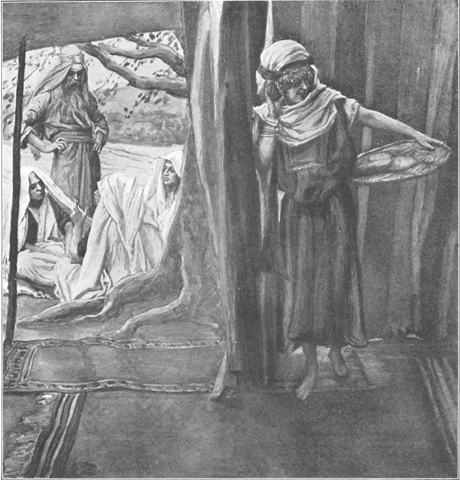
Picture: The Egyptians Admire Sarai's Beauty, James Tissot.
13 February 2016
Keturah: Ghost
Genesis 25:1-6
She never left;
she is still here,
filling the spaces
between you and me.
She never left;
she reappears
every time that I fail,
every time that we fight,
filling the gaps
as they widen between us -
haunting me.
She never left;
she is still here.
I hear her voice,
a whisper in my ear
that what you want is her,
what I can never be.
I see her eyes,
following me
reproachfully,
accusing me
of stealing your love.
I feel her presence
lying between us,
cold and unyielding,
clinging to you
and pushing me away -
haunting me.
And yet I know there is no ghost -
only my fear, haunting me.
I am afraid of not reaching her standard,
afraid that you might love me less,
that when you see me you think of her
and wish you could have her instead.
I want to be free.
Set me free from insecurity
so I can love you fearlessly,
and be who I am
with no more ghosts
haunting me.
________________________________________________________
[9. / 12. February 2016]
Keturah was Abraham's other wife... and from the text it kind of looks like she became his wife after Sarah died (which means he must have been crazy old by then) - I just assumed that here. This is mainly about dealing with "the Ex" or the tendency to compare oneself... We don't read anything about Keturah in the Bible other than the children she had, so we don't know how she felt about being the new wife of a widower - but here I looked a bit into what it might be like to feel insecure about the previous wife, to the extent of actually feeling her present.
One problem with the feeling of being "haunted" by the previous wife / the ex / etc is that - I believe - in many cases (especially when we're talking about dead people) it's based on the assumption that this ex is against the new match. Which is not really fair towards her: why assume that she is cruel and unkind and jealous?
Anyway I decided to start out with the "ghost" (the other woman being a threat to the relationship, being "against it") and then move on to the realisation of what is actually going on inside, namely the fear and insecurity that turns the other woman into a threat. It's not the other woman interfering - it all comes from inside Keturah herself. What needs to be "exorcised" is the fear.
(Probably the idea to write about ghosts is the result of reading Northanger Abbey and looking up some gothic horror...)
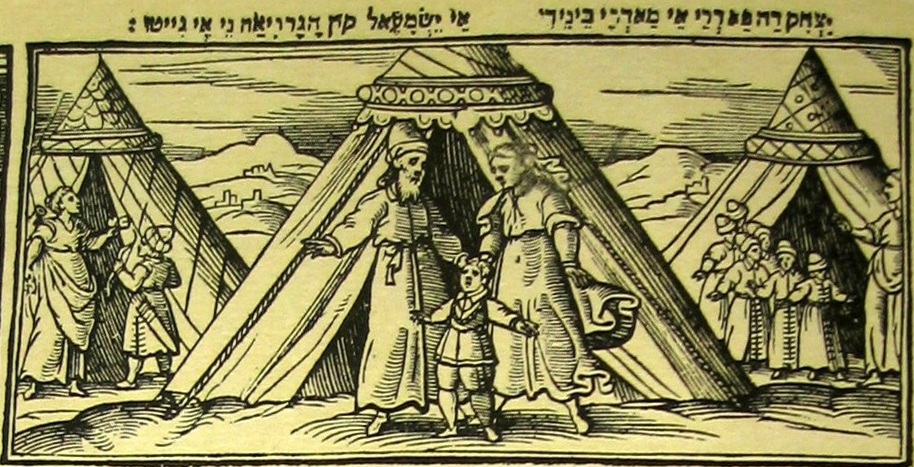
Picture is from the Venice Haggadah... Abraham and his 3 women - Keturah is the one with the many sons, on the far right.
15 September 2014
Sarai: Jealousy
Genesis 16:1-6
By now
she will be in his arms.
I dare not think it,
but I do.
I wonder,
will she be as scared
as I was the first time?
I wonder,
will he whisper
the same sweet words into her ear,
that he likes to say to me?
I dare not think it,
but I do.
Tempted, so tempted,
to sit outside his tent
and listen
to every rustle of the sheets,
to every moan from her lips -
I dare not think it,
but I do.
No, no, no.
It should be me,
and me alone.
What if he falls
for this younger girl,
for her beauty,
for the energy
I no longer have?
I dare not think it,
but I do.
This was my choice,
done for his sake,
done out of love,
the last desperate measure
to grasp at a promise
far out of reach.
This was my choice,
but was it right?
I dare not think it,
but I do.
Tempted, so tempted,
to storm right in
and drag her off his body,
far away from him.
But if this is
the only way
to make him happy -
so be it.
_____________________________________________________________________
[10. October 2013]
While reading through Sarah's story again, and trying to imagine things through her eyes, I felt like writing this: her thoughts about giving Hagar to Abraham, so Hagar could have the son promised him by God.
Why did Sarai do this? Did she lack trust in God? Was she trying to "help things along" a bit? Maybe she felt she was getting in the way of God's promise and Abraham's happiness because she was unable to have children. So she decided to let Abraham sleep with her slave and have a child with her - a decision which probably wasn't so easy, and one which led to all sorts of conflict in the family, Hagar being banished twice because of Sarai's jealousy. If Sarai had trusted and waited, maybe things would have been different. Still, God remains faithful, and He did let Sarai have a son in the end. Our mistakes have consequences, like Sarah's did... but still they don't get in the way of God.
(Next challenge: write the same thing from Hagar's perspective... I don't suppose she was too keen to be given away like that to an old man)
Picture by Matthias Stom.
I find interesting how Sarai has an almost empty look in this picture, like she's trying not to think too much about what it is she's doing.
03 October 2013
Sarah: He Who Laughs Last
Genesis 18:1-15
I laughed:
What a ridiculous notion!
Me: a mother?
At my age?
Yeah right.
We've been waiting for years,
and always: nothing.
You said and you promised,
but always: nothing.
Believe you now?
Not gonna happen.
We laughed:
What a wonderful moment!
Me: a mother!
At my age!
And yet -
after waiting for years,
and always: nothing,
I laughed at your promise,
and now, there's something!
Now this has wiped
the grin off my face...
I guess
you're laughing now
at this gobsmacked woman -
me - who laughed
at you.
You left us waiting for years,
and we saw nothing,
but you've done as you promised,
because nothing
is impossible for you.
And now, I am sure
you're laughing much louder
than I did before.
__________________________________________________________
[October 2011]
Here's one thing you find out if you learn Hebrew: Isaac is, in Hebrew, Yizchak, which means: "He laughed." But who was laughing here? It was Sarah, wasn't it? So my Hebrew prof likes to say that Isaak should have been called Tizchak ("she laughed").
But maybe not only Sarah laughed. Writing this poem I had to think of the saying, "He who laughs last laughs loudest."
Picture by James Tissot.
I laughed:
What a ridiculous notion!
Me: a mother?
At my age?
Yeah right.
We've been waiting for years,
and always: nothing.
You said and you promised,
but always: nothing.
Believe you now?
Not gonna happen.
We laughed:
What a wonderful moment!
Me: a mother!
At my age!
And yet -
after waiting for years,
and always: nothing,
I laughed at your promise,
and now, there's something!
Now this has wiped
the grin off my face...
I guess
you're laughing now
at this gobsmacked woman -
me - who laughed
at you.
You left us waiting for years,
and we saw nothing,
but you've done as you promised,
because nothing
is impossible for you.
And now, I am sure
you're laughing much louder
than I did before.
__________________________________________________________
[October 2011]
Here's one thing you find out if you learn Hebrew: Isaac is, in Hebrew, Yizchak, which means: "He laughed." But who was laughing here? It was Sarah, wasn't it? So my Hebrew prof likes to say that Isaak should have been called Tizchak ("she laughed").
But maybe not only Sarah laughed. Writing this poem I had to think of the saying, "He who laughs last laughs loudest."
Picture by James Tissot.
20 September 2013
Hagar: The God Who Sees Me
Genesis 16:1-16

You
are the God who sees me -
a maid, used to being ignored,
invisible
till I get in trouble
like now.
I wanted to be seen
and now they have to look,
look at my pregnant belly
and notice me at last.
But they pushed me from their eyes
to a place far out of sight,
so I can just disappear
and be nothing.
But you
are the God who sees me -
my pride, my faults,
the trouble I've caused,
the trouble I deserve.
You
have come to look for me -
to you, I'm not invisible.
And though you see each part of me,
even those I've tried to hide,
you shower me with promises,
dry my eyes,
help me up,
and gently show me to the path
I was too proud to take.
You
are the God who sees me
but loves me nonetheless.
_____________________________________________________________________
[September 2010]
I don't suppose Abraham was mean to his servants or anything, and who knows, maybe Hagar wasn't so invisible. But it's easy to feel that way and often people do, and then do something silly to become visible. Hagar didn't do anything silly; she just unexpectedly got more attention and started unnecessarily lavishing in it. Which got her to lose it all. In the end, it's God who gives the appreciation we need, and it's in God we can find it, and not in attention-seeking.
I find it interesting that God hardly reproaches her - He just tells her to go back and basically "sin no more" (what Jesus said to various people He helped!!), plus He gives her promises! God's grace, once again. His love endures forever~
Picture by James Tissot.
You
are the God who sees me -
a maid, used to being ignored,
invisible
till I get in trouble
like now.
I wanted to be seen
and now they have to look,
look at my pregnant belly
and notice me at last.
But they pushed me from their eyes
to a place far out of sight,
so I can just disappear
and be nothing.
But you
are the God who sees me -
my pride, my faults,
the trouble I've caused,
the trouble I deserve.
You
have come to look for me -
to you, I'm not invisible.
And though you see each part of me,
even those I've tried to hide,
you shower me with promises,
dry my eyes,
help me up,
and gently show me to the path
I was too proud to take.
You
are the God who sees me
but loves me nonetheless.
_____________________________________________________________________
[September 2010]
I don't suppose Abraham was mean to his servants or anything, and who knows, maybe Hagar wasn't so invisible. But it's easy to feel that way and often people do, and then do something silly to become visible. Hagar didn't do anything silly; she just unexpectedly got more attention and started unnecessarily lavishing in it. Which got her to lose it all. In the end, it's God who gives the appreciation we need, and it's in God we can find it, and not in attention-seeking.
I find it interesting that God hardly reproaches her - He just tells her to go back and basically "sin no more" (what Jesus said to various people He helped!!), plus He gives her promises! God's grace, once again. His love endures forever~
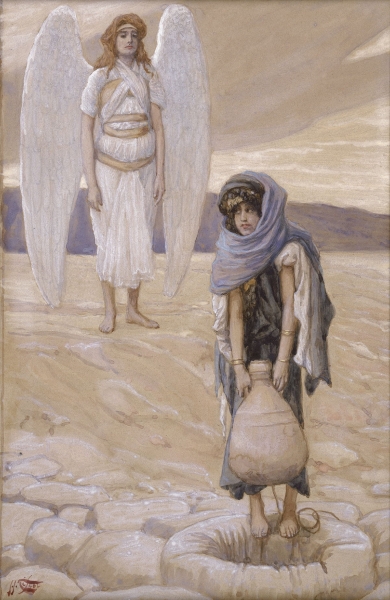
Picture by James Tissot.
Subscribe to:
Posts (Atom)