Showing posts with label death & loss. Show all posts

28 June 2023

Widow Of Seven Husbands: On The Other Side

 Matthew 22:23-33

On the other side
will I see them again?
What a reunion
with all my seven men.
Awkward,
I imagine.
Do I really want
to meet all of them again?

On the other side
whose will I be?
Can there be fights
Over There?
And if not: how else
will we solve it?
Whose
do I really want to be?

On the other side
what will we do?
Won't they expect me
to serve them as I did,
housework and cooking
and childcare and sex
for ever and ever?
What do I want to do?

On the other side
I think I'd like to be free.
To do what I want.
To belong just to me.
On the other side
I'd like no more pain,
no more loss, no more grief,
no more conflict or shame.

You say
on the other side
He'll call me by my name,
no longer wife of a man,
mother of a son,
daughter or sister
but me.
You say
on the other side
all I need to know
is I am His,
and He wants to be mine.
You say
on the other side
all will be new
and all will be changed.

The other side
is still shrouded in mystery
but I am not afraid
because Love is there.
And Love will take me by the hand
across
into the mist,
and I will trust
all shall be well
on the other side
with You.

____________________________________________

[27. Jun2 2023]

The Sadducees try to trick Jesus with a question. They don't believe in the resurrection, so they try to show how ridiculous the idea is by telling the story of a hypothetical woman who got married 7 times (through the custom of levirate marriage). Who will be her husband after the resurrection?

Jesus' answer is that they have a completely wrong idea of what resurrection / "life after death" mesans. What they are rejecting is not actually that which Jesus means when he speaks of eternal life. Eternal life does not mean living on just as we do now. It will be completely different, marriage won't be a thing anymore. And while writing from the woman's perspective I considered what that would mean for her (a woman experiencing marriage in a patriarchal setting and 7 times not being allowed to choose who she wanted to spend her life with!).

To what extent do we still view "life after death" the way the Sadducees do, as an "extension" of life on earth, which (sometimes problematic) things from our human cultures "carried on" to eternity? The things we know and are comfortable with now are not good for everyone. God has promised us a new creation where there will be no more tears, no more pain, no more grief - and for that to happen, some things that we take for granted now must fall away. And that's not comfortable, because that makes it way harder to picture what it will be like.

Jesus does not tell us what happens to the wife of the seven husbands - he does not give a concrete picture of eternal life in this conversation with the Sadducees. All he says is: there is a resurrection of the dead because God is a God of the living, not the dead. Through the love of God, God choosing us, God taking us by the hand, we can have eternal life. That is all we need to know: that God is there, that God's relationship with us is what will "carry us across". Which also means: if we get to know and love God now, then the unknown won't have to be so scary. Because we won't have to go into it alone. And it's not completely unknown anymore, because we have someone we know there: God.

Picture: Alphonse Osbert

20 July 2022

Jochebed: Weaning

Exodus 2:1-10


How often now
have I said "I'm done" -
when you bit me
or had a trying night.
"I can't do it anymore,"
I thought
so many times.

And yet
I'm just not ready.
Every time
you turn away your head
or would rather play,
every time you prefer
meat or rice or figs
sadness overcomes me
and fear
as I realise:

Our time is coming to an end
and soon
you'll be no longer mine.
Even this borrowed time
must come to a close
and I'll have to give you away.

No, child, no - 
stay small
stay mine
I'm not ready
I'm so done
but I'm not ready.

I'd rather hold you
wriggling and screaming
to this dry breast you no longer want
than let you go
and give you up
for good this time.

______________

[Feb / July 2022]

Jochebed, Moses' mother, put her son in a basket after it became impossible to keep him hidden in Egypt where all Hebrew boys were killed. It was her last resort to keep him safe. By a miracle, he ended up being found by the Pharaoh's daughter, who took pity and wanted to adopt him. Through the quick thinking of his sister Miriam, Jochebed got her son back through the role of wet nurse.

But then what would it have been like for Jochebed to have that time come to an end as Moses started weaning? It's likely she was allowed to nurse way past 2, it's only modern Western culture where breastfeeding less than 2 years is thought to be the "norm". But still. That time ends. Every child weans. No more wet nurse. A second goodbye.

I'm in a bunch of breastfeeding groups and have observed that weaning is a complex topic. Sometimes as a mother one just has enough and wants to wean, other times the child abruptly stops before Mama is ready. Often the end is bittersweet. I'm not there yet 😆 but have experienced odd days where my daughter showed no interest for hours and I felt oddly offended by it. 🤣 So I imagine it must have been an extremely conflicting experience for Jochebed. You can't force a toddler to nurse (hence the "wriggling and screaming"), when they're done they really are done. But to have that mean not only the end of the breastfeeding relationship but also the end of your time with your child - terrible! 

I first wrote this in German this Feb at a workshop I did in my church (I like taking Ex 2 because there are 4+ women in the story), translated it today because I'm doing another workshop and just rediscovered it among my notes. 😆 

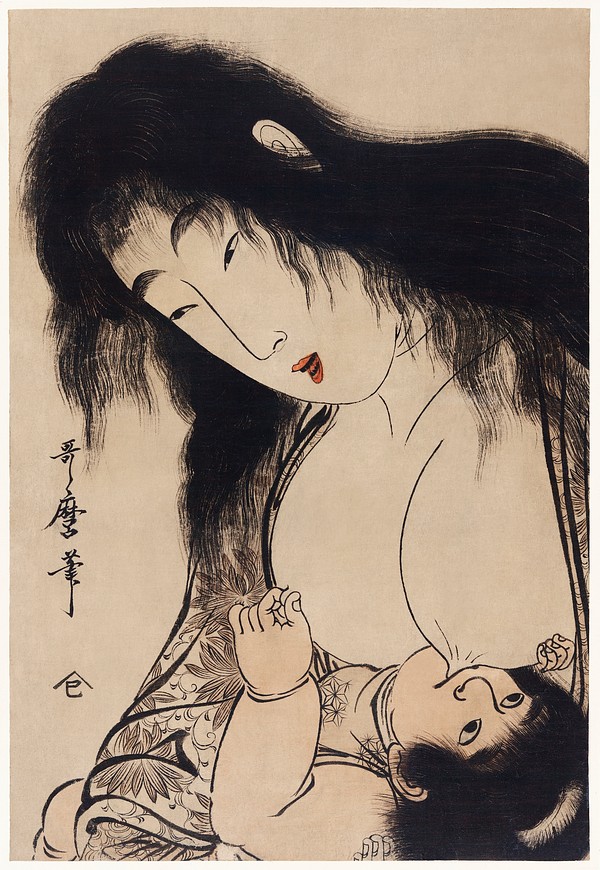
Picture by Utamaro Kitagawa. A very "toddler nursing" picture. 🥴 

19 July 2022

Haggith: Don't Heal Me


Don't heal my broken heart, God.
I want to feel the pain.
I want the wound
to stay open, bleeding.
I want to stay shattered;
Don't gather my pieces.
Let me grieve.

Don't heal my broken heart, God.
Let me stay here instead,
wallowing in bleeding love,
bleeding for him.
Healing would feel
like forgetting
getting over him
betraying him.
Losing him forever.

Don't heal my broken heart, God.
Don't take the pain,
don't comfort me.
For as the pain fades
so does he.
Keep my tears flowing.
Silence my laughter.
Keep me broken;
I don't want to be fixed.
I need him to stay present
in my pain, in my tears.
I need him to keep haunting me,
I need it to keep hurting me.

So don't heal my broken heart, God.
Let me grieve.

___________________________

[19. July 2022]

I read about a most terrible loss of a baby today. While I was praying for the mother the thought came to me that with such a loss, I would not want to be comforted. "Feeling better", ever, would feel like a betrayal.

Modern-day Western culture is very uncomfortable about grief. We try to make people feel better because that makes us feel better. But sometimes we just need to feel our feelings. It is so important to have and give permission to grieve. To feel all of it for as long as it takes, in whatever way it takes (everyone grieves differently!), instead of feeling under any pressure to "go back to normal".

I chose Haggith for this poem because she is one of many grieving mothers in the Bible. Her son Adonijah is one of the contenders for David's throne and almost becomes king. Bathsheba manages to get her son Solomon on the throne instead. Solomon then has Adonijah and his supporters killed. Politics and intrigue and we can have all sorts of theological conclusions about what went on here, but in the end you will always have people experiencing loss and grief.

I believe God allows us to grieve, that being a Christian does not mean having to be always happy, that it is perfectly fine to not want to get better yet. God lets us take our time to grieve. He will heal when we are ready.
So this also makes me think about how I am there for people in grief. How I pray for them. "Heal the broken hearts" - yes, but are they ready to be healed? What do they actually want and need? Maybe instead of being released from their feelings, they want a safe place to express them? Maybe I can be that safe place for someone. Just listening, not trying to comfort. Maybe a better prayer would be that grieving people can receive what they need - be that comfort, sleep, a listening ear or the courage to be angry.

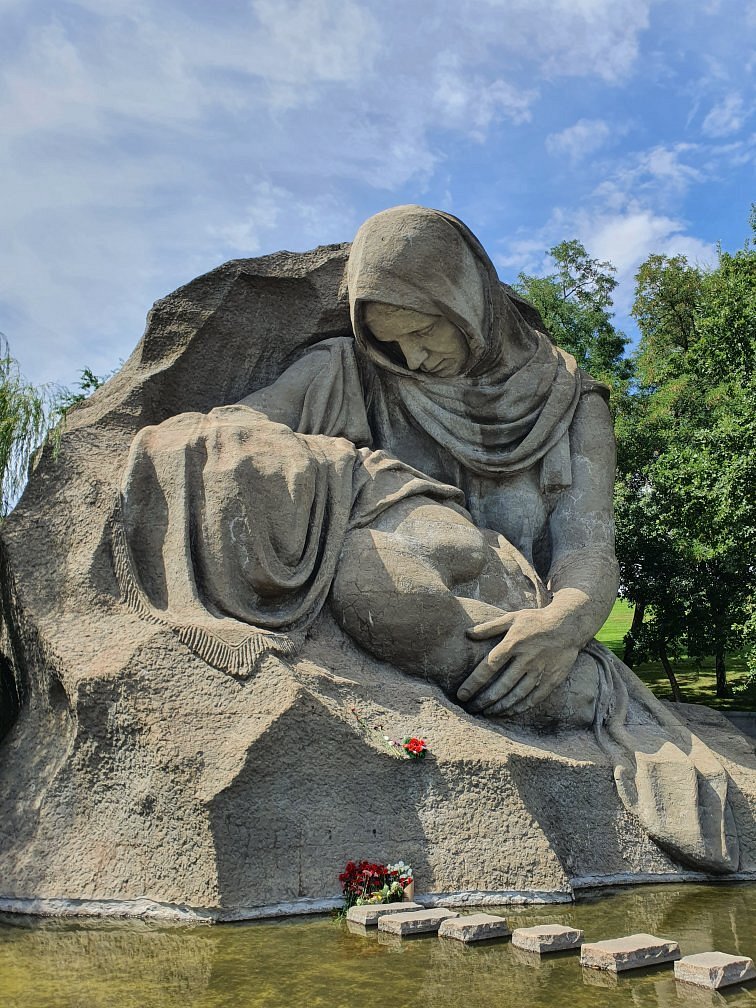
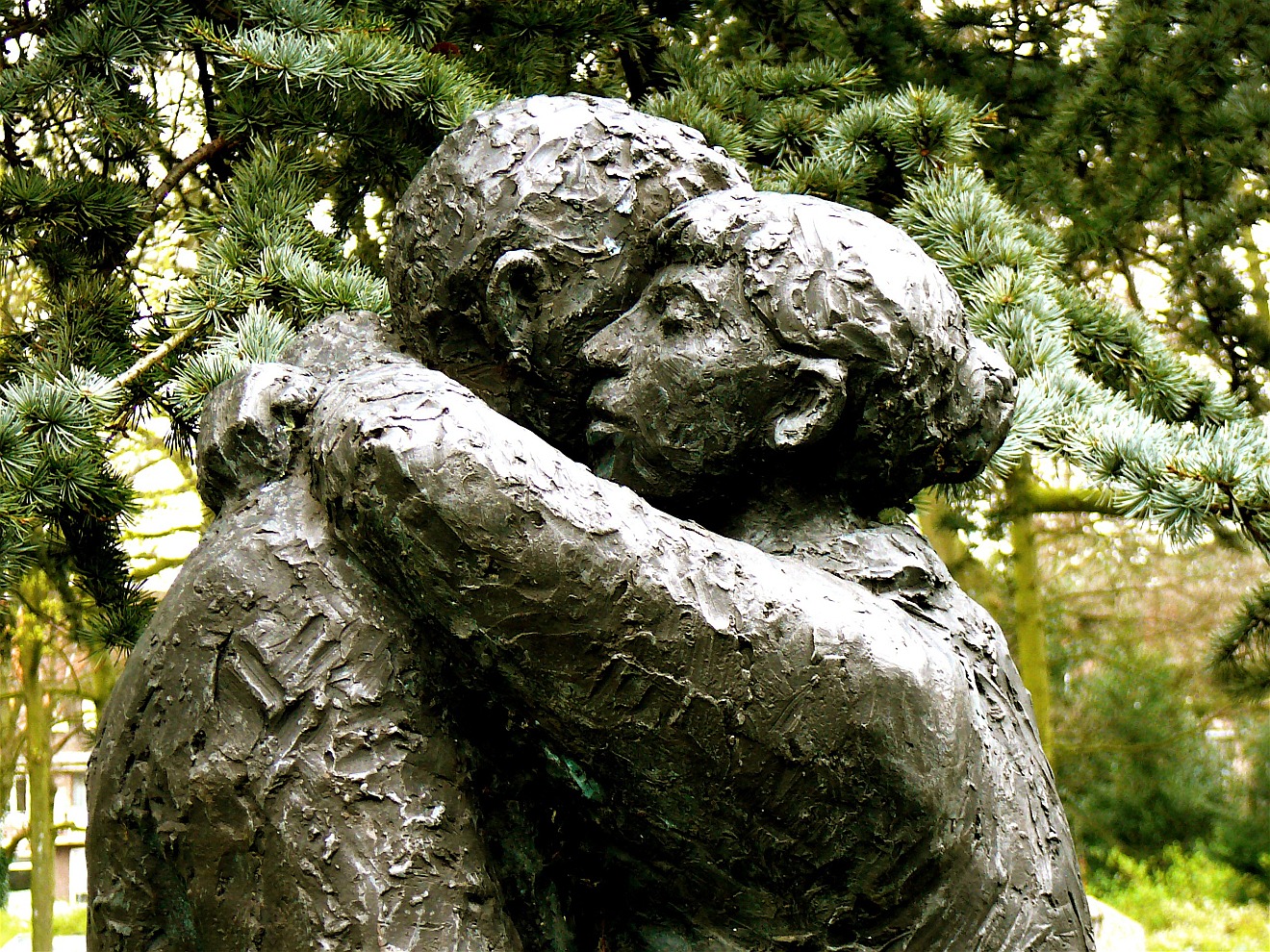
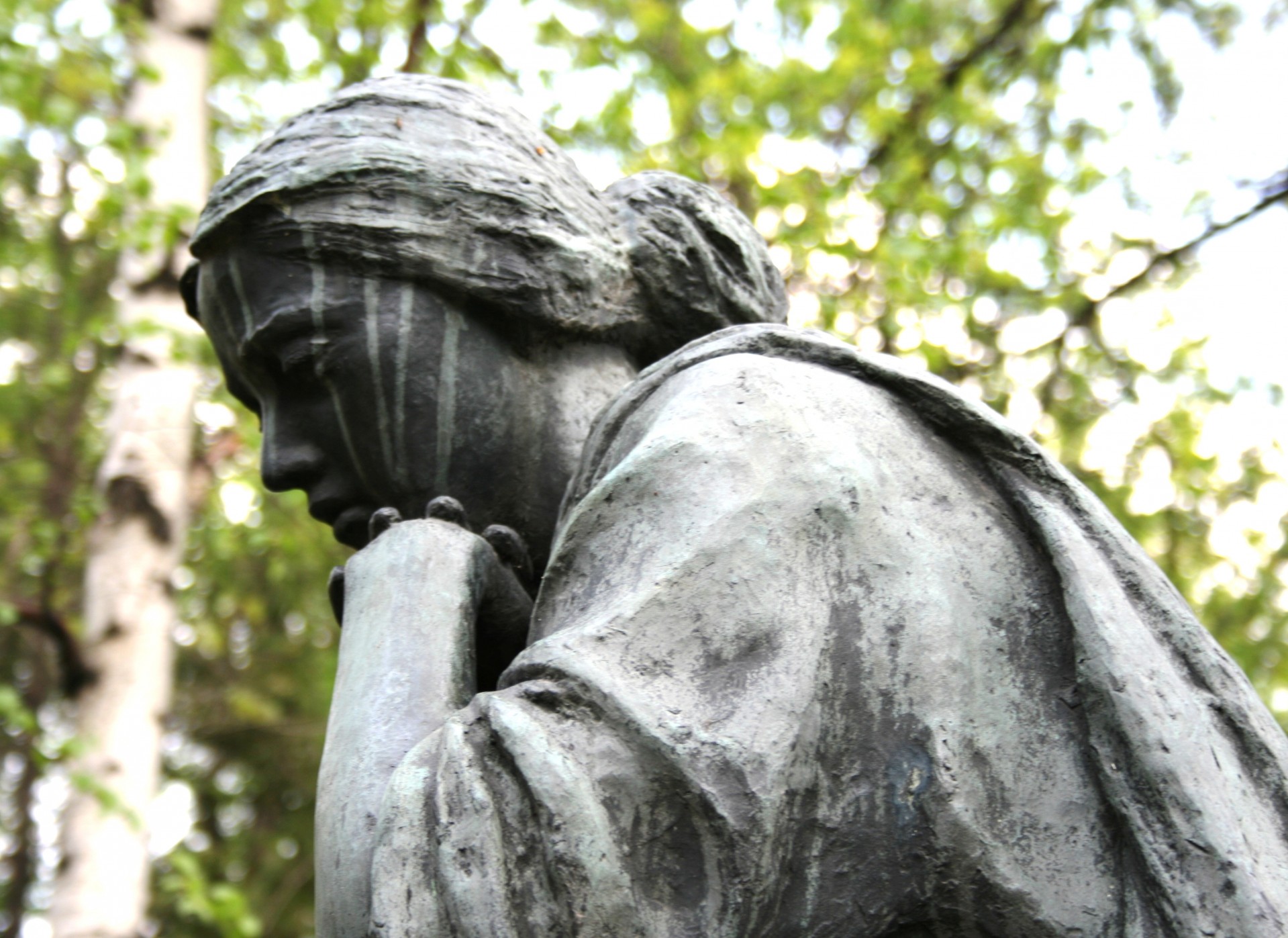
Picture: "Grieving Mother" in Volgograd

13 September 2021

Hiobs Frau: Fluche Gott, und stirb!

Und seine Frau sprach zu ihm: Hältst du noch fest an deiner Frömmigkeit? Fluche Gott und stirb! (Hiob 2,9)


Fluche Gott
und stirb!
Was ist der Sinn
weiterzugehen?
Er hat alles genommen.
Was ist der Sinn
an ihm festzuhalten
wenn das der Lohn ist
für all deinen Glauben,
für all deine Treue.
Wenn sogar Gottlosigkeit mehr bringt,
warum noch glauben?
Warum noch leben
wenn er uns schon verflucht hat,
das Leben zur Hölle gemacht,
nicht mehr lebenswert?

Gott.
Ich verstehe nicht.
Ist das was du Liebe nennst?
Ist das wie du uns verdankst
für Glauben und Treue?
Ist das was wir verdient haben?

Was soll ich tun
mit diesem Loch in meiner Seele?
Ich klage an
gegen den Himmel,
rüttle an deinen Thron,
denn ich kann nicht mehr,
kann nicht verstehen,
kann nicht glauben,
ich mag nicht.

Wer hört meine Geschichte?
Wer heilt meine Wunden?
Wer lässt mich weinen, und tröstet mich?
Wer lässt mich fluchen und klagen
so viel wie ich muss
bis das Gift raus ist?
Wer
wenn nicht du?

Oh Gott,
der Gott der mich verwundet,
der Gott der mich heilt –
ich verstehe dich nicht,
kann dich manchmal nicht einmal leiden,
und doch
bist du mein Gott
den ich suche
sogar wenn ich dich hasse.

Ich kann nicht vergeben
was du getan hast –
hilf mir, zu vergeben.
Ich kann dich nicht lieben
weil du das zugelassen hast –
hilf mir, zu lieben.
Ich kann nicht vertrauen
der Hand, die mich fallen liess –
hilf mir, zu vertrauen.

Ich kann nicht glauben
an einen "Gott der Liebe"
der dieses Leid zulässt –
hilf mir,
Gott der Liebe,

an dich zu glauben.

Wenn ich es nicht alleine kann,
wenn ich ertrinke in der Finsternis
meiner Trauer und Wut,
rette mich vor mir selbst
und mach mich wieder dein.

______________________________________

[Übersetzung: 13. September 2021, Original: Job's Wife]

Wir haben im Konfirmandenunterricht heute Abend das Thema "Warum müssen Menschen leiden?" und ich dachte, eventuell baue ich dieses Gedicht irgendwo ein, und so habe ich es jetzt schnell übersetzt. Keine Ahnung ob ich es jetzt in der Stunde verwende oder nicht, aber jetzt ist es zumindest mal übersetzt. XD

Was mir wichtig ist aus dem Hiobsbuch: Es gibt keine Antwort zur Frage, warum Menschen leiden müssen - Gott gibt uns keine Antwort. Aber wir dürfen klagen. So habe ich auch dieses Gedicht geschrieben: wir dürfen klagen, dürfen Gott anklagen, dürfen fluchen, dürfen auf Gott wütend sein, vielleicht hassen wir Gott auch zeitweise wenn wir mitten im Leid sind. Gott hält das aus. Oft haben wir gelernt, solche Gefühle nicht auszudrücken, nicht nur nicht gegenüber Gott sondern auch gegenüber Mitmenschen. Lieber still in sich hineinfressen. Was nicht wirklich so gesund ist. Gerade die Geschichte von Hiob zeigt uns aber, dass wir klagen dürfen. Von Hiobs Frau lesen wir wirklich nur diesen Satz, Hiob selbst lässt aber so einiges raus, was wir uns vielleicht nicht getrauen würden, Gott zu sagen. Aber Gott hält es aus! Gott kommt damit klar, und er ist es auch, der uns trösten kann und mit der Zeit auch wieder zu sich führen kann. Aber wenn wir im Moment auf Gott wütend sind dann glaube ich dürfen wir das. Gott hält das aus.

Vom Buch Briefe die ich niemals schrieb von Ruth van Reken habe ich den Gedanken aufgenommen, dass wir manchmal "Gott vergeben müssen". Wenn man so aufgewachsen ist wie ich, dass Gott doch nie Fehler macht usw., dann kann das ein fremder Gedanke sein. Aber auch wenn Gott keine Fehler macht: vielleicht habe ich  mal Mühe mit etwas, das Gott zugelassen hat. Da kann es mir guttun, wenn ich Gott sagen kann: Ich fand das nicht richtig. Und da kann es entlasten, wenn ich Gott vergeben kann. Mehr als wenn ich das Ganze in mich hineinfresse in der Meinung "Gott macht ja keine Fehler usw". Das schadet der Beziehung zu Gott finde ich mehr als wenn ich das wie einen Fehler behandle. Gott kommt damit klar. Ich denke Gott hält in der Beziehung mit uns so viel mehr aus als wir oft meinen. Bei Hiob hat er ganz viel Klage und Anklage ausgehalten und Hiob am Ende recht gegeben.

Wir verstehen zwar nicht, warum Menschen leiden müssen, und Gott gibt uns keine Antwort. Aber wir dürfen klagen. Wir dürfen anklagen. Wir dürfen wütend und traurig sein. Und Gott ist in dem allem bei uns. Für mich ist Gottes Antwort auf das Leiden das Kreuz: Gott der mitleidet. Gott der mitten in das Leiden hineinkommt, es selber am eigenen Leib erlebt, und unsere Klage zur seinen macht, "Mein Gott, mein Gott, warum hast du mich verlassen?" Für mich ist das die "christliche Antwort auf das Leid", und das ist wohl keine Erklärung aber mir gibt es Kraft, wenn ich leide.

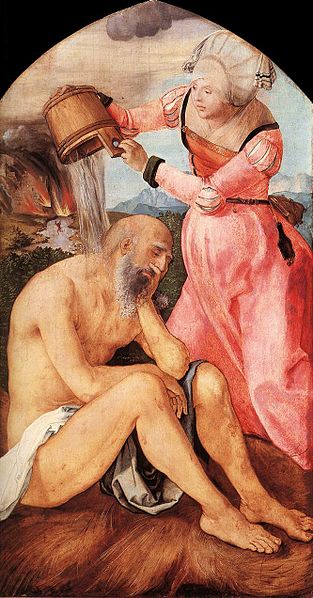
Bild von Albrecht Dürer.

29 August 2021

Solomon's Judgement: Rent Hearts


 I.
You were all I had.
My bright light
in this dark life,
something to live for,
a small thread of meaning
in the drudgery.
You were all I had.

But now
the light is snuffed out,
the thread is cut.
My arms are empty.

My arms are empty,
longing,
desperate to be filled.
So I will fill them -
I must, I must.
I will pretend
that he is you
back in my arms again.

You were all I had.
I can't give you up.
I will pretend
that he is you.
And if I can't - then so be it.
Let them rend him with a sword,
my heart is rent already.
I'm too broken to care,
too deep in grief
to grant her what I can't have.
If I must suffer,
she should too.
If I can't have you
no one should.

Let them rend him with a sword.
My heart is rent already.


II.
You are all I have.
My bright light
in this dark life,
something to live for,
a small thread of meaning
in the drudgery.
You are all I have.

But now
the threat of losing you -
snatched, stolen, ripped from my side,
my arms are empty.

My arms are empty,
fighting,
fighting to get you back.
I love you,
I need you,
I need you to be safe.
Come back to me,
back to my arms again.

You are all I have.
I can't give you up.
I need you
back in my arms -
but if I can't, then please be safe.
My heart is rent without you,
but I need you to be whole,
need you to live
and shine your light,
if not for me,
then for yourself.
If the only way 
to keep you safe
is letting you go -
then so be it.

My heart is rent without you,
but I need you to be whole.

_________________________________

[29. August 2021]

Actually had other ladies higher up on my to do list but spontaneously decided to write the p.o.v. of the two prostitutes who fought over a baby. One had accidentally smothered hers in her sleep and now both were claiming the living one. Solomon suggested cutting the baby in half to find out who the real mother was, because she would be more concerned with keeping her child alive.

Anyway because this poetry project is about compassion with the characters / trying to imagine what they are feeling, I did not want to do a "bad mother / good mother" thing. Was the mother of the dead baby selfish for not caring if the live one was killed? Maybe, or maybe she was just too full of grief (which can make us not think straight). One mother's primary concern is her grief, which makes her care about little else. The other's main concern is her child's safety, which makes her willing to sacrifice. Both women are in a terrible situation though - each in some way has her heart broken. One can't do anything for her child anymore - the other can still try to keep him safe.

Picture by William Blake


03 July 2021

Rizpa: Ich bin Mutter

 1. Samuel 21,1-17


Ich bin Trauer –
zerrissen von Verlust,
ein Loch in meinem Herzen
wo du einmal warst.

Ich bin Verlust –
allein nun, verlassen,
meiner Söhne beraubt –
grausames Menschenopfer
im Namen Gottes getan.

Ich bin Liebe, ausgegossen
aus gebrochenem Herzen,
fliessende Tränen
die dich nicht auferwecken können,
schützende Arme
die dich umhüllen
dass dich am Tag die Sonne nicht steche
noch der Mond des Nachts.


Ich bin Zorn
der kämpft für meine Kinder
gegen alle Gewalten der Natur,
wenn es sein muss: gegen Gott;
gegen die Verwesung,
gegen den Tod.

Ich bin Treue
mächtiger als Hass,
schärfer als ein Schwert,
stärker als der Tod;
ich ertrage jeden Sturm,
ertrage jeden Schmerz –
deine Beschützerin
über das Ende hinaus.

Ich bin Mutter.
Meine Liebe stirbt nie.
Ich würde den Tod töten
wenn ich es nur könnte.

Wo ist nun Gott?
Freut er sich über Menschenopfer?
Oder bekämpft sie den Tod mit mir?

__________________________________

[Übersetzung 7. Mai 2021]

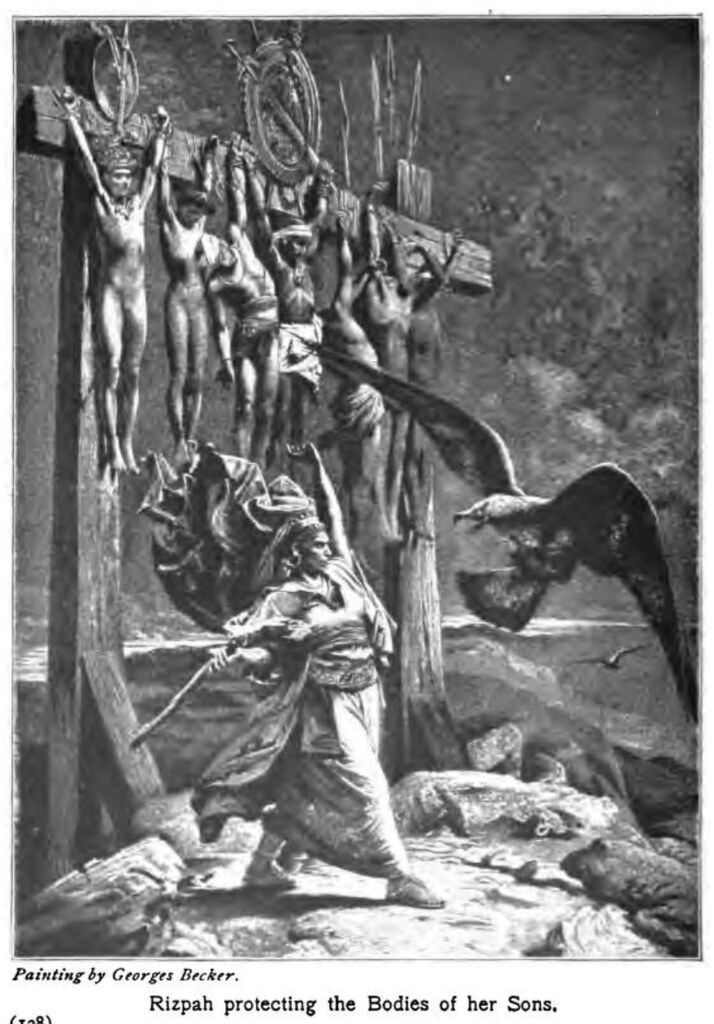
Bild von George Becker

07 June 2020

Rebecca's Nurse Deborah: The Flesh Is Willing But The Spirit Is Weak

"And Deborah, Rebekah’s nurse, died, and she was buried under an oak below Bethel. So it was called Allon-bacuth." (Genesis 35:8)

"Keep awake and pray that you may not come into the time of trial; the spirit indeed is willing, but the flesh is weak." (Mark 14:38)


If only
if only
if only it were easy
if only it were quick
blink of an eye
pass through a veil
cross over a threshold
and then I am there

Instead
this pain
this battle
every breath a rattle
waiting
waiting
fighting
wanting to leave
wanting to let go
but no
I can't

not yet

The flesh is willing 
but the spirit is weak.

I am ready
so ready
my body is tired
exhausted
finished
done

I want peace
I want rest
I want to stop
breathing
stop
living


The flesh is willing
but the spirit is weak.


I wish
I could see them
my children
my grandchildren
growing up
and what they accomplish
I wish
I could say
so many things
but my lips are dry and cracked
and where has my voice gone
I wish
I could forgive
I wish
I could be forgiven
instead I wait
and breathe
and fight

The flesh is willing
but the spirit is weak.


The flesh is ready
this body wants to go
but no
my spirit
clings on
with iron might
to all my loves
and all my hopes
and all my pain
if only

if only
I could just let go


The flesh is willing
but the spirit is weak.

Maybe that is why
we say
Into your hand, O Lord

I was a midwife in life
will you be
my midwife in death
and help me
cross that threshhold
pass through that veil
let go at last
and find rest and peace?

"Into your hand
I commit my spirit;

you have redeemed me,
O Lord, faithful God."


______________________________________________________

[7. June 2020]

The only thing we hear about Rebecca's nurse (a different Deborah from this more famous one) is about her death - so I decided to write about dying from her perspective.

I'm a hospice chaplain part-time so this was somewhat inspired by experiences and conversations I have had in the hospice with the dying. The other week I got the sentence in my head "The flesh is willing / but the spirit is weak" - a turning-around of what Jesus said in Gethsemane. Because sometimes the body is just so ready to go but you're not able to let go yet.


Art by Claude Monet.

26 May 2019

Widow Jerusalem: I Cannot Save You

Baruch 4:8-28

"But I, how can I help you? 
For he who brought these calamities upon you 
will deliver you from the hand of your enemies." 
(Baruch 4:17-18)

Alone with the pain,
alone without you.
What can I do?
Watching you as you go astray,
watching you fall and be taken away,
away from my loving arms.
What can I do?
What could I have done
to protect my lost sons,
to prevent all this pain?
What can I do
to rescue you,
bring an end to these wounds
you inflict on yourselves?

What can I do?
How can I save you?
What sacrifice
could this mother make?
I'd make them all,
I'd destroy myself
if only
if only
I could rescue you.

But it would be in vain.

What can I do?
I cannot save you.
How important for me
to realise this is true,
to learn to let go
and wait from afar,
not break myself
against your rocky hearts.
I cannot save you,
I'm allowed to let go,
let go and let God
who can do what I can't.

What can I do?
I can cry to the Lord,
day and night, all my life,
cry out for you.
I can watch, I can pray,
I can hope, as I wait,
encourage you with my faith
that you'll yet be saved.

Alone with the pain.
Alone without you.
I cannot save you -
and yet
there's still much I can do,
as I let you go
into the hands of God,
as I let him do
what I can't.
I will pray,
I will hope,
I will trust
until at last
the day comes
when I will have you back.

_____________________________


[26. May 2019]

I'm currently reading the Apocrypha (books excluded from the Bible during the Reformation, which were part of the Bible of the early church and are still in the Catholic Bible) and stumbled upon this personification of Jerusalem as a widow mourning her children. I loved this depiction and especially v. 17-18: "How can I help you? For he who brought these calamities upon you will deliver you from the hand of your enemies." As someone who has had to work through co-dependency, that really spoke to me.

Mother Jerusalem is struggling with the loss of her children who have been taken into exile. They have had to feel the consequences of their actions. As their mother she wants to rescue them - and co-dependent people tend to try to "save" others, to their own detriment. Trying to save other people is pointless, though - often our attempts are counter-productive. Often we end up protecting people from the consequences of their own actions so that they can never grow, at the same time breaking ourselves and losing ourselves. It is so very important to realise that we cannot save other people. The first of the 12 steps in Al-Anon (programme for loved ones of alcoholics) is to realise we are powerless over alcohol - i.e.: to realise what Mother Jerusalem is realising here. "How can I help you? - Only God can."

Realising we can't save people helps us give ourselves permission to let go. We co-dependents often feel we have to save the people we love. Realising we cannot gives us the freedom to let go and no longer give ourselves a bad conscience when we fail to change the people around us. Step 2 is: "Came to believe that a Power greater than ourselves could restore us to sanity." And that is also what Mother Jerusalem realises in v.17-18: she cannot save her children - but God can. "Let go and let God" is one of the slogans of Al-Anon. Letting go does not mean giving up, but instead giving what I cannot do to someone who can. Mother Jerusalem does this here: in Baruch 4 she keeps emphasising her trust in God, her hope that he will change what she cannot.

These are some of the most important things I learnt about dealing with co-dependency... I cannot save the person I love - however, God can. So I am allowed to let go and no longer try doing what I can't do. Instead I can focus on what I CAN - and trust God with the rest. :-)

12 Steps of Al-Anon
Picture: Mary Jane Peale, "Pearl of Grief"

01 August 2018

Pharaoh's Daughter: Just Like Me


Exodus 2:1-10

Foreigners.
Outsiders.
With your strange religion,
your alien ways.
Taking our jobs,
threatening our culture,
hostile,
dangerous,
lazy ingrates.
Who knows what you're planning?
Who knows when you'll be more than us?
Who knows what you'll do?
What then?

Stereotypes
are like horoscopes:
broad enough to sound so true,
convincing enough
that you can't smell the lies.

But
I see you mourn your children.
You're just like me.

Stereotypes
are like horoscopes.
So easy to hate all of you,
for the actions of a few,
so easy to let fear
distort your features,
till you're no longer people
but monsters to be culled.

But
I see you mourn your children.
You're just like me.
Because
I've mourned my children too.

I know what it's like
when joy is replaced with emptiness.
I know what it's like
to have your hopes and dreams
smashed to smithereens
with your aching mother's heart.
I know what it's like
when your breasts weep milk
for a child no longer there.

I see you mourn your children.
You're just like me.

So you see,
I can't hate you,
can't watch them cull you like animals,
because you're not.
You're just like me.
I can't watch
as another child dies,
as another mother is left bereft,
because you're just like me.

We don't have to mourn this child.
You and I can both be mothers.
I can save us three.


______________________________________________________________________

[1. August 2018]

Some of what flowed into this:
  • Visiting my third home South Africa and experiencing the disconnect that still often remains between the races.
  • All the stuff here in Europe about refugees being turned away, deported, or talk about sinking boats on the Mediterranean to discourage more migrants from trying to cross over. The rhetoric is appalling.
  • Watching "Schindler's List" with my Ouma and seeing how horrible human beings can be (and they haven't changed one bit).
  • Islamophobic rhetoric which I often hear here in Switzerland (a lot of it from "Christian" circles which is sickening).
  • Reading a bit too many novels involving infertility / miscarriage / etc.
 Anyway I decided to look at Pharaoh's daughter from the angle of "What if she was desperate to have a baby but kept having miscarriages, and finding Moses for her was like an answer to that longing for a child?" Of course the Bible tells us hardly anything about her background; we only know she is Pharaoh's daughter, we don't know whether she has other children ("The Prince of Egypt" gives her a son), we don't know what moved her to adopt Moses except simply that she had pity for him (Ex 2:6). I played with the "what if" here. Thinking of how finding small connections to the people we're supposed to distrust or hate can open the door to compassion, break down stereotypes and remind us of their humanity.

There are so many stereotypes that you hear day by day. I included some common ones about immigrants in this poem. They sound correct enough that they're easy to believe. Stereotypes are often based on some aspect of truth which makes them so convincing. But they can make us forget the others' humanity, can blind us to the complexities of other people. It's all too easy to commit horrors against other human beings (see the Holocaust... the Nazis were normal people, not monsters) - and even to think it's okay or to think we're doing a good thing! (The people who killed Jesus thought they were doing God a service..)

We need to look beyond the stereotypes, generalisations and caricatures to the humanity of the people we're afraid of or being taught to distrust. In South Africa I heard a lot of things about all sorts of people but I saw all of them hanging out their laundry - and that to me was such a powerful reminder of how in the end, we are all human, with the same day-to-day hopes and fears. We need to stop generalising about each other and dehumanising each other, and start noticing the sufferings we have in common (e.g. child loss as I wrote about here) or the small details of life (like hanging laundry).

Pharaoh's daughter stepped beyond the stereotypes of her day and crossed a boundary by saving the life of a Hebrew child who her own father had commanded to be killed. She took a step towards dialogue by making the arrangement with Moses' mother that she should nurse him till he was weaned, and then let Pharaoh's daughter adopt him. What are the ways we can dare to dialogue with the people who are different from us?

Picture by Lawrence Alma Tadema.

15 November 2017

Rizpa: I Am Mother

2. Samuel 21:1-14


I am grief,
My heart torn with loss,
an aching hole
where once you were.

I am loss,
alone now, forsaken,
robbed of my sons,
bereft in a cruel sacrifice
done in the name of god.

I am love,
pouring from a shattered heart
flowing in tears
that can't bring you to life,
enveloping arms
to shield you from the sun and rain.

I am fury,
fighting for my children
against all forces of nature,
if must be: against god,
spitting in the face of death,
battling down decay.

I am fidelity,
more powerful than hate,
sharper than a sword,
stronger than death,
enduring all storms,
ignoring my own pain,
your protectress
beyond the end.

I am Mother.
My love never dies.
I would kill death
if only I could.

Where now is God?
Delighting over human sacrifice,
or fighting death with me?

________________________________

[15. November 2017]

I have been intrigued by the picture of Rizpa furiously fighting off the carrion birds to protect her dead family members.

Rizpa's story is a terrible one. After David's rule has been established, there is a famine, and David asks God why. The answer: there is "bloodguilt" on the family of Saul because Saul killed the Gibeonites, i.e. in the tribal system of those days, revenge was still pending. Now instead of asking God what to do, David asked the Gibeonites what they wanted - and they demanded human sacrifice. So David had all the remaining male descendants of Saul killed (except Jonathan's family).

Here's where Rizpa, Saul's concubine, comes in. She goes out to the corpses and defends them - throughout the harvest season! Rizpa remains mother even in death. I find that picture very impressive.

Interesting to note: the famine does not end after the men were sacrificed - but after they were given a decent burial. Not only they, but also Saul and Jonathan who had been dead for years. Which to me shows that God clearly did NOT accept the human sacrifice. There is a lot of ugly violence in the Old Testament, and this is one example of it. But God does not condone it. The hero in this story is Rizpa, who shows David what is to be done. The end of bloodguilt is not punishment and sacrifice but forgiveness and burial.

Rizpa fighting death made me think of how in Jesus God conquered death for us. I see God in her, in this story - not delighting over the murder of men innocemt of their forebearer's crimes.

18 July 2017

Cozbi: Pierced


Numbers 25

I am pierced
for my transgressions,
pierced by your spear
and your holy zeal.
I am your atonement sacrifice,
human blood to quell the wrath
of the angry deity.
My death buys an end
to suffering and plague,
my sinner's sinful death
in forbidden embrace,
in the midst of the act
that brought this disgrace.

I am pierced
for my transgressions,
your human sacrifice.
You have killed the sinner
to end the sin,
killed the guilty
to free from the curse.
Now your violence
bears the blessing of peace,
the seal of approval
from your god.
Now your line
is a line of promise:
eternal priesthood -
forever like this.

And they will wonder and speculate
that He Who Will Come will come from you,
that He Who Will Come will be like you,
eternal priest,
burning with zeal.
And they will wonder and speculate
and look for another Phinehas
who takes the spear
and with one good thrust
rids the world of godlessness,
cleans the world from sin at last.

Will they then look
upon the one they pierced,
pierced
for our transgressions?
The one who did not wield the spear
but had it thrust into his side
till blood and water came spilling out;
the one whose zeal
was not spelled out in violence
but in death and suffering;
the one whose victory over sin
was not won by killing sinners
but by self-sacrificing love?

Will they see
their God
pierced
at the hands of the Phinehas' of this world,
at the hands of holy zeal,
their God,
a sinner pierced for blasphemy?

Pierced
for our transgressions,
pierced by our spear
of holy zeal.
God, our atonement sacrifice
to appease an angry humanity.
God, not an angry deity,
but love
pierced
by our hate,
a mirror to wake
a dreaming world,
break our spears
and forgive.

___________________________________________________

[18. July 2017]

Cozbi was a Midianite woman, likely a temple prostitute. Israel on the way through the desert encountered Moabites and Midianites and started worshipping their god/s (Baal Peor) and getting involved with their women (a big deal in a culture where religion is passed on through the mother). As a consequence, there was a plague, from which many people died.
Phinehas, a descendant of the high priest Aaron, killed Cozbi together with her Israelite husband / lover (apparently "in the act" so they were both pierced through - as in the picture above). The text describes this as "atonement". The plague ends after this.

It's a somewhat weird story - and not a very comfortable one, in my opinion. The killing of Cozbi and the man, Zimri, is like a "human sacrifice" appeasing God. Phinehas is lauded for what he did, his action receives a godly "stamp of approval", he receives blessing and promise, in fact a very similar promise to what David received. David was given a promise of "eternal kingship", Phinehas one of "eternal priesthood" (v.13).

While researching my Master thesis about the genealogy of Jesus, I came across all sorts of interesting Messiah theories from the centuries before Jesus. There was a strong tradition expecting the Messiah to come from the line of David, be another David or Solomon, a "King-Messiah". Another tradition believed in a Messiah from the line of Levi, a "Priest-Messiah" (either the same person or a second Messiah in addition to the Davidic one). Because of the promise to Phinehas in Numbers 25, there was a line of thought that expected a "Priest-Messiah" in the pattern of Phinehas. In general, Messiah expectations were not very unlike Phinehas. Especially during the time Israel was under the Greeks (and later the Romans), with foreign religions encroaching, there was a tendency to hope for a powerful "military" Messiah who would with force remove the "godless", non-believers, sinners etc.

So I find it very interesting that Jesus is very different from Phinehas - and Jesus' "atonement sacrifice" is very different from this "sacrifice" of Cozbi and Zimri. Jesus does not kill sinners with "holy zeal" - instead He actually ends up killed by the "holy zeal" of the religious leaders who name Him a blasphemer. Jesus is the one who ends up pierced with a spear (reference to John 19). I believe the concept of "penal substitution atonement" is wrong: God is not an angry god to be appeased. In Taiwan where I grew up, the ones needing appeasing were the ghosts and demons - and my God is not a demon. Jesus' death, the way I understand it when I read the Bible, is not to "appease God" because Jesus is God, as part of the trinity. Jesus is God showing us that God is different, that God is not an angry god needing appeasement. In fact Jesus' death shows us that it is us human beings who are looking for blood and violent solutions. I believe Jesus' death shows us the dangers of "holy zeal" going so far as to kill God Himself. Jesus did not die to appease God - we killed Him to appease our own lust for violent solutions. And the power in Jesus' death is that God does not react with revenge and punishment to the greatest sin of all (the murder of God), but with forgiveness - and that is the point from which we can change, from which we can forgive and reconcile and become more like Him.

Read Numbers how you will - I choose to read it through the lens of the Gospels, through the story of Jesus. I don't want to "sanctify" Cozbi here; we really don't know enough of her story. But what I did realise last time I read this story was that we have someone pierced by a spear here - and we have someone pierced by a spear in the Gospels. And it was expected that the Messiah would be the one wielding the spear and piercing sinners - like Phinehas. But what really happened was that the Messiah took the position of Cozbi and Zimri, the "sinners", and let Himself be pierced. And that made me think and I hope it makes you think too. :-) I find such things very fascinating to think about.

Quick word about my "hermeneutic" here: I believe the Bible is given to us by God and is inspired, that it is full of wonderful and important things to learn. At the same time, I believe that God chose to reveal Himself and all these truths through human beings who were tied to their own time and culture. This does not mean we shouldn't take the Bible seriously, or that we can't ever hope to understand the Bible. My answer to this issue is to on the one hand try to understand the original culture at least a little bit - I read into background culture things a lot while doing this challenge, because especially women's issues in the Bible are very hard to understand without some idea of the patriarchal culture the Bible was written in - on the other hand, to have a place to read the Bible from. For me, that is Jesus and the Gospels - I read the whole Bible through that lens. Which means that if something - like this story of Cozbi and Phinehas - does not fit with the idea of God given to us by Jesus, then I don't throw it out the window but ask myself what God shows me through this difference. Which is what I did in this poem... If we read this without Jesus, we could conclude that religious violence is okay - and it has been read like this in the past, to horrid effect. I believe we need to read the Bible through the lens of Jesus, if we want to understand it properly.

(Feel free to ask and challenge me on this bit. This has been my hermeneutic for the past few years. It has meant taking seriously the fact that there are problematic texts in the Bible, that there are texts that have been used in a very problematic way in the past, while at the same time loving and respecting the Bible as given to us by God.)

10 June 2017

Maacah Mother of Tamar: Mother Lioness

2 Samuel 13

Tear my clothes,
throw ash upon my head.
Today my daughter is dead.

Why do we bear daughters
only to watch them be consumed
by the fires of the lust of a man
eating them alive?
Today my daughter is dead,
alive but dead,
an empty shell,
a rejected husk,
a ghost condemned
for another's lust.
Why do we bear daughters
only to watch them be destroyed
by a world that blames the helpless
and lets evil win the day?

They say a snake corrupted Eve -
today, it speaks to Adam
for it lives between his legs.
Why do we bear daughters
only to watch them be devoured
by merciless greed,
then cast away shamed,
a broken reed?

I want to tear him apart,
I want to rip his throat,
I want to bite off his manhood,
show no mercy to this merciless brute
who had no mercy for her.
Why do we bear daughters
only to watch them be regarded as objects,
playthings to be used and cast aside?
Why do we bear sons
if this is what they become?

I want to devour him
and leave nothing left,
I want him destroyed
the way he destroyed her.
I want to wail to the skies
forty days and forty nights,
tear my clothes,
throw ashes on my head
for today my daughter is dead.

Why did you create us
only to watch us like this,
tearing at each other
like wild beasts?
O God, like me you bore children
and you watched them fall apart.
Does your Mother-heart
break like mine?
O God, do you mourn
every day and every night
for your degenerate children
who wander as though dead?
O God, do you long, like me,
to go out in fury
like a mother lioness,
tearing evil limb from limb?

Or do you, like me,
tear your clothes,
throw ash upon your head,
and mourn your broken children,
alive but dead?

_______________________________________________________

[10. June 2017]

Thought I'd write from the point of view of Maacah, mother of Tamar. Tamar, daughter of David, was raped by her half-brother Amnon. With "alive but dead" I try to refer to how in a shame culture, being shamed in this way (by rape) can make a woman completely lose her worth in society. Tamar would have been made unmarriagable, all her chances for a future destroyed. To society, she was as good as dead.

Victims of rape generally reap more consequences than the perpetrators. Perpetrators get away; punishments are all too often not at all proportionate to the crime. A raped woman is innocent of what happened, but all too often is treated like a sinner. She suffers because of the sin of another.

When the Bible talks about justice and punishment and judgement, I believe it talks about things like this... about God standing in for the suffering and abused.

I decided to play with female imagery of God again here... not everyone's cup of tea, but it is a fact that God as God is "genderless", i.e. definitely not male, and that the Bible uses a lot of feminine imagery for God. I think the mother lioness fits to God... mother animals can be extremely ferocious when their children are attacked. While I am certain that God loves both perpetrators and victims, and salvation is about restoration and healing for both, I also believe (also from some of the pretty gory imagery that we read e.g. in the prophets) that God can be as ferocious as a worried mother animal when it comes to defending those who are wronged. The hard part is that we are all His children (tried to touch on that a bit in the last two stanzas which talk about all the children, not just the daughters), perpetrators and victims alike. God wants all to be saved; at the same time He does not stand for injustice. God's mourning over us must be all the greater, then... a combination of Maacah here, and Ahinoam, Amnon's mother.

Other poems about Tamar and Amnon here.

15 May 2017

Wise Woman of Tekoa: Justice and Mercy


2. Samuel 14:1-24

Justice must be served,
the guilty must be punished;
justice must prevail
through the hand of the King.
As a just ruler
you must deal out judgement,
appeasing the masses
that clamour for blood.
Wrongs can't be ignored,
evil can't be covered -
the guilty must be punished,
justice must be served.

But, Lord,
I am a Mother,
and you, Lord, are a Father.
Does not your father's heart
throb in you like mine?

Justice must be served
on my son who killed his brother;
the thirsty masses cry for blood.
I can't ignore his wrongs
that tear my heart asunder -
but vengeance will not heal me,
retribution won't atone my loss.
I have lost one son -
would you have me lose another?
Justice must be served,
but is this truly justice?

For, Lord,
I am a Mother,
and you, Lord, are a Father.
Does not your father's heart
throb in you like mine?

Justice must be served
on your son who killed his brother.
As a just ruler
you must deal out judgement.
But Lord,
you are a Father
and he is your son.
Close the eyes of the ruler,
look with the eyes of a Father,
and tell me what you see.
Put aside the ruler's iron mind
and listen to your father's heart.
See your child
and find mercy.

Evil can't be covered,
but mercy covers all.
Wrongs can't be ignored,
but a Parent's heart sees
the broken child beneath the sin.
Open your arms,
give in to your longing,
invite your child home
to the embrace where he belongs.
Let love restore
that which was broken;
let the tears of mercy
wash away the pain -

For justice is not retribution;
wrongs can't be healed by revenge -
justice is mercy and restoration,
justice is a parent's love,
justice is God
sparing His weak children,
granting us life again and again.
Justice is a Mother's embrace,
a Father's grace.

________________________________________________

[15. May 2017]

So: King David's eldest son Amnon raped his half-sister Thamar. Thamar's brother Absalom, seeing David do nothing, took justice into his own hands and murdered Amnon. David reacted by banishing Absalom. The wise woman of Tekoa comes in as an attempt of David's general Joab to convince David to end the banishment and let Absalom return.

I really like this story. It shows the complexity of justice and mercy and a parent's love - and it made me think about God's mercy and what that means.

The wise woman of Tekoa basically told a story similar to David's: the case of one of her sons killing his brother, and the people demanding punishment. The way she told the story she nudged David into saying the murderer should be spared for the mother's sake - because otherwise she would lose both sons. That way she could "twist" David into realising that the right decision for him would be to call Absalom back. That's how Bible wisdom works, apparently. ;-) (Nathan used the same method to bring David to indict himself on the Bathsheba incident...)

What the wise woman of Tekoa showed David was: he should look at the matter not as a ruler, but as a father. She showed him it was all right to give in to his love for his son - that it was not any less "just", but more so, than punishing him.

How do we imagine God looking at us and "judging" us? As a ruler? Or as a Father? A ruler or judge looks at the law and how well we followed it. He is completely neutral. A parent is not neutral: a parent loves his/her child. I believe God looks upon us as a parent; He sees us as His children and wants to save us. His aim is salvation, not ensuring all the rules are followed. "We must all die; we are like water spilled on the ground, which cannot be gathered up. But God will not take away a life; he will devise plans so as not to keep an outcast banished for ever from his presence." (v.14)

And, yes, there are perpetrators and victims, as the complicated story of Amon, Thamar and Absalom (including later Absalom's rebellion) shows all too well! But both perpetrators and victims are loved by God. God wants salvation for all. God's justice is justice for perpetrators and victims - which means it is more than just retributive justice or "paying back" what was done. I love the concept of "restorative justice"; I believe that is what all of us actually need... because victims are not really served by retributive justice either. The woman of Tekoa, a victim because she was robbed of her son, is not helped by the execution of her second son! I believe the justice of God is restorative justice: healing and restoring relationships, helping perpetrators to stop being perpetrators, bringing victims to their rights. And that is the kind of justice we Christians are called to live as well.. giving people a chance to change, helping up the downtrodden, working for peace and healing between people who otherwise would hurt each other.

As for "justice is mercy"...this is on my mind a lot. It bothers me how, very often, I see the word "justice" abused in the Christian context, as though justice were the opposite of mercy. As in: "God is a merciful God but He is also just", as if justice and mercy were opposites. Biblically, they are not - they are tightly and inseparably interlinked.

22 November 2016

Ishbosheth's Porter: Was it me?


2 Samuel 4 (LXX)

Was it me?
Was it my fault?
Because I left open the door?
Because I fell asleep?
Was it my failure
that let them slip in?
Was it my negligence
that killed my king?

I know, it was them
who wielded the knife.
I know, it was them
who committed the crime.
And yet it is I
weighed down by guilt.
And yet it is I
weighed down by shame.

What if
I had stayed awake?
What if
I had locked the door?
What if
I had been there to stop them,
to prevent their evil plan?
What if
I had not lain
huddled in a corner
fast asleep?

I know it is foolish,
but my mind twists and turns,
playing with "what ifs",
repeating the scene
in all the variations
of what might have been,
what could have been prevented
if not for me.

There is no punishment -
there is no reprieve.
I am alone,
imprisoned in this guilt
that makes no sense to feel.
Who can set me free
from these what ifs
screaming in my mind,
accusing me?

Was it my negligence
that killed my king?
Was it my fault?
Was it me?

_________________________________________________

[21. November 2016]

Actually this woman doesn't exist. Maybe. I found her in 2. Samuel 4:6 in my 1982 Luther translation - turns out she shows up nowhere else, and the 2017 Luther Bible has her removed. After discovering that the verse is so very different in all other Bibles I checked, and even looking up the Hebrew (although my Hebrew sucks), I decided to check the Septuagint (Greek translation of the OT, which in a few places is different from the Hebrew basis of our modern Bibles), and - tadaa - there we have our porter, though the English version I linked above makes it male (Luther clearly makes it female). I checked my Greek dictionary: the porter is ἡ θυρωρὸς - according to the dictionary the usually masculine -ὸς ending stays the same in the feminine form, but the feminine article ἡ shows it's a female porter. Which means Luther is correct and in the Septuagint it is a woman!

Anyway, the story behind this: Saul has been killed in battle, and David has finally become king - but only of Judah. The rest of Israel is ruled by Saul's son Ishbosheth. A war ensues. But Ishbosheth is starting to lose support. Two of his captains plan to kill him. They sneak into his house and kill him in his bed.
The porter is only mentioned in passing - and only in the Septuagint. I wonder why older versions of the Luther Bible have this Septuagint verse. I don't mind really - it added me another lady to my list and let me write this poem. ;-)

The porter was asleep when the two assassins sneaked in. I decided to write about the guilt she might have felt... I can imagine that when you are involved in a tragedy or crime or surprising loss, you start wondering whether you could have prevented it from happening, what you might have done, what you did wrong. That she fell asleep is already one thing she can hang a lot of guilt on: maybe she thinks that if only she had been awake, she would have been able to keep the men out. (But would she, though? They were his captains. She would probably have trusted them and they might have made plausible excuses. Being awake would probably not have prevented the crime either! But when you're running through the "what ifs", you don't consider that!)

That kind of guilt is very hard to deal with, because we have no answers - we don't know what would have happened if we had only done this or that differently. And it's easy to imagine that one little thing might have changed the whole outcome of what happened - but who knows? I guess going through such feelings of guilt is also a natural part of grief... as long as we don't stay stuck in it. I'm thinking what's helpful is to voice the guilt, to let it out (to God, to another person). And for others to take the guilt seriously, but also be comforting and remind the one affected that it is not their fault.

24 May 2016

Job's Sisters: The Abyss


"Then there came to him all his brothers and sisters and all who had known him before, and they ate bread with him in his house; they showed him sympathy and comforted him for all the evil that the Lord had brought upon him; and each of them gave him a piece of money and a gold ring." (Job 42:11)

Standing
before this abyss of pain.
What can I do?
The words that I speak
are but pebbles that fall
down
down
echoing
into its depths,
swallowed,
useless in its bowels.

Helpless I face this yawning chasm
that consumes and destroys
all attempts at consolation,
my oh-so-spiritual explanations,
every piece of well-meant advice.

The words that I speak
are but pebbles in my hand -
but pebbles can wound and maim and break
an already broken heart.

Standing
before this abyss of pain.
Am I afraid
that if I silently sit
and listen to your tortured tale
it might suck me down
down
down
into the mire of despair
alongside you?
Am I afraid
of sharing your hurt,
of bearing with you this agony,
of wounding my heart
for the sake of healing yours?

What can I do
but stand here by the abyss,
stand here by you?
What can I do
but silently hold you
and listen to your pain
until my tears fall
together with yours?
What can I do
but pour compassion and love
into the bottomless pit
until it is filled?

________________________________________________________________

[23. - 24. May 2016]

I only discovered Job's sisters in Job 42:11 "by accident" a few months ago. You see, there's a lot of women in the Bible who keep jumping at me from around corners just when I thought I was getting close to finishing with the challenge...

Job suffered a whole mass of misfortunes, one after the other, losing all of his possessions, his children and even his health within one day. His friends came to him and sat with him in silence in the beginning - then began trying to explain, to find reasons, to find something, anything sinful in Job's past to somehow explain why God would let something so terrible happen to him. The whole book of Job is basically about these discussions.

I think all too often we Christians act like Job's friends. We look for explanations, or try to give good spiritual advice (I do this too). Or if someone starts lamenting like Job, actually really fighting with God and even telling God off, we quickly try to correct them (well, I do). But does that really help them? God ends up telling off Job's friends. Job was just (even while yelling and complaining all the time), his friends, on the other hand, were in the wrong. Maybe they should have kept quiet, sitting beside Job in his suffering as they did at the beginning.

Job's sisters show up at the very end, after Job gets "rehabilitated" with God. They're at the start of his upward curve. There's not much about them, so writing this I decided to focus on the theme of comforting (since it says that's what they did, along with financial support that probably helped Job get going again).

I often find myself lost for words when I hear stories of suffering. Anything I could say feels meaningless. I know that this isn't always the case, that sometimes people need words. But I find that if I open my mouth too quickly, often the kind of things that come out are not what the person I'm speaking to really needs. Words can wound, whether on purpose or not, and sometimes our attempted "words of comfort" can cause just the reverse of what we want them to. I believe that the most important thing in supporting, comforting and counselling someone is to listen, to give them room to talk. To show empathy. This means making ourselves vulnerable, though - letting what we hear get to us instead of hiding behind advice and correct theology etc.

I think we need to be slower to words and explanations and advice, and quick to compassion in the sense of com-passion / Mit-leid, "suffering with".

Picture by William Blake.

08 April 2016

Eli's daughter-in-law: Ichabod

1. Samuel 4:12-22

My God, my God,
why have you forsaken me?
Here I lie in my blood alone,
robbed of my husband, my family,
dying, leaving behind a child
even more forsaken than me.

My God, my God,
why have you forsaken us?
Why let your glory be taken away,
withdrawing your presence, causing defeat?
Why leave us here in our blood alone,
your people - forsaken by you?

My God, my God,
why have you forsaken him?
Why give him life on this darkest of days,
born fatherless, motherless - godless?
Why bring him into this dark, cruel world,
empty, forsaken by you?

"My God, my God,
why have you forsaken me?"
I hear my cry
from your lips, o God,
as you die on a cross alone,
robbed of all glory,
cast out and shamed,
forsaken
with your people
with my child
and with me.

So maybe I am no longer alone,
for you are here,
forsaken like me.
Maybe my cries are not in vain,
for you are here,
crying out with me.
Maybe your glory is not far away -
for you fill this forsakenness
with your presence
and turn this brokenness
into glory.

_______________________________________________________

[8. April 2016]

This was going to be my Good Friday poem for this year, but I had too much going on so didn't get to finish it in time...

I was reading 1. Sam 4, the story of the ark of the Covenant being taken away by the Philistines. In the middle of this story we have Eli's daughter-in-law, giving birth to her son and naming him "Ichabod", which means "The glory has departed from Israel." The ark of the Covenant stood for the presence of God with His people, His glory among them. That it was lost was a heavy blow - the Israelites understood it as God forsaking them. They had thought He would give them victory if they brought along the ark into the battle - instead they were defeated, and instead of concluding from that that the ark "didn't work", that God wasn't stronger than the Philistines (which would have been a plausible thought in the worldview of those times), they realised God had allowed the defeat and distanced Himself from them.

Eli's sons, priests who lived only for themselves and abused their position, were both killed in the battle. Eli died upon hearing the news. Eli's daughter-in-law was the last who was left - and she too died while giving birth to Ichabod, the poor forsaken child whose name expresses the deep forsakenness his mother felt.

Is God cruel? He had warned beforehand that he would punish the family of Eli because of the injustices they committed. It seems harsh that a new-born child has to suffer because of that. I see it this way: Much evil happens in this world where people harm other people, just like Eli's sons. And we want God to take away this evil. But all that we do, all our actions, connects and knots up and in the end, there is no solution without more problems, without more people being hurt - that is the consequence of sin. We can't escape the consequences, even if God intervenes. In this case, God's intervention led to the hopeless situation of new-born Ichabod.

And this is where I had to think of the Cross - the place of Jesus' forsakenness. Jesus was forsaken too, just like Ichabod. He was in a position of deepest shame: the cross, a place not just of torture and death, but of public shaming! The glory had been taken away. And this too was part of an intervention of God to set aright what we had messed up. Jesus bore those consequences. Jesus became Ichabod.

And by doing so, He turned the whole forsakenness around. Because God Himself experienced being forsaken by God, our feeling of forsakenness no longer separates us from Him, but is a place where we can meet Him - because He is right there with us. Because the Cross as place of shame became the place of glory (the Gospel of John focuses on the Cross as the place where Jesus reaches His highest glory, it is where He is enthroned), Ichabod no longer needs to be Ichabod - God's glory is no longer absent, but right there in the middle of our shame. We can no longer be forsaken by God because God, in Jesus, is right there in our forsakenness sharing it with us!

Picture by Diego Velázquez

15 January 2016

The Tenth Plague: Empathy


Exodus 12:29-32 | Wisdom 11:2-16

Do to others as you would have them do to you. (Luke 6:31)

Only now I understand you,
only now I feel your pain.
Only now do I feel sorry -
     do you feel sorry for me?

It's something else when it happens to others,
to the outsiders, foreigners, the ones we don't like.
I could close my eyes, ignore it,
or pretend it was all right -
I did not know what it was like,
I did not care to ask.

But now I feel the pain you felt,
now I lose what you have lost,
now He has taken what we took from you,
and made me see what we did to you.

I did not care to ask,
I did not know what it was like.
Perhaps,
had I stopped to imagine
myself in your place,
my son in your son's place,
perhaps then
I would not have let them do to you
what I didn't want done to myself,
would not have made you lose your sons,
for I can't bear losing mine.

Only now I understand you,
only now I feel your pain.
Only now do I feel sorry -
    do you feel sorry for me?

__________________________________________________

[10. January 2016]

This is about / written from the p.o.v. of the mothers of the first-born who died during the tenth plague in Egypt. I decided to write about them after seeing the picture (above) by Charles Sprague Pearce - I must admit I had never considered their point of view before!

I hope this is understood correctly... in no way do I want to say the Egyptian mothers "deserved" what happened to them. Instead I see it as them having to learn empathy the hard way. Reading Wisdom 11 I found interesting that the Israelites had to learn empathy in the desert when they were thirsty (v. 8). And the sentence "one is punished by the very things by which one sins." (v. 16) The Egyptians actually got away considerably better during the tenth plague, I realised, than the Israelites who lost all their sons (except those like Moses who were hidden or saved) during the pharaoh's decree. The tenth plague was not simply a blow from above - it was the Egyptians being made to experience exactly that which they had done to the Israelites before.

So I wrote this considering how a bereft Egyptian mother might look differently at the Israelite mothers who had lost their children under the decree. I doubt that these Egyptian mothers really played a major part in killing Israelite children - but even if one does not play an active role, one plays a passive one (as happened a lot during the Holocaust): not standing up, not protesting, not defending those who are being abused by the system. Often we only realise what is going on and how wrong it is, and that we should be doing something, once we are ourselves affected.

Maybe we need to ask ourselves (before it's too late) who are those suffering today who need our voice. Before, like the Egyptian mothers, we have to be taught empathy the hard way...


Picture by Charles Sprague Pearce.

13 January 2016

Jairus' Wife: Asleep?


Luke 8:40-56

They were all weeping and wailing for her; but he said, ‘Do not weep; for she is not dead but sleeping.’ And they laughed at him, knowing that she was dead. (Luke 8:52-53)

Asleep?
Is this a joke -
not taking us seriously
as thinking adults?
Do you think we can't see
the grim reality,
do you think it will help us
to pretend she's not dead?

Asleep?
Are you a fool
unable to face reality,
needing delusions
to find comfort from pain,
ignoring in vain
what cannot be undone,
as though calling death sleep
could wake her again?

Asleep?
Is this a comfort,
telling me she is in peace,
not in fear and not in pain?
Are you saying she is fine,
that I need not pine -
that death is not a threat,
but peace and quiet rest?

Asleep?
Is this a promise,
a still and gentle hope
that death is not the end?
That she will be returned to me,
and we shall reunited be -
that death's not irreversible
and sleepers will awake?

________________________________________________

[13. January 2016]

Play Bach's "Sleepers Awake" after that last line ;-)

This is the result of talking about death and funerals these past two days, during a course on how to do weddings, baptisms and funerals. This morning my classmates and I had the opportunity to look at different texts (poetic and biblical) and pictures concerning death and collect our thoughts to them (as preparation for funeral sermons). Anyway all of that seems to have seeped in somehow and I found myself scribbling this during lunch.

In the background of this is on the one hand the story of Jairus' daughter - a girl who died and was raised back to life by Jesus. On the other hand I was thinking of the situations of families who have just experienced a loss. As a pastor one visits the family, partly to be with them in that time (some deaths are harder to deal with than others - I've been at three difficult funerals so far where someone died young, unexpectedly, or even before being born) and partly with the aim of organising the funeral (e.g. what songs will we sing, what text should the pastor preach on, plus preparing a short biography of the deceased which either the family or the pastor will share during the service).

One challenge is to not give the mourning family unhelpful answers. So: what with Jesus' statement that Jairus' daughter was "just sleeping"? Is that a helpful way to talk about death? In the texts and images I looked at this morning there were various different metaphors, ideas and images for death. So here I thought I'd look at this image of "sleeping". It can be taken as a kind of affront (stanza 1), or as an unhelpful delusion (stanza 2) - or as a comfort (stanza 3) or hope for resurrection (stanza 4). I believe in stanza 3 and 4. I also view this as a kind of "progress" from being closed off and suspicious (stanza 1+2) to opening up to the positive meaning in what Jesus said (stanza 3+4). Sometimes we also need to leave people time to get to that point.

And: I wanted to leave this all as questions. I think we need to give the bereaved the space to ask questions. And I believe the best way to understand what resurrection and life after death means is to ask questions, to imagine, to use images and metaphors, because until we are there we only see "through a glass darkly" (1 Cor 13:12).

Jairus' daughter's poem is here.


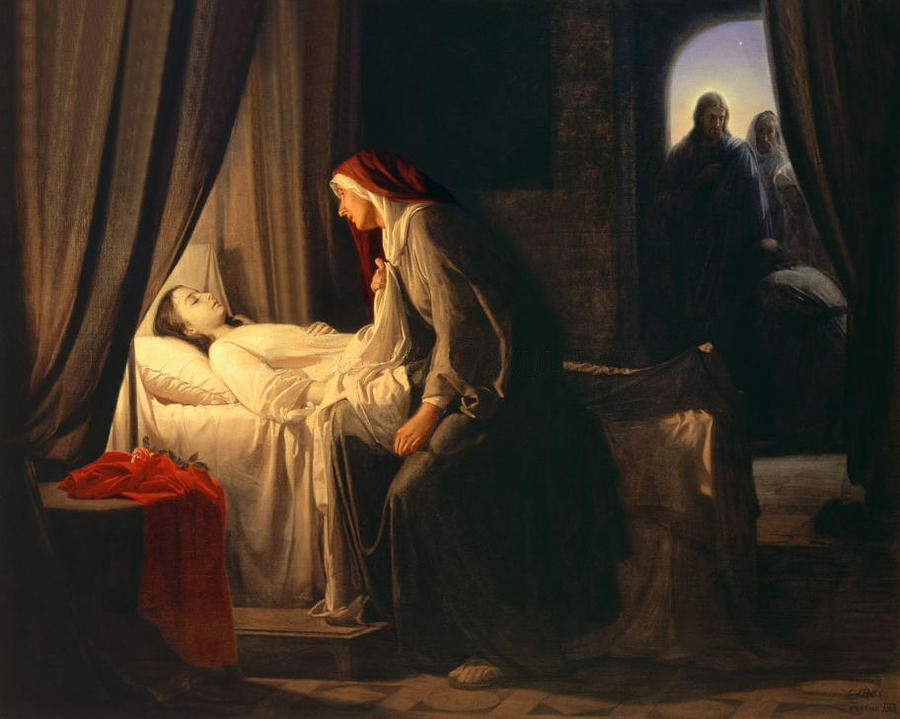
Picture by Carl Bloch - I love it: mother and daughter, and Jesus on his way in the background...

31 December 2015

Shunammite Woman: Hoping against Hope


2. Kings 4:8-37

I.
A hole in my womb,
desperate to be filled.
A gap in my heart,
longing to be complete.
A space in my arms,
waiting to hold
a child of my own.

A dream unfulfilled,
turning into a nightmare,
as month after month
my hopes are dashed,
as year after year
my womb remains empty
and my wish retreats
into resignation.

So don't give me false hopes now,
Man of God,
for my faith has been stretched
beyond belief
and I couldn't take
another disappointment.


II.
A quickening in my womb -
the answer to my prayers!
Love in my heart
ready to be shared.
Complete at last,
for lying in my arms:
a child of my own.


III.
An ache in my womb:
childless again.
A stab in my heart
as it tears apart,
as in my trembling arms
he breathes his last:
the child of my own.

Is this the price
for becoming a mother:
to receive this precious gift,
then watch it slip away?
to be granted a miracle,
but only for a while?
to hold my own son,
only to watch him die?

So don't give me false hopes now,
Man of God,
for my faith has been stretched
beyond belief,
and I couldn't take
another disappointment.

And yet
you are the only one
I would still turn to now,
hoping against hope
that the hope you give me
is not false.


IV.
You gave me no false hopes,
Man of God:
Now my faith has been stretched
beyond belief,
as I have seen
miracle after miracle,
received gift after gift,
and in my arms lies again
this child of my own,
returned to me once more.


___________________________________________________

[31. December 2015]

The Shunammite woman was a rich woman who supported Elisha's ministry. Wanting to reward her, Elisha offered to give her what she wished for - she did not tell him directly, rather Elisha's servant Gehazi told Elisha that she wished for a son. I find her answer quite intriguing: "No, my lord, O man of God; do not deceive your servant." (2. Kings 4:16) I based the "don't give me false hopes" bit on that. The first section (I.) is about her barrenness and longing for a child.

The second section (II.) is about how the Shunammite woman's wish was fulfilled, and she had a son. However, one day the boy fell sick or something (he went around crying "My head, my head!", so probably had some pain in his head) and died in her arms (v. 18-21) (III.). His mother went to Elisha - and insisted that he help her, and no one else (though interestingly enough she didn't directly ask for help, but just alluded to something being wrong with her child). I find it interesting how in this story and in the story of Naaman, Elisha does not show very much interest in getting personally involved (he sends his servant instead). But on the woman's insistence, he goes himself. The child comes back to life - actually the second miracle this mother has experienced (IV.).

First she received a child against all hope - then she lost him, and received him a second time against all hope! Quite an experience!
I wanted to combine here the themes of longing for a child, faith when it's hard to believe, the woman's doubts ("do not deceive your servant" / "don't give me false hopes"), loss of a child, and how the woman experienced two miracles - receiving, losing, and receiving again.

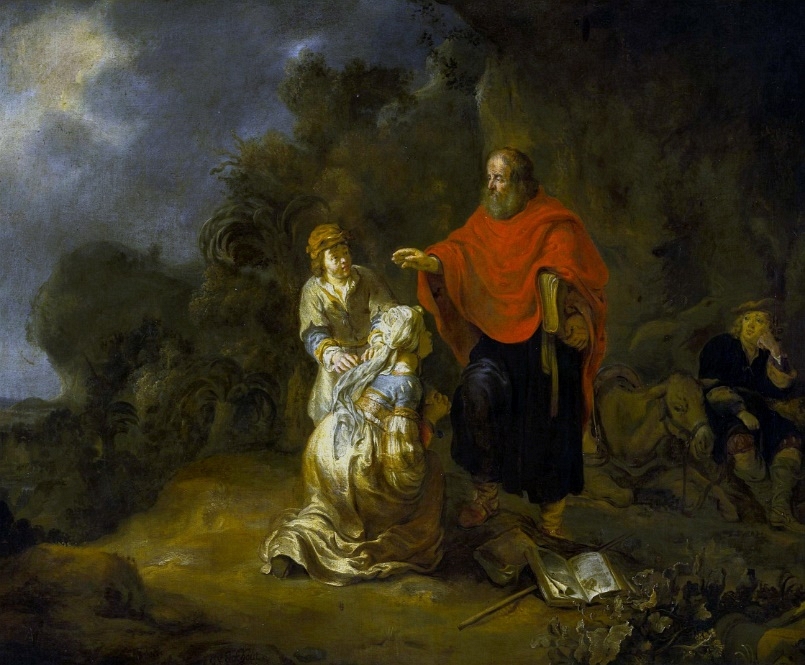
Picture by Gerbrand van den Eeckhout - the scene where the woman goes to Elisha and insists on him coming to help.

19 December 2015

Job's Daughters: Beauty from Ashes


Job 42:10-15

"He named the first Jemimah, the second Keziah, and the third Keren-happuch. In all the land there were no women so beautiful as Job’s daughters; and their father gave them an inheritance along with their brothers." (Job 42:14-15)

I grow from the dust of memories,
shadows that went before me,
the brothers and sisters I never knew.
I rise from the ashes of yesterday,
a new beginning after suffering and death,
a new morning that rises again.
I pour out sweet from the cup of bitterness,
a balm to comfort your tormented soul,
adorning your days of old age.

Sometimes I live
as though they did not,
forgetting that we
are not your only family.
Then I remember:
I am dancing on a grave
and there are still cracks
in your mended heart.

I cannot replace them,
the faces and voices
that still haunt your dreams.
I cannot fill the empty spaces
in our home and in your heart,
cannot drive out the memories
or undo the past.

But, precious father, I will try
to relieve your pain by giving you joy.
I will pour my love on you
and be somebody you can love
and tell your story to.
I cannot replace what you have lost,
but I can help you find purpose again,
raising beauty from the ashes,
letting life begin anew.

_______________________________________________________

[18. December 2015]

I based the first stanza on the meaning of the names: Jemimah means "dove" ("I rise from the ashes" - more the image of a phoenix but it is a bird...), Keziah means "cassia" ("I grow from the dust" - growing plant), Keren-happuch means "horn of antimony", antimony being a cosmetic. So yes, I'm taking a short-cut again and writing one poem for three girls, but I think it worked well this way...

I wrote this thinking about how on the one hand Jemimah, Keziah and Keren-happuch (and their brothers) were a new beginning for Job, while on the other hand they could never be a replacement for the sons and daughters he had lost. I imagine it would be odd, knowing that before one was even born, one's father had a different life, another family, which no longer exists and one can never get to know. Hence "dancing on a grave"...

I find William Blake's picture of Job and his daughters (above) very interesting (and very well thought-out): in the background, it shows Job's losses. So I think it fits really well to this poem. Things go well for Job in the end, and he receives a lot of comfort, not least through his daughters. But the past can't be undone. Still, that doesn't mean things remain dark and hopeless. Job has a chance to enjoy what he has now, and though it does not take away completely the pain of his loss, I think his new family does relieve the pain, giving him something new to live for, encouraging him again.

Job's wife's poem is here.