Showing posts with label Ezra/Nehemiah. Show all posts
11 March 2016
Noadiah: Listen
"Remember [...], O my God, [...] also the prophetess Noadiah and the rest of the prophets who wanted to make me afraid." (Nehemiah 6:14)
Listen, listen,
hear my words.
Drink them up,
let them grip you within,
until they echo
round and round
inside your mind,
inside your heart.
Listen, listen -
it's only advice.
It's for your own good.
It's for everyone's best.
Listen, listen -
I'm only being honest.
This is God,
challenging you.
Listen, listen,
listen to me.
Listen, listen -
how do you know
that what you say is from God
and what I say is not?
Listen, listen -
you only reject
what you don't like,
what's uncomfortable.
Listen, listen,
listen to me.
Listen, listen,
drink my poison up.
Listen, listen,
let me fill you with doubt.
Listen, listen,
let me confuse you.
Listen, listen,
as I make you small,
as I bend you and break you
and make you fall.
Listen, listen,
listen to me.
Listen, listen,
ssssssssssssss...
________________________________________________________
[9. March 2016]
Noadiah was a false prophet who tried to discourage Nehemiah from rebuilding the wall around Jerusalem after the return from the Exile. I tried here to touch on the issue of false prophecy. Of course Noadiah would never admit to the last stanza, but that is what often happens (intentionally or not) in such a situation.
How do you recognise whether a message is truly from God or not? Are all the uncomfortable messages from God? No - even though God often does tell us challenging things. We need wisdom and discernment to differentiate between a real challenge from God (which it is important to respond to the right way) and discouragement that comes from people. And this is very hard! I believe the best way to be safe from this kind of attack is to know the Bible, to know what God is like, to have a general idea what His will is, so that we can measure the more specific messages to what we know of God from His word. Also, the question is what motives the "prophet" / messenger has. Is this person serving him/herself, or truly serving God? Jesus taught us that we can recognise a false prophet by his/her "fruits" (works / lifestyle). Do they live in a way that would please the God of love?
As for the snake: I discovered a few lines into this poem that "listen, listen" has a sibilance (an "s" sound) - and that the snake is a lovely metaphor for someone who lies, manipulates, and fills you with poison. That's why this ends with a hiss. ;)
Picture by Helena Forde.
09 January 2016
Shallum's Daughters: Called
"Next to him Shallum son of Hallohesh, ruler of half the district of Jerusalem, made repairs, he and his daughters." (Nehemiah 3:12)
A call has gone out: "Who will come
rebuild the city of the Lord?
Who will restore our ruined home
back to her glories from of old?"
I heard the call, and here I am,
even though I am no man,
to help rebuild Jerusalem.
I heard the call, and I obeyed -
so do not turn me now away,
but let me in God's service stay.
A call has gone out - who are we
to limit God in whom He sends?
On men and women equally
He pours His Spirit from His throne.
The giver of our gifts is He;
He chooses who fulfills His ends.
The work we do is His alone -
you looked for men, and He sent me.
I heard the call, and I have come
a woman working for her Lord.
So let us now restore our home
back to her glories from of old.
______________________________________________
[2./9. January 2016]
Shallum's daughters are women included in the list of builders in Nehemiah 3. I find them a great example of how we need to drop gender stereotyping. There are no such things as "men's jobs" and "women's jobs" - I believe instead we ought to be thinking in terms of gifts and talents. There are certain gifts that are more common to the one sex or the other - but if someone has gifts and a calling, they are not to be suppressed because of our stereotypes. Because what God is interested in (I believe) is our gifts and calling, not the boundaries set by society. Often what we imagine as men's or women's roles are cultural - you can see that quite plainly when comparing with traditional roles in other countries (did you know that in many African groups it is traditionally the women who work the fields, not the men?).
I believe God gives His Spirit, as well as gifts and calling, on men and women equally (Joel 2:28-29). Women are sometimes given gifts that lead them to do "men's jobs" - and it would be a sin to bury their talents. Shallum's daughters helped rebuild the wall of Jerusalem after the return from the Exile. And I believe in doing so they were living out their passion for God - and listening more to God than to the dictates of their culture.
In the background of this is a little something I picked up while researching for my bachelor thesis about women in missions (there used to be controversies over whether women, especially single women, should be allowed to be missionaries at all):
Another sentence I like to quote from my bachelor research is this one from "Miss Fielde", a baptist missionary to China (which I found in an old missionary journal from the 1870s!):
(I'm usually too lazy and uncreative to try meter and rhyme, but after reading some of Emily Brontë's poems last night I felt ashamed of the fact, so here's a rare one that rhymes and has a kind of tetrameter - with some irregularities of course because I'm too impatient for this kind of thing)
A call has gone out: "Who will come
rebuild the city of the Lord?
Who will restore our ruined home
back to her glories from of old?"
I heard the call, and here I am,
even though I am no man,
to help rebuild Jerusalem.
I heard the call, and I obeyed -
so do not turn me now away,
but let me in God's service stay.
A call has gone out - who are we
to limit God in whom He sends?
On men and women equally
He pours His Spirit from His throne.
The giver of our gifts is He;
He chooses who fulfills His ends.
The work we do is His alone -
you looked for men, and He sent me.
I heard the call, and I have come
a woman working for her Lord.
So let us now restore our home
back to her glories from of old.
______________________________________________
[2./9. January 2016]
Shallum's daughters are women included in the list of builders in Nehemiah 3. I find them a great example of how we need to drop gender stereotyping. There are no such things as "men's jobs" and "women's jobs" - I believe instead we ought to be thinking in terms of gifts and talents. There are certain gifts that are more common to the one sex or the other - but if someone has gifts and a calling, they are not to be suppressed because of our stereotypes. Because what God is interested in (I believe) is our gifts and calling, not the boundaries set by society. Often what we imagine as men's or women's roles are cultural - you can see that quite plainly when comparing with traditional roles in other countries (did you know that in many African groups it is traditionally the women who work the fields, not the men?).
I believe God gives His Spirit, as well as gifts and calling, on men and women equally (Joel 2:28-29). Women are sometimes given gifts that lead them to do "men's jobs" - and it would be a sin to bury their talents. Shallum's daughters helped rebuild the wall of Jerusalem after the return from the Exile. And I believe in doing so they were living out their passion for God - and listening more to God than to the dictates of their culture.
In the background of this is a little something I picked up while researching for my bachelor thesis about women in missions (there used to be controversies over whether women, especially single women, should be allowed to be missionaries at all):
God does not always give us what we expect! And very often in history, where men were expected, God sent women!"[T]hey would regularly pray for men – and for pioneer work, they usually meant men – but in a strange way, which they were slow to accept as a divine answer to their prayers, a considerable number of women usually completed the numbers." (Valerie Griffiths, Not Less Than Everything, 2004 - good book!)
Another sentence I like to quote from my bachelor research is this one from "Miss Fielde", a baptist missionary to China (which I found in an old missionary journal from the 1870s!):
"A true Christianity can never debar woman from showing her gratitude to her saviour by setting Him forth as the true and sufficient Helper of her sex, both for the life that now is and the life that is to come."So yes... don't limit God. Don't tell women not to do men's jobs. Because firstly: men's jobs and women's jobs are culturally relative. And secondly: the Spirit blows where He chooses.
(I'm usually too lazy and uncreative to try meter and rhyme, but after reading some of Emily Brontë's poems last night I felt ashamed of the fact, so here's a rare one that rhymes and has a kind of tetrameter - with some irregularities of course because I'm too impatient for this kind of thing)
27 December 2015
Foreign Wives: Paying the Price
Ezra 9-10
So I pack my bags again,
a few bags more than when I came,
a child at each hand and on my back
the heavy load of your shame.
You say it was a sin,
marrying me -
yet I am the one who is punished.
The day I arrived
I was a girl,
lost and confused,
thrown into a world
I was not ready for.
Given to a foreign man
whose dialect I could not understand,
to warm his bed and bear him sons,
to get to know him,
learn to love him,
to overcome the fear
and my longing for home,
and become his wife.
You say it was a sin,
marrying me.
yet I had no say in the matter.
The day I arrived,
I was a girl,
frightened and lonely,
facing you - the man my parents chose.
Now I am a woman,
a wife rejected,
unwanted and scorned,
sent home in disgrace
back to the fools who sent me here.
We had our differences,
our disagreements,
barriers in language we never quite overcame.
We had our arguments,
our misunderstandings.
We had a life together,
though we never understood each other,
and today as I leave you,
I feel I never knew you.
You say it was a sin,
marrying me.
I say you don't undo it
by sending me away.
For either way
someone must pay -
and so it is I,
trudging home shamed,
a child at each hand,
weighed down with the burden of your sin,
paying the price
for your mistake.
____________________________________________________
[27. December 2015]
When the Israelites were allowed to return from exile under the Persians' reign, many (especially among the elite) intermarried with the Canaanites - thereby breaking God's law which forbade intermarriage with the people of the land (Dtn 7). When Ezra heard of this, he was deeply shocked - and together with the people came to the conlcusion that the mixed marriages should be separated, the women and their children sent home.
To understand the concern behind this, we need to remember that in those days, religion was closely connected to nationality and ethnicity, and note the "matrilinear" workings of Judaism. To this day, children are "born Jewish" only if their mother is Jewish (which is why in the OT intermarriage was so problematic). In OT times mothers were the ones responsible for bringing up children, and for their religious education. A mother from a different people would follow a different religion, and bring up her children in that religion. A few OT stories (notably the example of Solomon's wives and Jezebel) show foreign wives having a bad influence on their Israelite husbands. After the exile, the Israelites' identity was fragile - they couldn't use that kind of negative influence or confusion.
But what about the wives? In those days, being sent away by one's husband must have been a deep disgrace. Women would be sent back to their parents, vulnerable and dependent, probably having a hard time finding a new husband because they had been married before. In those days, people did not usually marry for love, so I doubt the "enforced" divorces caused much heartbreak of that kind. Still: the women were most likely not in those marriages by choice, and probably nobody asked for their opinion either when they were sent away.
My conclusion in reading this uncomfortable story is that this is a dilemma. Sin cannot be undone, even though the men repent of it. The damage is done and the damage will continue unfolding; sin has its consequences and it is a great grace of God if those are stopped, but He does not always stop them. (An example I keep thinking of is David's sin with Bathsheba: God forgave him, but still let the consequences happen - havoc in David's family, Absalom's rebellion.)
In the case of the mixed marriages, it would have been bad for the men to keep their wives - but it was also bad for them to send them away, because in doing so they hurt these women who were not really at fault. It was the men's sin, but the women bore the consequences. The best solution would have been not marrying the women in the first place (they knew it was forbidden) - as it was, in trying to amend the wrong they had done, the men ended up causing more pain. Sin can be forgiven, but it can't be undone.
I wove in a bit about intercultural miscommunications and difficulties that would have come with an intercultural marriage - intercultural marriages are challenge enough when you marry for love; I'm sure the situation is less than ideal if it's an intercultural arranged marriage!
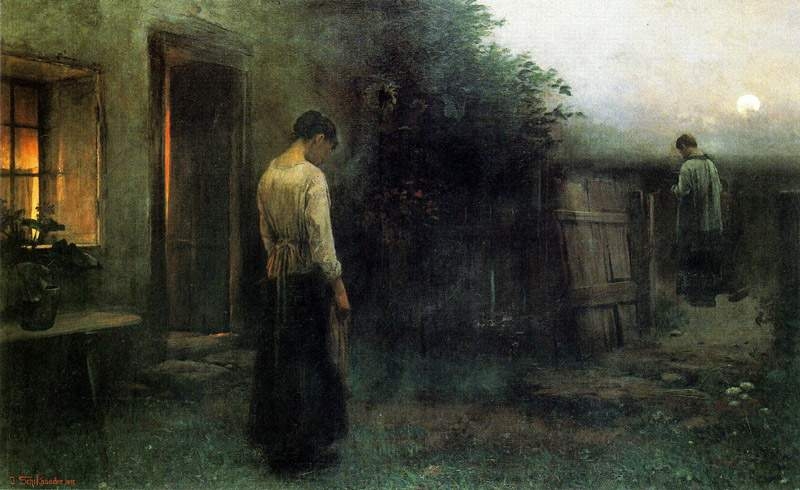
Picture by Jakub Schikaneder
So I pack my bags again,
a few bags more than when I came,
a child at each hand and on my back
the heavy load of your shame.
You say it was a sin,
marrying me -
yet I am the one who is punished.
The day I arrived
I was a girl,
lost and confused,
thrown into a world
I was not ready for.
Given to a foreign man
whose dialect I could not understand,
to warm his bed and bear him sons,
to get to know him,
learn to love him,
to overcome the fear
and my longing for home,
and become his wife.
You say it was a sin,
marrying me.
yet I had no say in the matter.
The day I arrived,
I was a girl,
frightened and lonely,
facing you - the man my parents chose.
Now I am a woman,
a wife rejected,
unwanted and scorned,
sent home in disgrace
back to the fools who sent me here.
We had our differences,
our disagreements,
barriers in language we never quite overcame.
We had our arguments,
our misunderstandings.
We had a life together,
though we never understood each other,
and today as I leave you,
I feel I never knew you.
You say it was a sin,
marrying me.
I say you don't undo it
by sending me away.
For either way
someone must pay -
and so it is I,
trudging home shamed,
a child at each hand,
weighed down with the burden of your sin,
paying the price
for your mistake.
____________________________________________________
[27. December 2015]
When the Israelites were allowed to return from exile under the Persians' reign, many (especially among the elite) intermarried with the Canaanites - thereby breaking God's law which forbade intermarriage with the people of the land (Dtn 7). When Ezra heard of this, he was deeply shocked - and together with the people came to the conlcusion that the mixed marriages should be separated, the women and their children sent home.
To understand the concern behind this, we need to remember that in those days, religion was closely connected to nationality and ethnicity, and note the "matrilinear" workings of Judaism. To this day, children are "born Jewish" only if their mother is Jewish (which is why in the OT intermarriage was so problematic). In OT times mothers were the ones responsible for bringing up children, and for their religious education. A mother from a different people would follow a different religion, and bring up her children in that religion. A few OT stories (notably the example of Solomon's wives and Jezebel) show foreign wives having a bad influence on their Israelite husbands. After the exile, the Israelites' identity was fragile - they couldn't use that kind of negative influence or confusion.
But what about the wives? In those days, being sent away by one's husband must have been a deep disgrace. Women would be sent back to their parents, vulnerable and dependent, probably having a hard time finding a new husband because they had been married before. In those days, people did not usually marry for love, so I doubt the "enforced" divorces caused much heartbreak of that kind. Still: the women were most likely not in those marriages by choice, and probably nobody asked for their opinion either when they were sent away.
My conclusion in reading this uncomfortable story is that this is a dilemma. Sin cannot be undone, even though the men repent of it. The damage is done and the damage will continue unfolding; sin has its consequences and it is a great grace of God if those are stopped, but He does not always stop them. (An example I keep thinking of is David's sin with Bathsheba: God forgave him, but still let the consequences happen - havoc in David's family, Absalom's rebellion.)
In the case of the mixed marriages, it would have been bad for the men to keep their wives - but it was also bad for them to send them away, because in doing so they hurt these women who were not really at fault. It was the men's sin, but the women bore the consequences. The best solution would have been not marrying the women in the first place (they knew it was forbidden) - as it was, in trying to amend the wrong they had done, the men ended up causing more pain. Sin can be forgiven, but it can't be undone.
I wove in a bit about intercultural miscommunications and difficulties that would have come with an intercultural marriage - intercultural marriages are challenge enough when you marry for love; I'm sure the situation is less than ideal if it's an intercultural arranged marriage!
Picture by Jakub Schikaneder
Subscribe to:
Posts (Atom)