Showing posts with label God's people as bride. Show all posts

14 July 2016

Gomer: Looking for Love

Hosea 2:2-25


Looking for love
in all the wrong places -
feels like I'm wandering
blind through a desert,
chasing mirages,
consumed by my thirst -
never satisfied.

I once had love
but I did not see it -
didn't recognise what I had.
Instead I set to wandering
towards the greener grass
only to find a desert
on the other side.

So burn me now,
my cuckold husband:
destroy me with your love
that I've turned into hate!
You loved me with a fire -
now it's a flame of rage.
So burn me with the anger
of your jealous revenge!

I once had love
and I threw it away,
looking for love
in all the wrong places.
Why should you accept me
into your arms again?
Why should you lead me
back out of this wasteland?
I know the power
of a man's jealousy -
I cannot expect you to love me again.

So what is this love
greater than jealousy?
What is this love
that overcomes revenge?
What is this love
that comes looking for me
out in this void that I lost myself in?
What is this love
that chases after me
drawing me back
into its arms again?

This is the love
I was looking for:
the love I had all along.
This is the love
I was looking for:
I see you - and I am complete.

______________________________________________________________

[14. July 2016]

"And I will take you for my wife forever; I will take you for my wife in righteousness and in justice, in steadfast love, and in mercy. I will take you for my wife in faithfulness; and you shall know the Lord." (Hosea 2:19-20)

Gomer is the wife of Hosea - an unfaithful wife. At the same time, she is a parable for the unfaithful people of Israel, who have turned away from God to idols, and away from the life God meant for them to a life that harms and oppresses others. The book of Hosea is full of calls back to the relationship with God and to a life of mercy and justice towards others (e.g. Hosea 12:7).

I find interesting how the book of Hosea portrays God's reaction to His people's sin to the reaction of a jealous husband to the wife who was unfaithful to him. Jealousy can be very powerful... I guess the greater the love, the greater the hurt when you find out you've been cheated on. The book of Hosea describes strong feelings of anger. And yet again and again it shows: God is not man; He won't be controlled by anger and jealousy, but goes beyond righteous anger to grace and mercy, giving new chances again and again. God overcomes the pain we cause Him, and invites us back where a human husband probably would have balked (and had a right to - the Bible allows and in places even encourages divorce from an unfaithful partner).

God does feel righteous anger and jealousy - because He loves us, and our unfaithfulness causes Him pain, and seeing us hurt ourselves in our fruitless search for love elsewhere pains Him too. But God is not fixated on anger. He wants to draw us back. That is why He has spoken again and again through the prophets: because He never forsakes us, but wants to win us back to Him again. It's up to us to recognise this love and return to Him. The doors are open!

23 June 2015

Sulamith: Desiring You


Song of Songs

I want to get drunk
with you,
with the sweet, heady wine of your love.
I am starving for you;
my whole body aches
with desire like a fire
consuming me until
I am satisfied in you.
Intoxicate me,
let this love go to my head;
take me now
and fill me up with you.

I want to drown
in you,
in the endless depths of your love.
Parched in the desert I cry for you;
all of my being needs you.
How can I exist
apart from you?
I want to spill myself out
and be consumed by you.
Surround me,
drag me down into the floods;
take me now
and make me part of you.

I want to hide
in you,
in the cool, quiet shade of your love.
Let me lie in your arms
entranced by your presence,
dreaming in the comfort
of your warm embrace.
Cover me with your mantle,
hide me beneath your wing,
take me,
marry me,
make me your own.
Take me now
and make me one with you.

_____________________________________________________

[22. June 2015]

In case you didn't notice, this is about God. ;-)
I got inspired to write this while reading Everything Belongs by Richard Rohr (really good and thought-provoking book!). In one chapter, he speaks of the connection between divine love and human love. In that chapter, Rohr says on prayer: "Often the imagery becomes sexual, because it is the only adequate language to describe this contemplative experience." - "Religious images were once 'sexual': passionate, suffering, naked, bleeding, familial, and relational."

So if you're thinking I was "pushing boundaries" with the imagery here: it was intentional (sorry, not sorry). If you have a problem, go read Song of Songs.

In general, Song of Songs gets interpreted in these 2 ways:
  1. It is about the love of a couple.
  2. It is a parable of God's love.
I find it interesting to consider how we can actually speak of our relationship with God like we speak of a human relationship... not just in the "best friend" sense but even, as in Song of Songs, with (pretty strongly) sexual imagery. Of course, in religious circles we have become so used to hushing up sex or speaking of it only in connection to sin, that this can be difficult to accept. We tend to relativise or "soften" certain images that pop up all over the place in the Bible, e.g. the marriage imagery that appears really often to describe God's relationship to His people. Maybe we need to let these images challenge us anew, instead of making them "child-safe" and palatable for our feeble constitutions.

Some references in this poem: Psalm 42 and 63 (thirsting for God), and the "mantle" and "wings" imagery from Ezekiel 16 and the Book of Ruth. Covering with a mantle is a symbol for engagement.


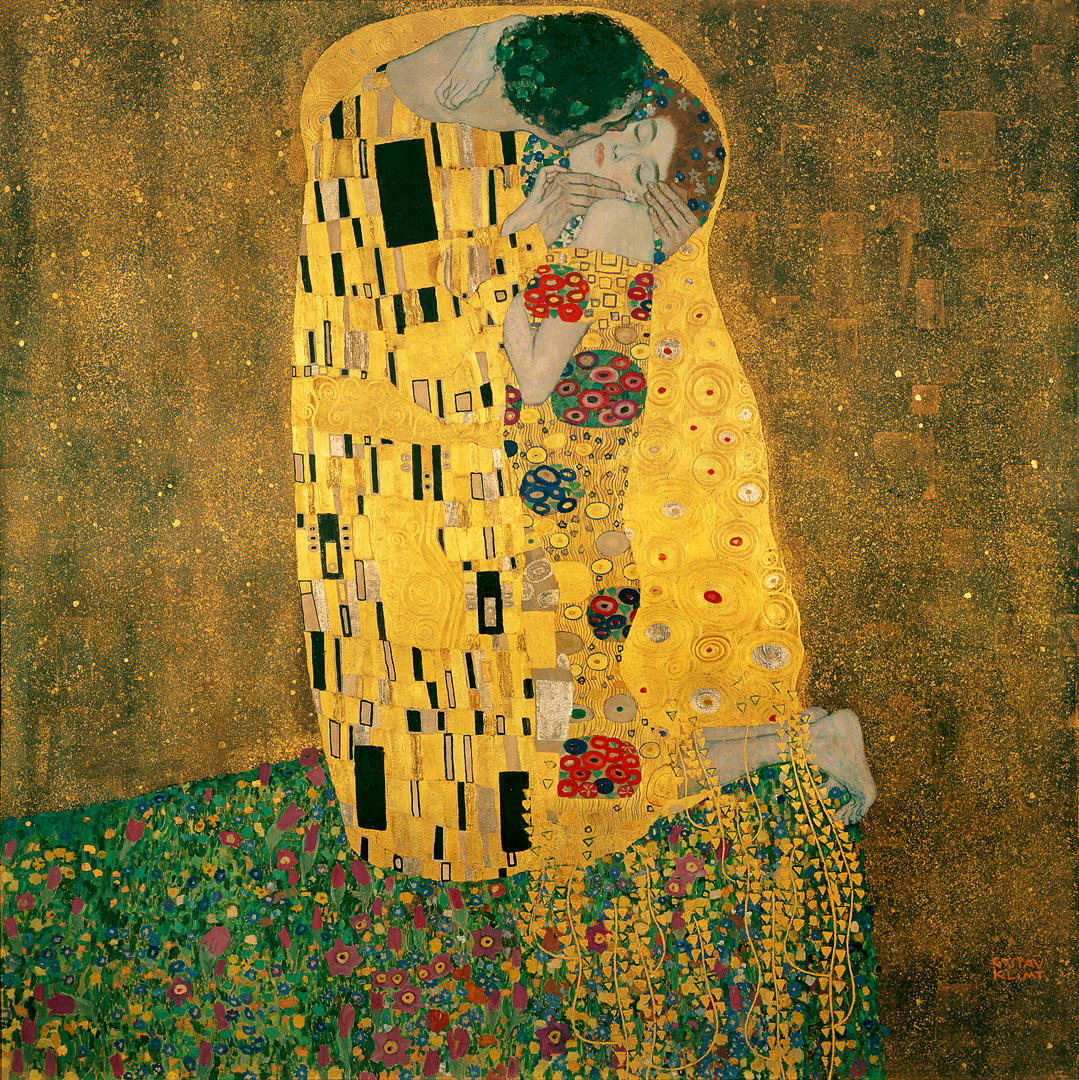
Picture by Gustav Klimt.

23 December 2014

Bride of Christ: Vows

Revelation 19:6-8 | Jeremiah 31:3 | Isaiah 61:10

Here,
with you,
before the altar,
words fail.

What joys now lie within my grasp -
but oh what fears
that even now
it could all slip away.

For what vow can I make,
what words can I say?
Nothing is enough.
Only this little handful of love,
a paper boat
that capsizes with every wind.
There will be days
when my trust in you
will be smothered by my useless fears,
days when I will have affairs
with worries and doubts
instead of hiding myself
in your strong arms.

I am not good enugh for this -
my days are doomed
to infidelity
and broken vows
will litter my paths
because I am too weak
to hold your hand.

Here,
with you,
before the altar,
I fail.

But
your love does not,
and you reach out to me,
and hold me where I can't hold you.
Not my vow counts,
but yours alone,
sealed with blood -
your grace is enough.

"I have loved you with an everlasting love;
Therefore with lovingkindness I have drawn you."


I will greatly rejoice in the LORD,
My soul shall be joyful in my God;
For He has clothed me with the garments of salvation,
He has covered me with the robe of righteousness,
As a bridegroom decks himself with ornaments,
And as a bride adorns herself with her jewels.

_______________________________________________________________

[January 2011]

Recently God helped me realise how helpful the bridegroom / bride imagery in the Bible can be. I was fretting again as I usually do, and then wrote this, and then noticed: I should imagine what I'd do if I had a problem and I had a husband. I think I'd want to tell my husband everything instead of spooking around the house at night worrying my head off.
Then why do I not in the same way tell Jesus everything and trust that I'm safe with Him???

More poems connected to the "bride of Christ" imagery here.

25 October 2014

Bride of the King: Reconciliation

Psalm 45

Today
is reconciliation.
Today
we forge the bond
between you and me,
between your land and mine.
Today
we seal the covenant.
Today
is the start of peace.

Can I forget my people
and my father's house,
and leave them forever
for you - a stranger?
Can I forsake
all I have known
and dare this alliance
with a stranger - with you?

You are different
from other kings -
you reign with peace and equity,
truth, justice and humility.
You look upon me,
your former enemy,
enthralled -
You are altogether beautiful, my love;
there is no flaw in you.

Can I forget my people
and my father's house,
for you?

Here is reconciliation,
here is peace.
Here is your hand, reaching out
to accept me as your queen.
Here is love
that brings an end to enmity.

So I will take your hand
and enter this alliance,
as joy and song envelop us
into the hopes
of all who long for peace.
And so today
we seal the covenant,
we forge the bond -
today
is reconciliation.

____________________________________________________________

[25. October 2014]

Been wanting to write this ever since reading Psalm 45 some days ago... the Psalm is a wedding song about the wedding of a King with a girl from another country who is called upon to "forget your people and your father's house" (v.10). Some verses seem to point to Jesus (e.g. v.6-7).

Anyway, the Psalm got me thinking about royal "alliance marriages", i.e. where a king married a princess from a foreign country to secure peace and to seal a covenant between the two nations. This was still happening some 100 years ago, actually. On the one hand, I do think one can see it as a problematic practice: a girl being carted off to some foreign country (in a time when people hardly travelled and she probably wouldn't have seen her home and family ever again), to marry a stranger who probably already had a whole load of other "alliance wives" (Solomon had quite a few...). On the other hand, I think that the concept of "alliance marriage" can tell us something about God - since the church (and in the Old Testament Israel) is frequently described as the "bride of Christ" or of God.

Alliance marriages were (a) to seal a covenant between two nations, (b) to secure peace.
In 2. Cor 5:18-20, the message of Jesus is described as a message of reconciliation. God wants reconciliation with us. And the way I see it, it's not God who throughout history has kept a sulky distance - it's us. The Bible shows God approaching us again and again, seeking relationship with us. God does not deny us peace - we are the only ones fighting, by insisting on managing by ourselves and rejecting the love of God. But in Jesus God became one of us, and Jesus died to reconcile us to God. And He wants to accept us as His bride - a gesture of peace, and actually of raising us into honour.

So the "wedding" of God with His people can maybe be seen like an alliance marriage: God wants to seal His covenant with us, and He wants to secure peace. He wants reconciliation with us, wants us to stop fighting off His love. And maybe accepting this love of God and following Jesus means forgetting and forsaking other things - like the bride in the Psalm is called upon to forget her people and her family. It means starting a completely new life, being changed by Him.

The "bride" imagery comes up quite a few times in the Bible, especially in prophetic texts (e.g. Ezekiel 16, Hosea, Jeremiah 3) but also in Revelation. Song of Songs is also often read as an allegory about the love between Christ and the church (and btw, the italicised bit in the poem is SoS 4:7). I find it does good to meditate on such texts and reflect what it means to be the "bride of Christ", how to compare our relationship to Jesus with the relationship of husband and wife.

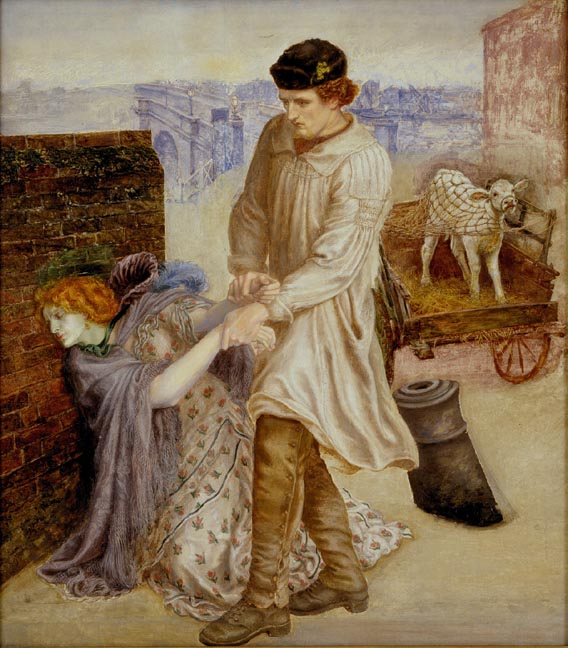
Picture by Dante Gabriel Rossetti.

21 March 2014

Ezekiel 16: Honour and Shame

Ezekiel 16


In shame I was born,
in shame cast aside,
unwanted, unloved,
thrown out to die.

I was hopeless till you came,
I was helpless, I was nothing -
yet you saw past my shame
and lifted me.
You lifted me up,
up, up into glory,
a place of honour by your side.

You showered me with blessings,
you covered me with gifts,
you swore me your love:
you were mine, I was yours.
Ashes turned to beauty,
the waif became a queen -
but I forgot
what I had been.

Honour turned to pride,
beauty to a curse.
I abused your gifts,
I threw you aside.

Eagerly, hungrily I sold myself,
gave others what belonged to you,
turned honour in for shame.
I was falling,
falling down -
down, down without seeing
what I was doing to myself.

You made me look in the mirror,
you made me see my disgrace,
let me face the consequences
of my unfaithfulness.
Without you, I have nothing,
all my beauty falls away,
all the blessings turn to ashes,
all my glory becomes shame.
Without you, I am nothing -
a veneer of honour,
chewed up from inside,
a black hole of misery -
that is what's left of me.

In honour let me die,
head held high,
knowing it is right
to bear this punishment -
go on, I will take it;
let justice be done,
let me swallow the bitter dregs
I poured for myself.

But
my last vestige of pride
you banish to the wind
by lifting up my head
and saying I am free.

In shame I lie before you,
broken,
for I cannot comprehend
this painful grace.
Why do you stay faithful
when faithless I have been?
Why lift me back to honour,
forgiving me?

I see now
the glory is not mine.
I see now
all I have is yours.
I see now
my honour is you,
and being with you
the only way to keep it.
I am ashes at your feet -
but in your hands, I'm beautiful.
So take me in your hands,
mold me into something new -
make this unclean vessel pure
not to my glory
but to yours.

___________________________________________________________________

[March 2014]

This poem is about the "faithless bride Jerusalem" from a parable in Ez 16. After writing a paper on shame / honour cultures and the Bible last year, I still have the honour / shame topic in my head, and it hit me again when reading Ez 16, especially the last bit. The story paints a journey from shame (as an abandoned child left to die) to honour (being adopted and married by God) to shame (priding herself in her beauty, committing adultery and worshipping idols) where punishment reveals the shamefulness of her sinful actions. Jerusalem is even depicted as worse than Sodom (more shame). But then comes the turning point: new honour, a new covenant. And what does the bride feel at being forgiven and lifted back to honour? She feels shame:

And I will establish My covenant with you. Then you shall know that I am the Lord,  that you may remember and be ashamed, and never open your mouth anymore because of your shame, when I provide you an atonement for all you have done, says the Lord God. (Ez 16:62-63)

I considered this: there's something honourable about accepting punishment (stanza 7) and something degrading about being forgiven. In a Chinese TV series I watched once, some of the characters kept insisting on being punished. They actually cried out, "Punish me!" Because they wanted justice to be done and they saw that as honourable. Choosing to suffer punishment is something you can do for yourself. Being reprieved makes you dependent. It makes you have to face what was wrong, and repent; you can't stick your head high anymore, you are not in charge. That's how I'd explain the bride's shame at this point. But it's also the shame of realising she has no honour of her own, but all her honour comes from God and is found in Him alone. She ran away thinking she could do on her own; now she has to realise that all she has comes from God and His great mercy and grace. In herself, there's only shame - in God is honour.

If you find the whole honour / shame topic interesting, you should check out this article about a theology based on shame / honour (particularly relating to Chinese culture).

The picture is "Found" by Dante Gabriel Rossetti - a man finds out his childhood friend is now a prostitute, and she is ashamed.