Showing posts with label marriage. Show all posts

28 June 2023

Widow Of Seven Husbands: On The Other Side

 Matthew 22:23-33

On the other side
will I see them again?
What a reunion
with all my seven men.
Awkward,
I imagine.
Do I really want
to meet all of them again?

On the other side
whose will I be?
Can there be fights
Over There?
And if not: how else
will we solve it?
Whose
do I really want to be?

On the other side
what will we do?
Won't they expect me
to serve them as I did,
housework and cooking
and childcare and sex
for ever and ever?
What do I want to do?

On the other side
I think I'd like to be free.
To do what I want.
To belong just to me.
On the other side
I'd like no more pain,
no more loss, no more grief,
no more conflict or shame.

You say
on the other side
He'll call me by my name,
no longer wife of a man,
mother of a son,
daughter or sister
but me.
You say
on the other side
all I need to know
is I am His,
and He wants to be mine.
You say
on the other side
all will be new
and all will be changed.

The other side
is still shrouded in mystery
but I am not afraid
because Love is there.
And Love will take me by the hand
across
into the mist,
and I will trust
all shall be well
on the other side
with You.

____________________________________________

[27. Jun2 2023]

The Sadducees try to trick Jesus with a question. They don't believe in the resurrection, so they try to show how ridiculous the idea is by telling the story of a hypothetical woman who got married 7 times (through the custom of levirate marriage). Who will be her husband after the resurrection?

Jesus' answer is that they have a completely wrong idea of what resurrection / "life after death" mesans. What they are rejecting is not actually that which Jesus means when he speaks of eternal life. Eternal life does not mean living on just as we do now. It will be completely different, marriage won't be a thing anymore. And while writing from the woman's perspective I considered what that would mean for her (a woman experiencing marriage in a patriarchal setting and 7 times not being allowed to choose who she wanted to spend her life with!).

To what extent do we still view "life after death" the way the Sadducees do, as an "extension" of life on earth, which (sometimes problematic) things from our human cultures "carried on" to eternity? The things we know and are comfortable with now are not good for everyone. God has promised us a new creation where there will be no more tears, no more pain, no more grief - and for that to happen, some things that we take for granted now must fall away. And that's not comfortable, because that makes it way harder to picture what it will be like.

Jesus does not tell us what happens to the wife of the seven husbands - he does not give a concrete picture of eternal life in this conversation with the Sadducees. All he says is: there is a resurrection of the dead because God is a God of the living, not the dead. Through the love of God, God choosing us, God taking us by the hand, we can have eternal life. That is all we need to know: that God is there, that God's relationship with us is what will "carry us across". Which also means: if we get to know and love God now, then the unknown won't have to be so scary. Because we won't have to go into it alone. And it's not completely unknown anymore, because we have someone we know there: God.

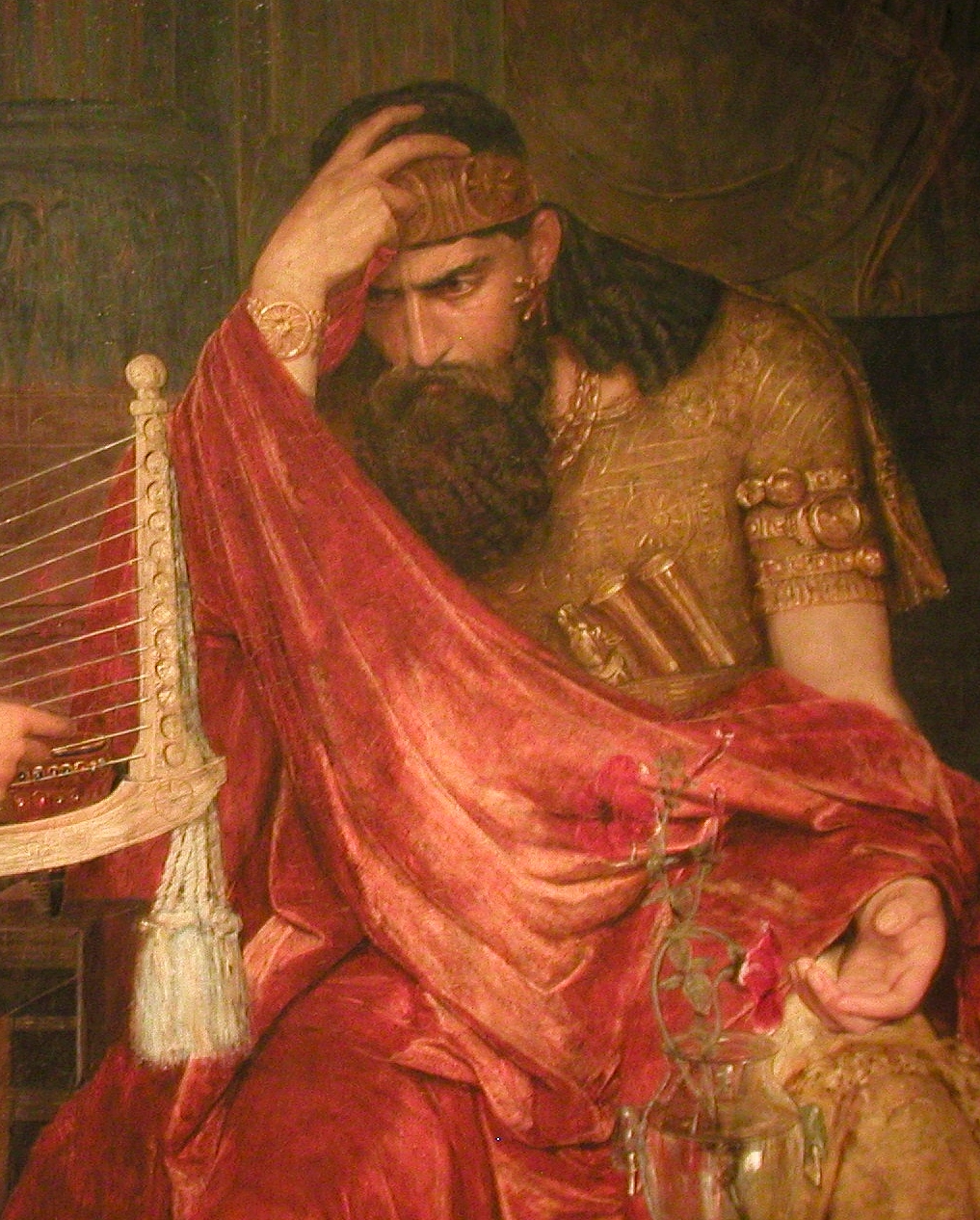
Picture: Alphonse Osbert

17 October 2017

Sarai: Is This Love?


Genesis 12:10-20 | Genesis 20:1-18

So this is love:
to sacrifice myself,
my body,
my integrity
to protect you.
So this is love:
giving up myself,
endangering myself,
risking my own neck
so you can be safe.

I don't deny
that this is love:
to give, to risk, to sacrifice.
Yes, this is love:
to look for your best,
to want you to be safe.

But
is this love
when it is always me
sacrificing,
always me
giving,
always me
paying the price,
always me
losing out
in the end?

You ask me to lie
out of love.
You ask me to endanger myself
out of love.
You ask me
to claim I'm your sister
to protect you, my husband.

And now here I am,
in the chambers of a mighty stranger,
unfaithful by force,
unfaithful out of love,
trading my body
for your safety.
Is this love?

Now here I am
a piece of flesh
thrown before a hungry man,
while my husband
cowers safe and cowardly
far away from me.
Now here I am
without you to protect me,
because this is how I protect you.

My love
you got it all wrong.

This is love:
when a husband gives his life,
risks himself,
for the sake of his wife.
This is love:
when you no longer need
to sell my integrity for the sake of your own.
This is love:
when my life and my body
are as valuable as yours.

This is love:
when it's no longer just me
giving, risking, sacrificing.
This is love:
when it's no longer just me
looking for your best,
wanting you to be safe,
but you
looking for my best,
wanting me to be safe,
standing by me
no matter the price.

______________________________________________________

[17. October 2017]

This story appears twice in Genesis - either it happened twice, or there's two traditions that came together in the Bible. The same story also appears with Rebecca, wife of Isaac.

The first version of this story (Gen 12) goes like this: Sarai and Abram go to Egypt - and Abram gets a bit nervous because of Sarai's beauty, so he makes her lie that she is his sister, so no one will want to kill him to get at his wife. Meaning: Abram is not going to risk his life for her protection. He'd rather risk her (making her more "accessible" for other men as an unmarried sister) than risk the eventuality of someone trying to murder him for the sake of getting her. What ends up happening is that the Pharaoh gets attracted to her and takes her for himself.

Abram doesn't do anything to stop that, does not defend his wife. Sarai is basically being grabbed against her will to become a fling or concubine or wife of the Pharaoh, and Abram would rather stay safe and does not intervene. Isn't this terrible?! (Plus, Abram benefits from Sarai being taken by Pharaoh: Pharaoh does a deal with him, pays him a lot in livestock for Sarai's sake. Abram is making a profit and practically selling his own wife!)

Abram does not stand up for his wife. God, however, does. God is the one who intervenes, warns Pharaoh, even brings a plague over him and his family. God defends Sarai.

Writing this I had to think of the description of marriage in Ephesians 5, in particular verse 25: "Husbands, love your wives, just as Christ loved the church and gave himself up for her." Abram's relationship with Sarai in this story is one of one-sided submission of the wife to the husband; the husband is worth more, his safety is more important, it's okay to risk her life, to sell her, to allow abuse to happen to her, as long as the man stays whole. But that is not the way of the Gospel. Ephesians 5 is often abused to uphold a "hierarchy" of men above women. But I believe what it is actually saying is that men and women are of equal worth, and that a relationship needs to be one of mutual giving - not just the wife serving her husband and giving everything for him, but the husband sacrificing for her as well.

A husband should never let his wife get abused for the sake of saving his own skin. (And vice versa.)

Picture: The Egyptians Admire Sarai's Beauty, James Tissot.

03 March 2017

Merab: What Could Have Been

1. Samuel 18:17-19

Strange to think now
I could once have been yours,
that it could have been me
gracing your side.
What might life have been
if my father kept his promise?
What might life have been
if you had married me?

Strange to think now
that I ever wanted you,
that there was a time
when I'd see you and swoon,
when my heart would beat faster
each time you looked my way.
Such a silly girl,
young and in love,
protesting when they gave me
to another man.

Strange to think now
what I might have endured -
could I have endured it
the way she did?
Could I have stood by you
against my own father,
abandoning my family?
Could I have lied to protect you
from the people I loved?
Could I have endured
years of separation,
fearing for your life?
Could I have endured
being reunited with you,
when you no longer loved me
but had married many more?
Could I have endured
a life torn in two?

Strange to think now
I could once have been yours.
Strange to think now
that I ever wanted you.
Could I have endured it
the way she did?
I was such a silly girl,
young and in love.
But today I look back
and thank the wiser hand of God
for not granting me my wishes
and not letting dreams come true.

___________________________________________________

[2. March 2017]

Merab was the elder daughter of Saul. Saul originally promised her to David, not her sister Michal - but then gave her away to be married to someone else (probably to spite David). Merab doesn't really get a voice in any of it; we don't see how she felt, whether she actually "liked" David the way I portrayed it here (though he was so popular, especially with the ladies, that I think it's quite possible). As often happened to women (especially princesses) in those times, others decided her fate for her and she had no say.

The theme I decided to pick up on here was how sometimes, it's better not to get what we wish for - that sometimes, we only see later how things would have unfolded, and have to admit that not getting what we wanted was better. We may sometimes be disappointed by God not answering prayers or not letting things happen the way we'd like them to - but "the wiser hand of God" knows what and how much we can take. I keep marvelling at how much Michal, Merab's sister (who became David's first wife), had to go through (and I'd like to write many more poems about her!) - and that she didn't break under all that. She had to take sides between her father and her husband - a dreadfully painful thing! So when Merab says in this poem, "Could I have endured it / the way she did?" she is talking about Michal. Not everyone can bear things the same way. God knows which trials to give us, and which to spare us from.

But often we need the wisdom of hindsight to see that it was better not to get what we wanted.
For me this means: I need to trust that God knows what He's doing when He doesn't make all my dreams and ideas and plans come true.

Picture by Ernest J. Rowley, The veiled lady (1903).

09 October 2016

Abigail: Disobedient


1. Samuel 25

I will disobey you,
my Husband -
I will ignore your command.
I will subvert your decision,
I will counter your wish.
I will disobey you,
my Husband -
and save us all.

How can I idly sit and watch
as your choice risks our destruction?
How can I stay silent and passive
in the face of such danger?
How can I submit
to the threat of war
when in my hands
lies the chance to make peace?

I will disobey you,
my Husband -
I will do what you refused:
I will share of our wealth
with these men who have asked us
before they take it by force.
I will disobey you,
my Husband -
and save us all.

I will not let my weapons rust,
my gifts of wit and diplomacy.
I will not bury God's gift of wisdom
beneath a false submissiveness
when I can use it now for peace,
to reconcile
and save us all.

No,
God does not ask me
to submit without question
and obey you unconditionally.
No,
God does not ask me
to sit silent at home
while all around me
the world crashes down.
No,
God does not ask me
to quash my own will
beneath that of a man,
be it my husband
or my future king -

I will disobey you,
my Husband -
I will take initiative.
I will go out and save you
from certain death,
I will go out and save him
from the sin of murder,
I will go out and save us all.

_____________________________________________________

[9. October 2016]

Recently I read this story again... David (on the run from Saul with a band of outlaws) asks the wealthy landowner Nabal to provide food for his men - in return for the protection they have given Nabal's shepherds. Nabal refuses. David is angered and decides to kill everyone on Nabal's estate.

This is where Abigail, Nabal's wife, steps in. She decides to override Nabal's decision and goes out to meet David with the provisions he asked for - thus preventing the massacre David had planned. She saves Nabal (and the servants, shepherds etc) from being killed, and saves David from bringing sin upon himself. Abigail becomes the mediator between Nabal and David, and becomes their "saviour" - all this by being disobedient and insubmissive!
(The help comes too late for Nabal, who is so frustrated with what Abigail has done that he "becomes like stone" and dies some days later. David, on the other hand, takes Abigail to be his third wife.)

This made me think of how conservatives like to talk about "biblical womanhood", i.e. what the role of women should be according to the Bible. According to conservatives ("complementarianism"), God has given men and women distinct roles: men shall lead, women submit and follow. The man is the head of the family, the woman should obey him. Leadership roles in the church also are reserved for men alone; women are not allowed to become pastors, preach or teach men. This is based mainly on a few texts in the letters of Paul (e.g. Eph 5:22, 1. Tim 2:11-15).

I believe this is a highly selective reading - and one that is not "counter-cultural", but clinging on to the patriarchal culture the Bible continuously subverts. The Bible is full of stories of women who dance out of this pattern of submissiveness and through their insubordination actually end up saving the day or fulfilling God's plan. Abigail is just one example. Others include:
  • Zipporah, who saved Moses' life by circumcising his sons (Ex 4:24-26) - something he for some reason had failed to or refused to do.
  • Deborah, who was a prophet and judge (leadership role), and in her story comes across as the strong woman warrior braver than the male captain Barak. Her husband hardly features in her story. (Judges 4)
  • Esther, who broke the rules and dared to approach the king unbidden to speak up for her persecuted people (Esther 5). Even as his wife, Esther was barred (on threat of death!) from coming to the king unless he called her.
  • Women in the early church like Philipp's daughters, the deacon Phoebe or the apostle Junia who did not stick to the traditional "women's roles" dictated by their culture, but served God in the church and in teaching and leadership roles.
There is hardly a single woman in the Bible who fits the "subservient" role conservative Christian leaders call "biblical". If we want to understand texts like Eph 5 and 1. Tim 2 properly, then we need to understand them in the context of the whole Bible, which includes stories of women disobeying their husbands, taking initiative and taking on roles conservatives like to reserve for men.

I believe true biblical womanhood is not unquestioning submission to your husband. Men can be wrong. We have been given gifts by God which we are to use. Marriage is about teamwork, not about my husband telling me what to do and me slavishly following without asking whether he's leading me in the right direction. Being a wife is not about simply doing all my husband wants, because there's a world out there and maybe his decisions harm us, or himself, or people out there. We are responsible before God and we can't hide behind submission - we have been given gifts to use them, when God calls us we are to follow (even if He calls us into a role our culture doesn't agree with), and when our husbands' decisions are harmful and we know it, we are in a position to do something. Like Abigail, like Esther, like many other women in the Bible who "disobeyed" - and in doing so, saved the day and did right in the eyes of God.

"Submission" is not about unconditional obedience, but about love, honour and respect - and sometimes love, honour and respect are exactly what call us to disobedience... (Btw for more on the correct meaning of "submit" in Eph 5, check out this article.)

Picture by Juan Antonio Escalante.

21 August 2016

Michal: The Love is Gone

"Now as the ark of the LORD came into the City of David, Michal, Saul’s daughter, looked through a window and saw King David leaping and whirling before the LORD; and she despised him in her heart. (...) Then David returned to bless his household. And Michal the daughter of Saul came out to meet David, and said, 'How glorious was the king of Israel today, uncovering himself today in the eyes of the maids of his servants, as one of the base fellows shamelessly uncovers himself!'" (2. Samuel 6:16+20)

The world has lost
its rose-tinted hue.
The butterflies
have flown away.
What I once felt for you
has gone.
I don't know where.

Now
when I look at you
I feel only resentment
and pain;
regret
at having been so stupid
to fall in love with you.

You were my hero,
you were my hope.
I gave everything for you.
I lied for you,
I would have died for you.
All these years
I waited for you,
I pined for you,
I wanted to stay true to you -
But what did you give to me?

I thought
that you loved me too,
as strongly and dearly
as I loved you -
was it asking too much
to expect you to be
faithful to only one woman - me?

The world has lost
its rose-tinted hue -
I see you now
as you truly are,
and can't believe
I ever loved
this womanising man
for whom I'm just a trophy,
something you paid for
to add to your collection,
one among many -
you disgust me.

I look at you
and all the love is gone.
I look at you

and despise you.

____________________________________________________

[23. / 24. November 2012] - one of the very old ones

Michal was David's first wife. She was in love with him (1 Sam 18:20); he "won" her from Saul by killing 200 Philistines and bringing back their foreskins (ew). When Saul wanted to kill David, she saved him. (1 Sam 19) Later when David was in hiding, Saul married her off to someone else (1 Sam 25:44). Once David became king, he fetched her back (2 Sam 3).

I've noticed people often view Michal negatively. Probably mainly because of her reaction in 2 Sam 6:16-23 to David's dancing in front of the Ark of the Covenant:
"Now as the ark of the LORD came into the City of David, Michal, Saul’s daughter, looked through a window and saw King David leaping and whirling before the LORD; and she despised him in her heart. (...) Then David returned to bless his household. And Michal the daughter of Saul came out to meet David, and said, 'How glorious was the king of Israel today, uncovering himself today in the eyes of the maids of his servants, as one of the base fellows shamelessly uncovers himself!'" (2. Sam 6:16+20)

But isn't her reaction understandable? She was David's first wife. He had how many other wives after that - and then danced around (half?)naked in full view of everyone. Sure, he said it was for the Lord (v.21) - but after all the womanising she'd seen I think it's understandable that she did not accept that for an answer.

So this poem is basically about "falling out of love". At first we see only this perfect image of our partner - and with time, that perfect image gives way to who he really is. Question is: do I like it, can I forgive him, can I live with it? Michal's answer was: no.


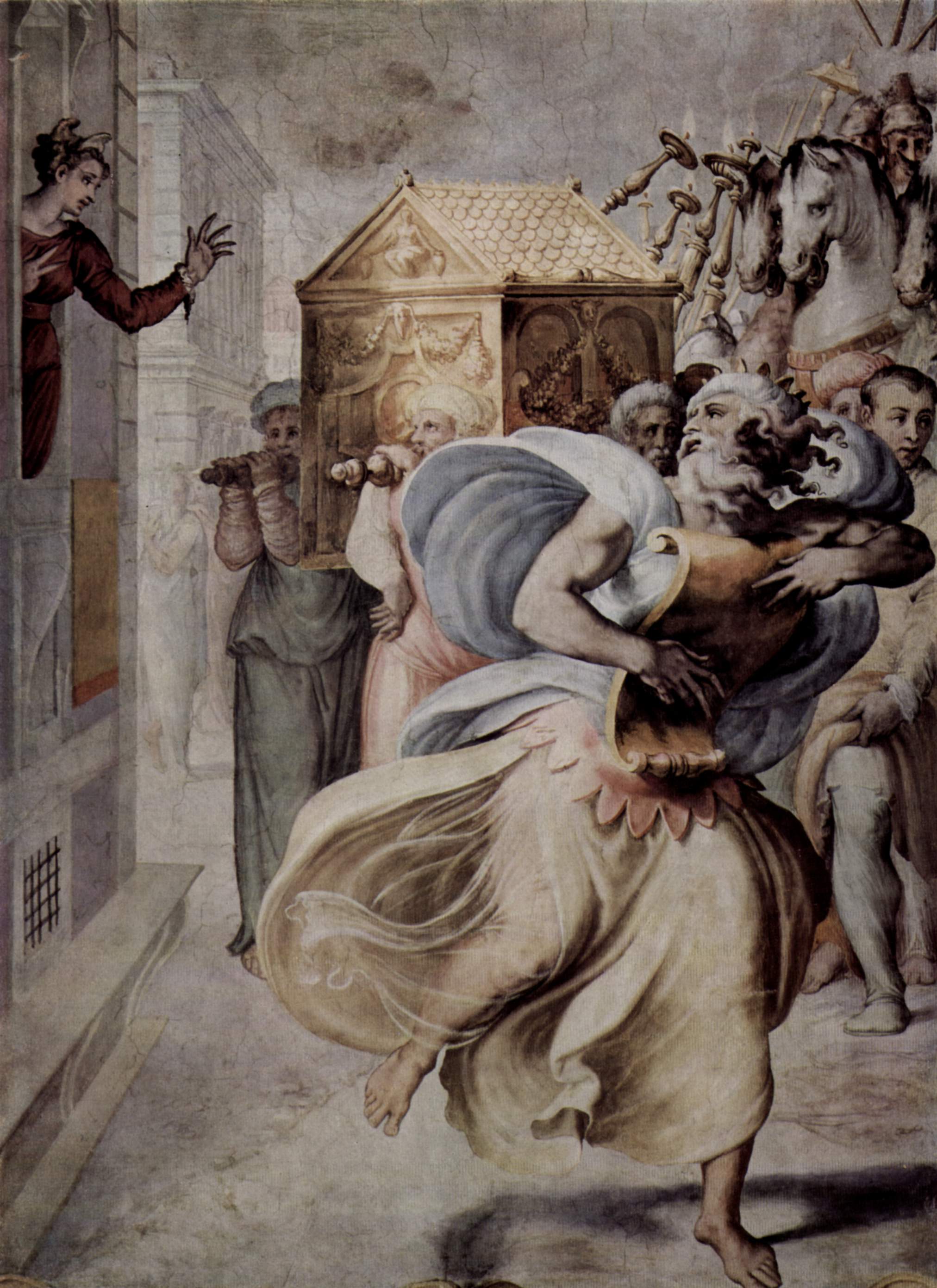
Picture by Francesco Salviati

17 August 2016

Mrs Peter


He comes home
in the middle of the night -
his birthday; I'd cooked
and waited, as it got cold.
He comes home,
shouting, "Darling! Pack! We're leaving!"
And off we are again
to I-don't-know-where.

He comes home
just before lunch -
I'm in the kitchen, cooking
for two, but he
brings a crowd, because
"John's got nowhere to go,
and here's this guy we met today,
and here's his wife,
and look - our new brother!"
(Don't ask me how
our food multiplied.)

Or he doesn't come home
for days on end,
and I wonder:

Is he in prison?
Is he dead?
Or at the other end of the world?
He comes back a month later
with all sorts of news,
lots of dirty washing,
and here and there a souvenir.

Impossible?
Maybe.
Sometimes I miss home,
or times of just us together,
or simply normal life
without faces at the window,
without twenty guests a day,
without fear for his safety.
He doesn't smell of fish now -
which maybe is a good thing -
but some days he comes back bloodied,
and I no longer clean the nets
but his wounds.

But this is my service
of love to him,
and this is my service
of love to the Lord.
Cleaning wounds,
cooking for armies,
meeting the strangers he drags in,
moving so often,
visiting him in prison,
fearing for his life -
all this is worth it,


because
I get to meet so many people,
I get to share in so much joy,
I get to see so many places,
I get to shine for Christ my Lord.
I would not exchange this life
for comfort or riches or normality -
would not exchange the experience
of watching reconciliation bloom,
of seeing broken lives made new,
of seeing hope rise where there once was despair,
of being a puny cog
in the marvellous work of God.


______________________________________________________

[17. January 2012 - edited 17. August 2016]

I'm a second generation missionary kid, so I've seen and heard a bit about the lives of missionary wives. I have for instance heard the story that my grandfather (missionary in Sicily) used to bring people to lunch unannounced quite regularly. And I know of missionary families where they had to move from one moment to the next because there was a war, or they were being kicked out of the country, or similar. Not easy.

But missionary wives are not just tag-alongs or behind-the-scenes workers; they are also missionaries in their own right, or should be. In fact, hospitality and cooking for whoever the husband brings home can be a really important way in building relationships and helping people come closer to Jesus. Because often what people experience or see in our family life or our relationships to each other will convince them a lot more than any words we preach! They want to see that Christianity works.

Anyway, the wife of the Apostle Peter probably didn't have it very easy - those days it was a bit harder again than it is now, after all. For instance: we have internet and telephones now, but just a hundred years ago, leaving one's friends and family to become a missionary meant not seeing them or hearing from them for ages. Letters took months to arrive! In ancient times it was even worse. Travelling was harder too, and took longer. No planes, no trains, no cars. And even now, being a missionary is not always easy - depending of course where one lives, and how one lives.

BUT it's worth it. Because there's more to life than comfort, and we have heaven before us with all eternity to catch up on good things we're missing now.


By the way: we don't really read about Peter's wife in the Bible, but we do know he had one. Jesus healed Peter's mother-in-law (Mt 8:14-15), i.e. Peter was married, and Paul mentions Peter taking his wife along with him on his mission journeys in 1. Cor 9:5.

Picture is "Fisherman's Wife praying for a happy return" by Henri Jacques Bource - I felt it was quite suitable.

27 July 2016

Abishag: Pity is not Love

[Warning: mild sexual content]

1. Kings 1:1-4

Here I lie,
afraid, ashamed,
in the arms of a man
who can no more;
trying to give you
what you cannot take,
caught in an embrace
that cannot satisfy.

Ashamed of my thoughts.
Ashamed of my feelings.
Ashamed that I recoil
at the sight of your body.
Ashamed that I flinch
at the feel of your touch.
Ashamed of my daydreams
of younger men,
the temptation to seek
my fulfillment elsewhere.

I want to be a good wife,
to make you happy -
but it's trapping me
in unhappiness.
It hurts to watch you
frustrated with yourself,
trying and failing
to be a husband again.

It fills me with revulsion,
it fills me with pity -
how I wish I could respect you
and love you instead!
But pity is not love,
and it can't help me endure.
Pity is not enough
to keep me true to you.

How I wish
they could just let you be old
and live out your days
calm and at peace.
How I wish
you must not bear this pressure
of being a king,
a potent man to the last.
How I wish
we could just admit weakness,
that failure must not be a shame.
How I wish
we could just be friends,
talking, playing games,
not trying every night
to do what we cannot.

Here I lie,
afraid, ashamed,
in the arms of this man.
Pity is not love.

__________________________________________________

[25. July 2016 above the South China Sea]

I've read a few interpretations about Abishag (including a feminist one I rather liked according to which Abishag had some power in government). I based this poem mainly on a quote from the Interpreter's Bible which I found on Wikipedia:
[T]he Hebrews...believed that the fertility of the soil and the general prosperity of the people were bound up with the fertility of the king. David by this time was old and decrepit and his sexual vigor is called into question. Attempts are made to remedy the situation. The first cure is to heap clothes upon his bed in order to secure such physical heat as might render him capable. When this fails a search is made for the most beautiful woman in the land. Great emphasis is placed upon her [Abishag's] charms. The LXX supports this by translating in vs. 2, "and let her excite him and lie with him." The fact that the king did not have intercourse with her is decisive in the story. If David was impotent he could no longer be king.
I also felt (after having read the story of someone who married an old man she was caring for out of pity, and then felt guilty for feeling disgusted, unsatisfied or attracted to other men) that I wanted to write about this situation of being a young woman with many opportunities (Abishag was said to be very beautiful), in an unhappy relationship with an older man.

What I realised while writing (and it comes out in the second-to-last stanza, "How I wish...") was that the attempt to keep David potent, and the belief that he could only be a proper king if he was, is once again the kind of human thinking that won't allow for weakness - a way of thinking that is not (from my understanding of the Bible) God's way.

In an ethics class I read a book by Wolfgang Huber (German bishop and ethicist) in which he differentiates between the "olympic man" and the "Jesus man". Human thinking wants the "olympic man", the athlete, strong and able, healthy, successful. This is what David's people were going for when they tried to keep him sexually fit to the last. You're not allowed to get old and decrepit and weak - and if you do, in today's Western culture, you all too often get pushed out of society e.g. into an old-age home. Contrast to that the "Jesus man": Jesus on the cross, weak and suffering. Jesus on the cross means that we are allowed to be weak, that there is nothing wrong about not being completely fit, active and capable of everything. God allows us to be weak and to fail, it is not "bad" or sinful to fail. In fact Jesus' failure on the cross was His victory!

So we ought to change our thinking... David's and Abishag's relationship could have been so different, if he had been allowed to be old and impotent. And I believe this also says something about how men need to be liberated and emancipated too from wrong ideas about manhood (an issue which - some of you might be surprised - feminism has started touching upon) which focus too much on strength and power. There is nothing "unmanly" about weakness - and thinking it is will only cause difficulty when, like David, you are stuck in a position where you are weak and there is no way out. We need to accept ourselves instead of trying to fit some human standard. Because that human standard is not God's standard...

Picture by Pedro Americo

29 April 2016

Zipporah: Costly Love


Exodus 2:15-21 | 4:18-26 | 18:1-9

I will pay the price of love,
giving up my independence,
entrusting my life into your hands
which, not so long ago,
were strangers' hands to me.

I will pay the price of love,
forsaking my security,
following you to a foreign land
pursuing a call I don't yet understand,
leaving behind all I have known.

I will pay the price of love
as you face the ghosts of your past;
I will fight for your faith where you cannot believe,
I will serve your God where you cannot,
I will save your life if I need to -
my bridegroom of blood.

I will pay the price of love,
giving up my peace to bear your burdens,
comforting you in the face of failure,
embracing you when you meet rejection,
rejoicing with you in each victory won.

I will pay the price of love,
following you into uncertainty,
falling with you into the hands of a God
who used to be a strange God to me.

I will pay the price of love,
obeying when you send me from you,
waiting, hoping, wondering, pining
out in the distance away from you.

And all the while
I will reap the benefits
of being yours
and calling you mine.
No matter how high the price I pay,
I receive back hundredfold
and I will never regret
the blood and the tears,
the worries and fears,
the burdens and sighs -
this love is worthwhile.

__________________________________________________________________

[29. April 2016]

To understand everything in this poem you'll have to read the three texts in the link at the top... (ahem... I'm hoping everyone reads the Bible texts too and not just my interpretations!)

Zipporah is mentioned mainly in those three chapters of Exodus... where she meets and gets married to Moses, where he takes her with him to Egypt, and where (at some point) he sends her back to her father (to be reunited again later when the Israelites had crossed the wilderness, Ex 18). I followed that "track" here.

Zipporah had various challenges to face in her marriage to Moses - on the one hand I guess he would have been burdened by his complicated past (close shave with death as a baby, adoption, finding out about his true identity, committing murder, persecution and exile...), on the other hand she became wrapped up in his calling to free the people of Israel from Egypt. We often view Moses as the powerful, confident leader, but when God called him he was not all that confident (e.g. saying God should find a better speaker) - and who was he at home, alone with his wife? With all he was going through - the Pharaoh not yielding, the Israelites doubting him - he probably did not reach home in the brightest of moods and could use some comfort and someone to ease the rejection he was feeling from everyone else.

The middle stanza with the "bridegroom of blood" refers to the (somewhat weird) scene where God wants to kill Moses and Zipporah cuts off her son's foreskin to save his life. I can't say yet how best to interpret that episode, but out of my gut I see it as Zipporah doing what Moses failed to (circumcision of their sons - sign of their belonging to God), stepping in for him in a moment of crisis.

Basically I guess this is about love and marriage not just being simple and easy... there are always challenges (of various kinds) to face, be it finding out your spouse has character weaknesses that start bothering you after a while, be it outside challenges like having to move somewhere for the other's sake (as Zipporah did...), be it sharing burdens, etc. Maybe that's why so many marriages get strained after a while? The question is whether we are willing to pay the price, i.e. not just take and receive, but sacrifice our own freedoms / comforts / wishes too. Taking the bad days along with the good, bearing the burdens along with the victories, is all worthwhile in the end.

Years ago, my Papa once wrote something very wise to me which I share with you here:
"To love someone, you need to think of what is good for the other person, not what is nice for me. That type of life is limited to what I like, what feels good for me. There is too little willingness to sacrifice, which is what builds a relationship. The more we both surrender, the more common space we create between us to establish something new, belonging to us both. What we do not surrender remains just the possession of one of the two."
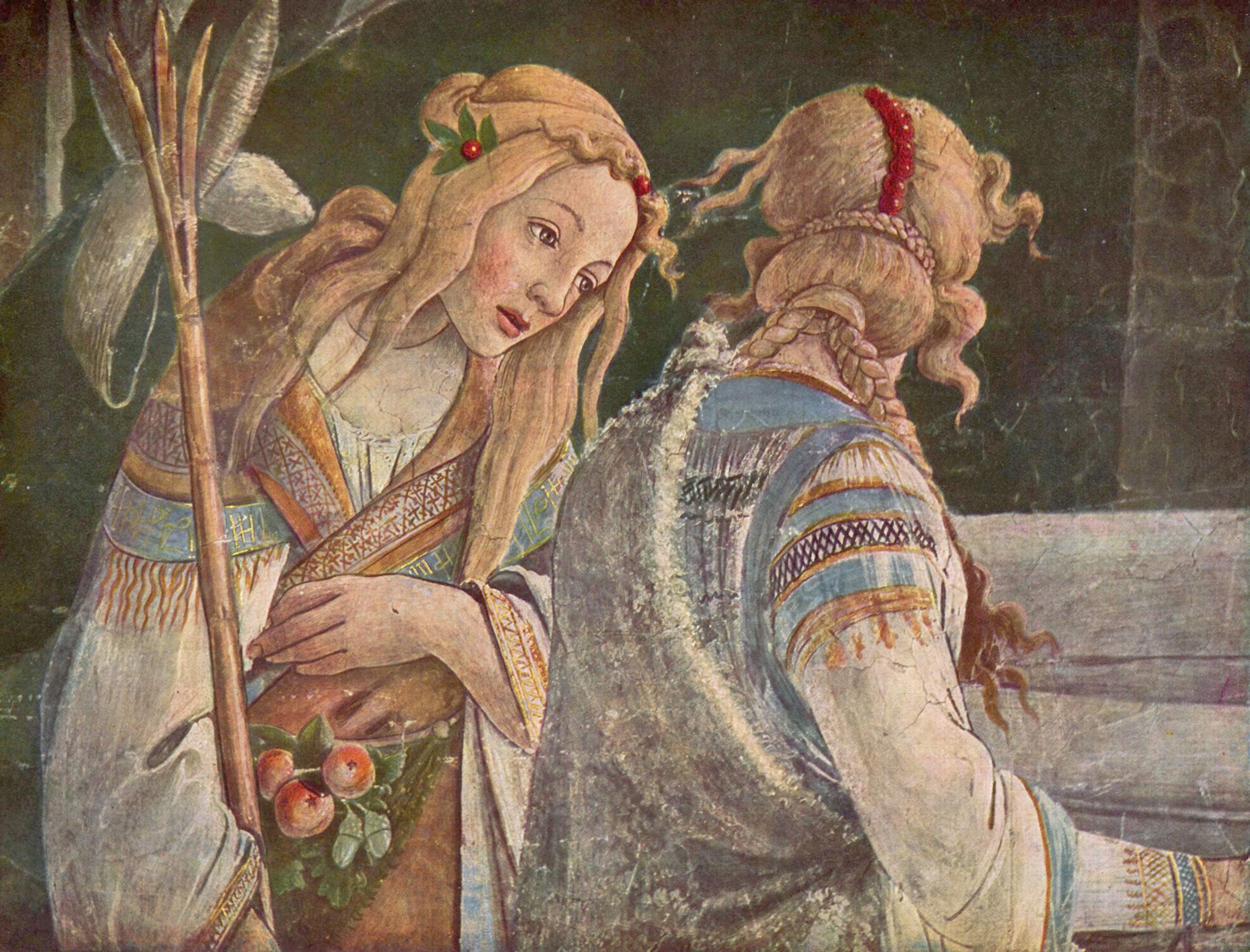
Picture by Sandro Botticelli - detail from "The Trials of Moses"

13 April 2016

Ahinoam: Two-Faced Man

"Now the spirit of the Lord departed from Saul, and an evil spirit from the Lord tormented him." (1. Samuel 16:14)


I hardly know you anymore:
one minute yourself,
the next – a stranger.
An evil spirit is gripping you,
gnawing from the inside,
consuming you within.

You wear two faces –
I hardly know you.
When are you yourself?
When are you It?
Where is the man I fell in love with?
Is there a hope I can have him back?
Or has the evil spirit consumed you,
stolen you from me forever?

I can't bear to watch
as it slowly destroys you,
as you plummet
into a whirlpool of despair,
spiraling down,
                       down,
                                down,
caught in a vicious circle of pain,
going under,
                  under,
                            under
into darkness,
no longer yourself.

I can't bear to watch,
for it slowly destroys me,
poisoning my love
into worry and pain.
I want to be your helper,
surrounding you with love,
but now I only cut myself
on the broken shards of my heart.
I promised I would love you
in sickness and in health,
in good times and in bad,
but...
what if this burden is too heavy,

and bearing it too much?

Come back to me, my love –
wake up from this nightmare,
rise up from this death!
Come back to me, my love –
please,
I want you free again.


______________________________________________________________

[13. April 2016]

Ahinoam is the wife of Saul (1. Samuel 14:50). Saul was the first king of Israel, but lost his right to the kingship. I find Saul a very interesting and complex character. An important thing I learnt from my Old Testament professor is that God did not reject Saul as person, but as king - and Saul's mistake was clinging on to the kingship after God had actually already taken it away from him.

Saul was plagued by an "evil spirit", a kind of depression. David was brought to Saul's court to give him "music therapy"; it did not always succeed in calming him, though, because he still tried to kill David under the evil spirit's influence (1. Sam 18:10-11).

From the perspective of his wife, Saul's condition must have been near unbearable. It is very hard to have to watch someone you love suffer, practically turning into someone else ("two faces"). You feel totally helpless, it can become too much for you to handle. At the same time you feel the responsibility to help (even while failing at it again and again), and your love presses you to do something - but sometimes your help is not accepted, or causes more damage, or pulls you down as well. There's a limit as to how much you can do and how much you should do. It's important to know when the point comes to get professional help. And it's important not to stay alone with this kind of thing, to find someone to talk to and share the burden with.
Poor Ahinoam did not have much more than a music therapist for her husband...

If you are going through a similar situation as Ahinoam, maybe these links might help you...
Picture by Ernst Josephson

13 February 2016

Keturah: Ghost


Genesis 25:1-6

She never left;
she is still here,
filling the spaces
between you and me.
She never left;
she reappears
every time that I fail,
every time that we fight,
filling the gaps
as they widen between us -
haunting me.

She never left;
she is still here.
I hear her voice,
a whisper in my ear
that what you want is her,
what I can never be.
I see her eyes,
following me
reproachfully,
accusing me
of stealing your love.
I feel her presence
lying between us,
cold and unyielding,
clinging to you
and pushing me away -
haunting me.

And yet I know there is no ghost -
only my fear, haunting me.
I am afraid of not reaching her standard,
afraid that you might love me less,
that when you see me you think of her
and wish you could have her instead.
I want to be free.

Set me free from insecurity
so I can love you fearlessly,
and be who I am
with no more ghosts
haunting me.

________________________________________________________

[9. / 12. February 2016]

Keturah was Abraham's other wife... and from the text it kind of looks like she became his wife after Sarah died (which means he must have been crazy old by then) - I just assumed that here. This is mainly about dealing with "the Ex" or the tendency to compare oneself... We don't read anything about Keturah in the Bible other than the children she had, so we don't know how she felt about being the new wife of a widower - but here I looked a bit into what it might be like to feel insecure about the previous wife, to the extent of actually feeling her present.

One problem with the feeling of being "haunted" by the previous wife / the ex / etc is that - I believe - in many cases (especially when we're talking about dead people) it's based on the assumption that this ex is against the new match. Which is not really fair towards her: why assume that she is cruel and unkind and jealous?

Anyway I decided to start out with the "ghost" (the other woman being a threat to the relationship, being "against it") and then move on to the realisation of what is actually going on inside, namely the fear and insecurity that turns the other woman into a threat. It's not the other woman interfering - it all comes from inside Keturah herself. What needs to be "exorcised" is the fear.

(Probably the idea to write about ghosts is the result of reading Northanger Abbey and looking up some gothic horror...)

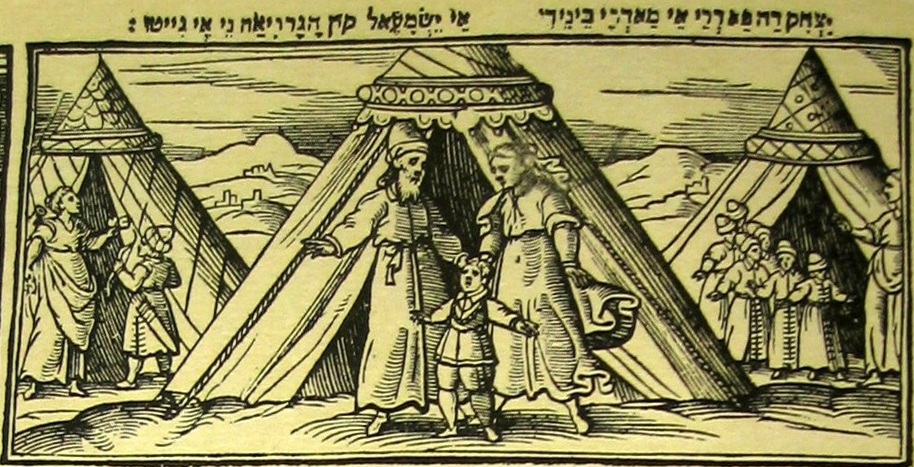
Picture is from the Venice Haggadah... Abraham and his 3 women - Keturah is the one with the many sons, on the far right.

02 January 2016

Maacah / Micaiah: The Measure of Power

2. Chronicles 11:18-23 | 2. Chronicles 13:1-2


"My little finger is thicker than my father's loins." (Rehoboam, 2. Chr 10:10b)

Do you know my name?
Or have you confused me,
exchanged me
with someone else?
Am I truly your beloved,
or just another pretty face,
a number in your race
to be the mightiest king of all?

You measure your power
like the heathen kings:
by the women in your bed
and the children you produce.
And I become a means to the end
of proving your virility.

Do you know her name?
Or have you confused her,
exchanged her
with me?
Can you keep track
of all your beloveds,
all your wives and concubines,
all your mistresses and lovers -
or do we morph into one face,
numbers in your race
to be the mightiest king of all?

And we become
the means to the end
of proving your virility,
of proving your little finger
is thicker than your father's loins,
of proving you mightier than all the rest.

You measure your power
like the heathen kings -
why don't you seek greatness
in the ways of our God?
Our God who chose
an impotent man
and made him great;
our God who chooses
goodness over power
and weakness over virility.

____________________________________________________

[1. January 2016]

I've been wanting to write this for months...
Upon reading the story of Rehoboam, I was intrigued by the fact that in 2. Chr 11:21-22 says his son and follower Abijah was the son of Maacah (Rehoboam's favourite), but in 2. Chr 13:1-2 Abijah's mother is said to be Micaiah. That got me wanting to write about these women.

Rehoboam had a total of 78 wives and concubines, and 28 sons. Back in the day, it was normal in Ancient Near Eastern culture for kings to prove their power by collecting a lot of women. On the one hand, marriages secured allegiances with other kingdoms. On the other hand, the power of a king was believed to be reflected in his virility: having a lot of women and producing a lot of sons.

Especially after reading 2. Chr 10, which tells of Rehoboam's choice of power over mercy which he summed up with his statement in 10:10 ("My little finger is thicker than my father's loins" - something I read as a bit of a lewd joke hinting at that power/virility connection), I get the impression that Rehoboam is a pretty "macho" kind of guy. He goes with the culture of the surrounding nations and collects a lot of wives and concubines to prove how powerful he is - a kind of "arms race" (hence the "numbers in your race" bit).

The polygamy of the Israelite kings had its consequences... one being the confusion / conflation of Maacah and Micaiah, another the threat of the "throne prince" by his many brothers who had to be sent all over the country and kept satisfied (11:23).

But is that really how it's meant to be? I had to think of Abraham, the man God chose to begin His chosen people: a childless man (in the p.o.v. of the day: impotent, weak, unimportant). Also of how God called His people not to adapt to the culture of the other nations - the "natural" human way of thinking which brings us harm instead of good. They were to be something different, showing the world that there are other ways - e.g. that true greatness is not reached through power and force, but through mercy and kindness (which are central elements of the character of God).

Picture by Hans Holbein the Younger.

27 December 2015

Foreign Wives: Paying the Price

Ezra 9-10

So I pack my bags again,
a few bags more than when I came,
a child at each hand and on my back
the heavy load of your shame.

You say it was a sin,
marrying me -
yet I am the one who is punished.

The day I arrived
I was a girl,
lost and confused,
thrown into a world
I was not ready for.
Given to a foreign man
whose dialect I could not understand,
to warm his bed and bear him sons,
to get to know him,
learn to love him,
to overcome the fear
and my longing for home,
and become his wife.

You say it was a sin,
marrying me.
yet I had no say in the matter.

The day I arrived,
I was a girl,
frightened and lonely,
facing you - the man my parents chose.
Now I am a woman,
a wife rejected,
unwanted and scorned,
sent home in disgrace
back to the fools who sent me here.

We had our differences,
our disagreements,
barriers in language we never quite overcame.
We had our arguments,
our misunderstandings.
We had a life together,
though we never understood each other,
and today as I leave you,
I feel I never knew you.

You say it was a sin,
marrying me.
I say you don't undo it
by sending me away.
For either way
someone must pay -

and so it is I,
trudging home shamed,
a child at each hand,
weighed down with the burden of your sin,
paying the price
for your mistake.

____________________________________________________

[27. December 2015]

When the Israelites were allowed to return from exile under the Persians' reign, many (especially among the elite) intermarried with the Canaanites - thereby breaking God's law which forbade intermarriage with the people of the land (Dtn 7). When Ezra heard of this, he was deeply shocked - and together with the people came to the conlcusion that the mixed marriages should be separated, the women and their children sent home.

To understand the concern behind this, we need to remember that in those days, religion was closely connected to nationality and ethnicity, and note the "matrilinear" workings of Judaism. To this day, children are "born Jewish" only if their mother is Jewish (which is why in the OT intermarriage was so problematic). In OT times mothers were the ones responsible for bringing up children, and for their religious education. A mother from a different people would follow a different religion, and bring up her children in that religion. A few OT stories (notably the example of Solomon's wives and Jezebel) show foreign wives having a bad influence on their Israelite husbands. After the exile, the Israelites' identity was fragile - they couldn't use that kind of negative influence or confusion.

But what about the wives? In those days, being sent away by one's husband must have been a deep disgrace. Women would be sent back to their parents, vulnerable and dependent, probably having a hard time finding a new husband because they had been married before. In those days, people did not usually marry for love, so I doubt the "enforced" divorces caused much heartbreak of that kind. Still: the women were most likely not in those marriages by choice, and probably nobody asked for their opinion either when they were sent away.

My conclusion in reading this uncomfortable story is that this is a dilemma. Sin cannot be undone, even though the men repent of it. The damage is done and the damage will continue unfolding; sin has its consequences and it is a great grace of God if those are stopped, but He does not always stop them. (An example I keep thinking of is David's sin with Bathsheba: God forgave him, but still let the consequences happen - havoc in David's family, Absalom's rebellion.)
In the case of the mixed marriages, it would have been bad for the men to keep their wives - but it was also bad for them to send them away, because in doing so they hurt these women who were not really at fault. It was the men's sin, but the women bore the consequences. The best solution would have been not marrying the women in the first place (they knew it was forbidden) - as it was, in trying to amend the wrong they had done, the men ended up causing more pain. Sin can be forgiven, but it can't be undone.

I wove in a bit about intercultural miscommunications and difficulties that would have come with an intercultural marriage - intercultural marriages are challenge enough when you marry for love; I'm sure the situation is less than ideal if it's an intercultural arranged marriage!

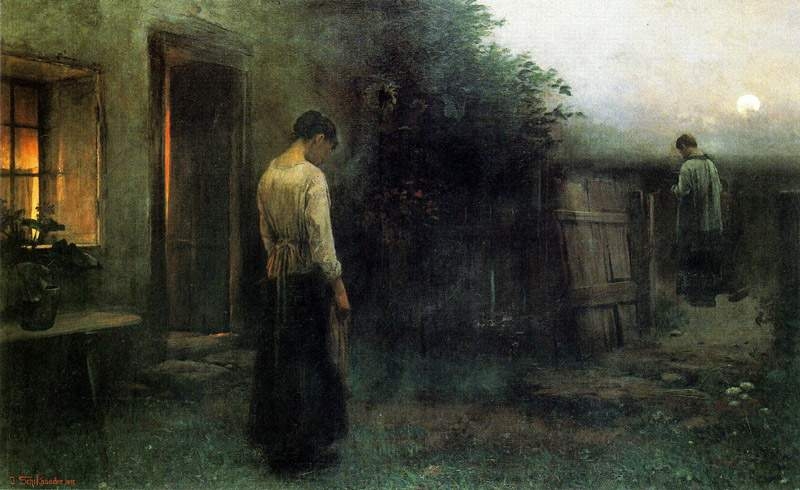
Picture by Jakub Schikaneder

03 December 2015

I Want To Love You


I take thee
to be my wedded husband,
to have and to hold
from this day forward,
for better for worse,
for richer for poorer,
in sickness and in health
to love and to cherish
till death do us part.

I want to love you
when my heart no longer races
every time I see your face,
when it is no longer mystery
that entices me,
when I have memorised you
and being with you is ordinary.
When the emotions fade away
into the dull everyday,
I want to love you still.

I want to love you
when I am distracted
by work and chores and worries,
when my attention
is drawn elsewhere;
when you are distanced
and cares weigh you down,
when troubles come
to cloud our horizons,
I want to love you still.

I want to love you
when my desires grow cold
and you no longer can satisfy me,
when strength fails
and I feel you slip away,
when I see you fall apart
before my very eyes,
gnawed by time.
When at last I have to let you go -
I want to love you still.

I want my desire to be for you,
and not for my fulfillment.
I want to love you for who you are,
not for the emotion
that grips me, then leaves
and cannot last.
I want to give myself,
sacrifice completely,
entrust myself to you
believing
you will love me this way too.
I want to love you,
spirit body soul,
till death do us part.

____________________________________________

[12. October 2015]

I was inspired to write this while visiting my grandparents, who are in their late 80s and both in an old-age home. When you truly stay together until the end, there are a lot of challenges. I don't usually think of that when I think about marriage - but watching my grandparents I realised some of the consequences (if one can call it that..) of love, and the full meaning of the marriage vows quoted at the start of this poem. I feel that when/if I get married, I want to say those vows and seriously mean them: that I'll not only stick with my husband when things are fine and nice and happy, but also in all the challenges ahead - and not just stick around because I must, but out of love.

I believe the kind of love that lasts is something more than the "Hollywood love" most of us believe in nowadays. I believe true love is more than feelings, that it needs to be an act of the will (of sorts) sometimes, something I want and make an effort for. Which is why even if my emotions are right, I don't feel I can honestly say "I love you" to the man I care about until I am able to fully entrust myself to him and accept the hard times, the conflicts, the differences etc too. If I only love him when my emotions are running sky-high and when everything is all right, is that true love?

I guess these are very high expectations, to be able to love someone through all the difficulties of life. I don't want to be naive about this either. But this is the standard I want to aim for, and I believe God will help me in my striving.
Important to me is also this: "believing / you will love me this way too". Fully giving oneself to someone else needs to be reciprocal - otherwise you just get trampled on, which is not the idea either!

Picture by Rembrandt

28 September 2015

Eve: Naked

And they were both naked, the man and his wife, and were not ashamed. (Genesis 2:25)

I'm all dressed up,
wearing my finest -
I've made myself pretty for you.
I've put my best dress on
and done myself up,
want to look perfect
and beautiful,
attractive,
impeccable -
to make you fall for me
all over again.

But what is beneath
all the nice, fancy clothes?
Is it not my fear
that you wouldn't care
the way that you do
if you really knew
what I'm hiding beneath?
I hide my imperfections,
cover them up,
veiled and robed,
masked from view.
I want to be perfect
but I hide myself -
my thoughts, my feelings,
opinions you might not like,
things I'm afraid will put you off -
I hide myself
beneath a fine façade,
afraid, ashamed,
not trusting you enough.

But I don't want this anymore.

I want
to take off all these clothes,
to strip naked
and stand before you
just as I am,
stitchless,
with every blemish,
every mistake,
every feeling and thought
laid bare before you.
I'll pull off this dishonesty
and show you every part of me.
I want to be naked,
no longer ashamed.


__________________________________________________________

[20. December 2012]

(I did not really write this from Eve's perspective, but am still adding it to the "Eve" set because it's based on stuff I learnt from Gen 2)

Original commentary from 2012:
I've been trying to write this for WEEKS; maybe God wanted me to be personally confronted with the issue a bit more before writing this.

The way I understand Genesis 2:25 is that Adam and Eve had nothing to hide from each other. Not just physically but also when it comes to being honest, talking to each other about things, not hiding things from each other. Honesty and communication are really important in a relationship. (Look who's talking. = = This is something I desperately need to work on, which is the reason why I wrote this...)

And isn't it interesting: we tend to make ourselves especially pretty when meeting someone, make sure we're well dressed for a date, put more effort into personal appearance than usual, and show our best side. (I know I get really uptight about not saying / doing anything that might bother him...) But shouldn't we actually be showing our true selves? Be honest?

Another poem based on Genesis 2:18-25 is Helper.
Recently I discovered how interesting and inspiring and awesome that text is. :D I think it says a LOT about relationships and marriage.

Picture: detail from "Garden of Earthly Delights" by Hieronymus Bosch.

16 September 2015

Priscilla: One Flesh

Acts 18

You left your home
and I left mine,
beginning something new.
We met, we loved -
hands intertwined,
which fingers are yours,
which fingers are mine?
Now I belong to you
and you belong to me,
no longer I,
no longer you,
but one.

Together
not only to delight in one another
or in this feeling that awakes
each time I know you're mine.

Together
not only to fill the gap
of longing in my heart
that needs another.

Together
not only for the lives
this union will produce,
little Yous and little Mes.

Together
not only to live side-by-side,
you with your cares,
I with mine.

You left your home
and I left mine.
God brought us together,
and we are one.
Now I belong to you
and you belong to me,
sharing more than our bodies
and more than our home:
sharing one calling,
sharing life.

Together
let us pursue one goal,
and help each other draw the yoke,
for two are better than one.

Together
let us run this race,
support each other when we fall
and pick each other up.

Together
let us serve the Lord,
unite our strengths
and work for Him.

Together
let us walk this road,
of one flesh
and of one mind.
No longer I,
no longer you,
but one
in Christ.

_____________________________________________________

[September 2013]

So... a single girl tries to write about marriage... heh ^^;

Recently I heard that there are Christians (including pastors) in China who have difficulties in their marriage because many Christian women are married to non-Christian men (in case you did not know: more women than men are Christians in China). That makes it hard to really live marriage as partnership, supporting each other. Hearing that I decided to write Priscilla's poem - because Priscilla is an example of a woman in the Bible who worked together with her husband, so much so that they are always mentioned together (and what's really interesing is that she's even mentioned first, as though she were the one "wearing the trousers" in that relationship haha)
Anyway PRAY for those marriages in China plz~

Genesis 2:24 - Therefore a man shall leave his father and mother and be joined to his wife, and they shall become one flesh.
We once had to discuss this in Greek class (because Jesus also quotes it once in the NT). What does "one flesh" mean? To me the thought of "belonging to each other" is a very beautiful one. I once read somewhere that becoming one flesh means no longer being two individuals, but becoming like "one person". Which is why Jesus uses this verse against divorce. Being "one person" to me means sharing absolutely everything, sharing your body (1 Cor 7:4), but also not just living next to each other but caring for each other's well-being and each others wishes and dreams.
And yes, sharing absolutely everything can be a bit of a freaky thought, which is why I think marriage (i.e. total commitment) is important. You need to really be able to trust each other. You make yourself extremely vulnerable - and for this to be fair, both have to do this, and be faithful, and commit. It might be really scary, and I think many people nowadays prefer just living together because really "becoming one" and sharing everything is a very risky thing and demands all of you. But I think there's more potential in hurting each other if we do not open up to each other this way, and I think we totally miss the point and purpose of sex if we do not fully commit, if we only "become one" physically and forget about the rest. I think sex without commitment, and without the total sharing of becoming one, is ultimately damaging, and not fair to the other person or to yourself.

Ecclesiastes 4:9-12 - Two are better than one, Because they have a good reward for their labor. For if they fall, one will lift up his companion. But woe to him who is alone when he falls, For he has no one to help him up. Again, if two lie down together, they will keep warm; But how can one be warm alone? Though one may be overpowered by another, two can withstand him. And a threefold cord is not quickly broken.
I just discovered this verse as a perfect verse for describing marriage as partnership. It's more than just "being in love", it's about really sharing each other's goals and dreams and supporting each other. Not just a selfish thing all about "my feelings" (because feelings go away after a while, believe it or not, and that fact is NOT a reason to divorce and find someone else) but about the other, and about working together for each other.

2 Corinthians 6:14 - Do not be unequally yoked with unbelievers.
I picked up the "yoke" image. The way I understand this is: it's better to have the same goal. A non-Christian will not have the same ultimate goal / aim as a Christian. That will really hamper partnership. This is not saying that non-Christians are somehow "inferior", but that it will cause difficulty in marriage because you will not be working for the same end. If your aim is to glorify God with your life, and your husband does not care, it will be hard to reconcile the wishes of your husband and the wishes of God. I think one can even get that among Christians!! So check what your guy's (or girl's) life aims are, and see if they are compatible with yours, otherwise it will only cause you dilemmas later.

Oh yes and the "fingers" bit I "borrowed" from Thomas Hardy; I'm reading Tess of the d'Urbervilles and after she and Angel get married that image comes up, which I find really beautiful although in the book the one-ness did not last very long... very good book btw.


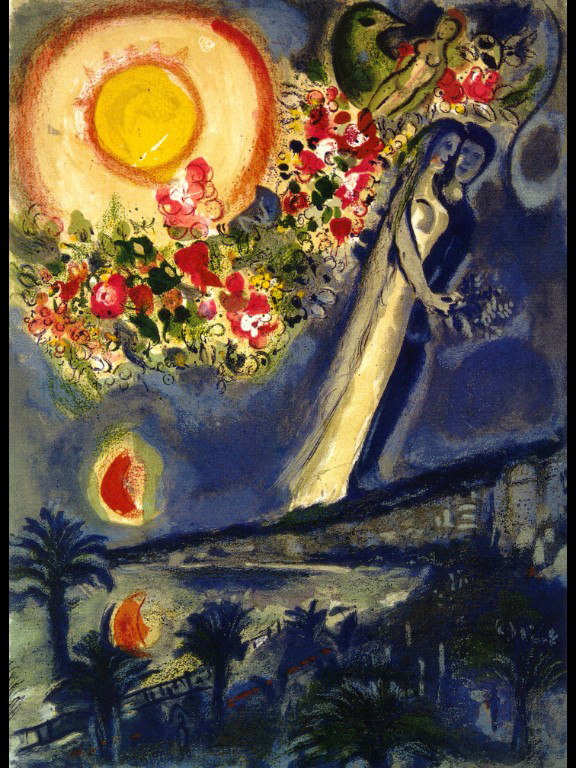
Picture by Marc Chagall

26 August 2015

Vashti: Museum Piece

Esther 1


What is a wife?
An ornament?
A pretty vase
to look at,
polish,
play with,
and then put away
till another day?
What am I to you?
A decoration?
I don't exist
until you want me
or want to show me off
like a rare artefact,
a prized possession.

Why can't you see me?
Why can't you see
that I don't want admiration
but love?
I don't want to be
your museum piece,
don't want to be
a picture on your wall
or a statue
to grace your halls.

I want to be
etched into your heart,
a part of you
you can't live without.
I want to be more
than my lovely face,
for when my beauty fades,
what will I be then?
A moth-eaten garment,
a crumbling masterpiece,
a faded painting
worth nothing to you.
Why can't you see me?

So tonight
I'll put my foot down
and stand up for myself
and for women everywhere.
Disobedience? Who cares -
it has to be said,
it has to be done.
We are not your ornaments,
your pretty little things,
collectors' items,
fine rare gems.
We are people
with hearts and souls,
with needs and wishes.
We want more.

Treat me like a human being.
Love me,
see me,
hear me.
Rather than be called a beauty
I would have you look
when I'm my ugliest
and say you love me
for me.

I put my foot down.
I disobey.
I'm your museum piece
no more.

______________________________________________________

 [January 2012]

Vashti was the wife of King Xerxes before Esther became queen to replace her. The king called her to show her off to guests at a feast - and she refused to come. It's interesting how some interpreters admire her for it, while others see her actions as wrong, an act of disobedience. Here's my take on the story.

The whole idea of wives being treated like ornaments or pretty vases comes very much from the influence of my very feminist best friend, who I am certain used those exact words once. Also, the "masterpiece" idea came from A Room with a View, where Cecil (a rather unlikeable guy haha) likes to call Lucy (the main character) "my Leonardo". If I remember right she also stands up to him about that once.

It is nice to be called pretty, but in the end we are more than that. If someone likes you for your looks, they won't like you for very long. Because unless we die early we all end up wrinkled and crinkled (which I find really beautiful and cute btw). We're all more than our looks - men and women both. We can't prevent attraction to looks (I think that's quite natural), but it shouldn't be all.

And I think an important verse for this poem is Ephesians 5:25. "Husbands, love your wives, just as Christ also loved the church and gave Himself for her." It's not right to place a wrong emphasis on the part about wives submitting to their husbands while ignoring this second, equally important part!

Picture by Gustave Doré

23 August 2015

Mahalath: Seventy-Seven Times


2. Chronicles 11:18-23

I was the first,
and in daydreams I thought
that I'd be your Only One.
(Stupid daydreams
of a foolish girl.)
Maybe it meant nothing
to you,
those first kisses,
those times you came to me
and murmured sweet words
as we fell asleep.
Maybe it was too much
to expect you to love me,
when love was not
what you married me for.

You have replaced me
seventy-seven times.
Now when you come
I wonder why you do.
I want you to leave,
take your dirty hands off me,
hands that have touched
too many others
who lie awake now
like I have done,
crying bitter tears
because
you have betrayed us
seventy-seven times
and being loved by a poor man
is better than this.

He was your first,
and in daydreams I thought
that he would be king.
(Stupid daydreams
of a foolish girl.)
For you chose another:
you loved her more than me,
and her son more than mine.
Maybe it is too much
to expect you to love me,
but wasn't he
what you married me for?

You have replaced me
seventy-seven times;
now you replace
your first-born son.
I don't want your love -
it is worth nothing now,
when your son suffers
because you can't love me.
You have betrayed me
seventy-seven times;
now you betray him,
and being a poor man's son
is better than this.
_____________________________________________________________

[23. August 2015]

I did not know Mahalath until this morning... she was the first wife of Rehoboam, son of Solomon, the king under whom the kingdoms of Israel and Judah divided. Reading 2. Chronicles 11, I noticed that although one of Mahalath's sons would have been the fist-born son, Rehoboam chose another to follow him as king - Abijah, the son of his favourite wife, Maacah (V. 21-22). I can imagine that this could have caused considerable conflict and jealousy between the wives. That's how this emerged... this is on the one hand about the consequences of polygamy (jealousy, feeling betrayed), on the other hand about the "replacement" of the firstborn with a later-born son of a preferred wife.

Rehoboam had 18 wives and 60 concubines - in total, 78. That's where the "seventy-seven" comes from: 77 other wives after Mahalath. Mahalath's first son was Jeush; he probably was the first-born.

Picture by Michelangelo.

16 August 2015

Adah: The Curse


Genesis 4:19-24

"Your desire shall be for your husband,
and he shall rule over you." (Genesis 3:16b)

Why do I keep coming back to you?
Why do I seek what causes me pain?
Why do I rush into the arms of my prison?
Why do I repeat the same mistakes?

So many times I could have left -
what made me stay?
So many times I had had enough,
enough of your violence,
your senseless cruelty.
What drew me back?

What keeps me here
with a vengeful man,
a cruel man,
who repays manifold
the smallest injury,
who sows anger
and reaps hate,
perpetuates this darkness
we're already living in?

Why do I not
take my children by the hand,
turn my back,
run far away?
What keeps me here
under your thumb,
dirt beneath your feet,
flesh to be used and cast aside,
the brunt of your fury?

Is it hope that you'll change,
or that I might change you?
Is it desire for the father of my sons?
Is it pure stupidity,
or fear, paralysing me?
Or is this a curse,
running through my veins,
binding me to my pain?

I want to love you,
but loving you is pain.
I want to leave you,
but find myself trapped
in a web of dependence,
of responsibility.
I want to be your helper,
surrounding you with love -
but love is not enough
and it's destroying me.

_____________________________________________

[July/August 2015]

I have been wanting to write a poem about Gen 3:16b for years. Mainly because it's the verse that comes to my mind every time I allow a man to hurt me and get away with it. Of course not as an excuse for not standing up against him, but as a description of the tendency to pretend whatever upsets you about him is "not so bad" because of your feelings for him. Caring for someone can blind against his faults, sometimes to the extent that one even accepts some pretty bad treatment before realising it doesn't have to be that way.

Anyway, I put myself in Adah and Zillah's shoes a bit... (whose situation is way more extreme than anything I experienced.) Lamech is described as a violent man, swearing vengeance on anyone who causes him the smallest hurt, so I imagine he would not have been the kindest of husbands either. Since he proclaims his "oath" before his wives, I suppose it's a warning to them too, not to come against him. So this is basically about how despite suffering under her husband, Adah finds herself unable to leave...

I do believe it would be better for her to leave. Also, I don't think Gen 3:16b "binds" anyone to an abusive relationship. But leaving is not easy - and those days it was even harder, since women were so dependent on men for protection. Sometimes it's clear what one should do (e.g. in this case: leaving an abusive husband), but other things like fear, dependence, responsibility etc. get in the way or make decisive action harder!

(Often for lesser-known Bible women I write a "shared poem", since writing two points of view on the same thing - especially if it takes a lot of imagination to figure out the story behind women who are mentioned only by name, with little or no additional info - doesn't always work out. This time, though, I'm splitting the pair because I had two ideas. Zillah's poem might follow soon.)

Picture by Jan Sadeler.

07 June 2015

Asenath: Stranger

Genesis 41:45

He burst into my life,
a stranger
with strange ways
and strange dreams,
a strange story
of a god who led him
through shame into glory -
and I loved him.

He burst into my life,
and brought into question
all the things I held on to,
everything I believed.
He opened the door
to a world I never knew,
frightening and new -
and I loved him.

He broadened my horizons,
stretched my imagination;
he was my piece of foreign land,
here to see,
here to touch,
my very own glimpse
beyond my borders
into the wider world.
And I'll never be the same,
because, with him,

You burst into my life
and turned it upside-down.
You challenged my beliefs,
and drew my love on you -
on you, the strange God,
whom I saw in all he did,
whom I heard in all he said,
whom I loved in loving him.
I love him
but what I love was made by you -
so how could I not love you too?

______________________________________________________________

[15. May 2015]

Asenath was Joseph's wife and daughter of an Egyptian priest (Gen 41:45).

There is an intertestamental / apocryphal book (what I like to call "ancient biblical fan-fiction", because in a sense it is) about Joseph and Asenath, and in particular about her conversion to Judaism (of which we don't read in the Bible). I read it last year - for fun, further study and in preparation of this poem (which has taken me half a year to write...). It's very interesting (the inter-testamental apocryphs all are, if you take them as fan-fiction and not as authoritative like the Bible); you can read it [here] if you like.

What struck me about the apocryphal story - and ended up flowing into this poem - is how it is about someone coming to faith through seeing the life of her husband. The Bible does not mention Asenath ever accepting Joseph's beliefs, but she would have been faced by them. So in this poem I focused on the one hand on the "meeting of cultures" in what was a cross-cultural marriage, and on the other hand on how through knowing Joseph, Asenath may have come to know God.

23 December 2014

Bride of Christ: Vows

Revelation 19:6-8 | Jeremiah 31:3 | Isaiah 61:10

Here,
with you,
before the altar,
words fail.

What joys now lie within my grasp -
but oh what fears
that even now
it could all slip away.

For what vow can I make,
what words can I say?
Nothing is enough.
Only this little handful of love,
a paper boat
that capsizes with every wind.
There will be days
when my trust in you
will be smothered by my useless fears,
days when I will have affairs
with worries and doubts
instead of hiding myself
in your strong arms.

I am not good enugh for this -
my days are doomed
to infidelity
and broken vows
will litter my paths
because I am too weak
to hold your hand.

Here,
with you,
before the altar,
I fail.

But
your love does not,
and you reach out to me,
and hold me where I can't hold you.
Not my vow counts,
but yours alone,
sealed with blood -
your grace is enough.

"I have loved you with an everlasting love;
Therefore with lovingkindness I have drawn you."


I will greatly rejoice in the LORD,
My soul shall be joyful in my God;
For He has clothed me with the garments of salvation,
He has covered me with the robe of righteousness,
As a bridegroom decks himself with ornaments,
And as a bride adorns herself with her jewels.

_______________________________________________________________

[January 2011]

Recently God helped me realise how helpful the bridegroom / bride imagery in the Bible can be. I was fretting again as I usually do, and then wrote this, and then noticed: I should imagine what I'd do if I had a problem and I had a husband. I think I'd want to tell my husband everything instead of spooking around the house at night worrying my head off.
Then why do I not in the same way tell Jesus everything and trust that I'm safe with Him???

More poems connected to the "bride of Christ" imagery here.