Showing posts with label bad girls. Show all posts
18 July 2017
Cozbi: Pierced
Numbers 25
I am pierced
for my transgressions,
pierced by your spear
and your holy zeal.
I am your atonement sacrifice,
human blood to quell the wrath
of the angry deity.
My death buys an end
to suffering and plague,
my sinner's sinful death
in forbidden embrace,
in the midst of the act
that brought this disgrace.
I am pierced
for my transgressions,
your human sacrifice.
You have killed the sinner
to end the sin,
killed the guilty
to free from the curse.
Now your violence
bears the blessing of peace,
the seal of approval
from your god.
Now your line
is a line of promise:
eternal priesthood -
forever like this.
And they will wonder and speculate
that He Who Will Come will come from you,
that He Who Will Come will be like you,
eternal priest,
burning with zeal.
And they will wonder and speculate
and look for another Phinehas
who takes the spear
and with one good thrust
rids the world of godlessness,
cleans the world from sin at last.
Will they then look
upon the one they pierced,
pierced
for our transgressions?
The one who did not wield the spear
but had it thrust into his side
till blood and water came spilling out;
the one whose zeal
was not spelled out in violence
but in death and suffering;
the one whose victory over sin
was not won by killing sinners
but by self-sacrificing love?
Will they see
their God
pierced
at the hands of the Phinehas' of this world,
at the hands of holy zeal,
their God,
a sinner pierced for blasphemy?
Pierced
for our transgressions,
pierced by our spear
of holy zeal.
God, our atonement sacrifice
to appease an angry humanity.
God, not an angry deity,
but love
pierced
by our hate,
a mirror to wake
a dreaming world,
break our spears
and forgive.
___________________________________________________
[18. July 2017]
Cozbi was a Midianite woman, likely a temple prostitute. Israel on the way through the desert encountered Moabites and Midianites and started worshipping their god/s (Baal Peor) and getting involved with their women (a big deal in a culture where religion is passed on through the mother). As a consequence, there was a plague, from which many people died.
Phinehas, a descendant of the high priest Aaron, killed Cozbi together with her Israelite husband / lover (apparently "in the act" so they were both pierced through - as in the picture above). The text describes this as "atonement". The plague ends after this.
It's a somewhat weird story - and not a very comfortable one, in my opinion. The killing of Cozbi and the man, Zimri, is like a "human sacrifice" appeasing God. Phinehas is lauded for what he did, his action receives a godly "stamp of approval", he receives blessing and promise, in fact a very similar promise to what David received. David was given a promise of "eternal kingship", Phinehas one of "eternal priesthood" (v.13).
While researching my Master thesis about the genealogy of Jesus, I came across all sorts of interesting Messiah theories from the centuries before Jesus. There was a strong tradition expecting the Messiah to come from the line of David, be another David or Solomon, a "King-Messiah". Another tradition believed in a Messiah from the line of Levi, a "Priest-Messiah" (either the same person or a second Messiah in addition to the Davidic one). Because of the promise to Phinehas in Numbers 25, there was a line of thought that expected a "Priest-Messiah" in the pattern of Phinehas. In general, Messiah expectations were not very unlike Phinehas. Especially during the time Israel was under the Greeks (and later the Romans), with foreign religions encroaching, there was a tendency to hope for a powerful "military" Messiah who would with force remove the "godless", non-believers, sinners etc.
So I find it very interesting that Jesus is very different from Phinehas - and Jesus' "atonement sacrifice" is very different from this "sacrifice" of Cozbi and Zimri. Jesus does not kill sinners with "holy zeal" - instead He actually ends up killed by the "holy zeal" of the religious leaders who name Him a blasphemer. Jesus is the one who ends up pierced with a spear (reference to John 19). I believe the concept of "penal substitution atonement" is wrong: God is not an angry god to be appeased. In Taiwan where I grew up, the ones needing appeasing were the ghosts and demons - and my God is not a demon. Jesus' death, the way I understand it when I read the Bible, is not to "appease God" because Jesus is God, as part of the trinity. Jesus is God showing us that God is different, that God is not an angry god needing appeasement. In fact Jesus' death shows us that it is us human beings who are looking for blood and violent solutions. I believe Jesus' death shows us the dangers of "holy zeal" going so far as to kill God Himself. Jesus did not die to appease God - we killed Him to appease our own lust for violent solutions. And the power in Jesus' death is that God does not react with revenge and punishment to the greatest sin of all (the murder of God), but with forgiveness - and that is the point from which we can change, from which we can forgive and reconcile and become more like Him.
Read Numbers how you will - I choose to read it through the lens of the Gospels, through the story of Jesus. I don't want to "sanctify" Cozbi here; we really don't know enough of her story. But what I did realise last time I read this story was that we have someone pierced by a spear here - and we have someone pierced by a spear in the Gospels. And it was expected that the Messiah would be the one wielding the spear and piercing sinners - like Phinehas. But what really happened was that the Messiah took the position of Cozbi and Zimri, the "sinners", and let Himself be pierced. And that made me think and I hope it makes you think too. :-) I find such things very fascinating to think about.
Quick word about my "hermeneutic" here: I believe the Bible is given to us by God and is inspired, that it is full of wonderful and important things to learn. At the same time, I believe that God chose to reveal Himself and all these truths through human beings who were tied to their own time and culture. This does not mean we shouldn't take the Bible seriously, or that we can't ever hope to understand the Bible. My answer to this issue is to on the one hand try to understand the original culture at least a little bit - I read into background culture things a lot while doing this challenge, because especially women's issues in the Bible are very hard to understand without some idea of the patriarchal culture the Bible was written in - on the other hand, to have a place to read the Bible from. For me, that is Jesus and the Gospels - I read the whole Bible through that lens. Which means that if something - like this story of Cozbi and Phinehas - does not fit with the idea of God given to us by Jesus, then I don't throw it out the window but ask myself what God shows me through this difference. Which is what I did in this poem... If we read this without Jesus, we could conclude that religious violence is okay - and it has been read like this in the past, to horrid effect. I believe we need to read the Bible through the lens of Jesus, if we want to understand it properly.
(Feel free to ask and challenge me on this bit. This has been my hermeneutic for the past few years. It has meant taking seriously the fact that there are problematic texts in the Bible, that there are texts that have been used in a very problematic way in the past, while at the same time loving and respecting the Bible as given to us by God.)
14 July 2016
Gomer: Looking for Love
Hosea 2:2-25

Looking for love
in all the wrong places -
feels like I'm wandering
blind through a desert,
chasing mirages,
consumed by my thirst -
never satisfied.
I once had love
but I did not see it -
didn't recognise what I had.
Instead I set to wandering
towards the greener grass
only to find a desert
on the other side.
So burn me now,
my cuckold husband:
destroy me with your love
that I've turned into hate!
You loved me with a fire -
now it's a flame of rage.
So burn me with the anger
of your jealous revenge!
I once had love
and I threw it away,
looking for love
in all the wrong places.
Why should you accept me
into your arms again?
Why should you lead me
back out of this wasteland?
I know the power
of a man's jealousy -
I cannot expect you to love me again.
So what is this love
greater than jealousy?
What is this love
that overcomes revenge?
What is this love
that comes looking for me
out in this void that I lost myself in?
What is this love
that chases after me
drawing me back
into its arms again?
This is the love
I was looking for:
the love I had all along.
This is the love
I was looking for:
I see you - and I am complete.
______________________________________________________________
[14. July 2016]
"And I will take you for my wife forever; I will take you for my wife in righteousness and in justice, in steadfast love, and in mercy. I will take you for my wife in faithfulness; and you shall know the Lord." (Hosea 2:19-20)
Gomer is the wife of Hosea - an unfaithful wife. At the same time, she is a parable for the unfaithful people of Israel, who have turned away from God to idols, and away from the life God meant for them to a life that harms and oppresses others. The book of Hosea is full of calls back to the relationship with God and to a life of mercy and justice towards others (e.g. Hosea 12:7).
I find interesting how the book of Hosea portrays God's reaction to His people's sin to the reaction of a jealous husband to the wife who was unfaithful to him. Jealousy can be very powerful... I guess the greater the love, the greater the hurt when you find out you've been cheated on. The book of Hosea describes strong feelings of anger. And yet again and again it shows: God is not man; He won't be controlled by anger and jealousy, but goes beyond righteous anger to grace and mercy, giving new chances again and again. God overcomes the pain we cause Him, and invites us back where a human husband probably would have balked (and had a right to - the Bible allows and in places even encourages divorce from an unfaithful partner).
God does feel righteous anger and jealousy - because He loves us, and our unfaithfulness causes Him pain, and seeing us hurt ourselves in our fruitless search for love elsewhere pains Him too. But God is not fixated on anger. He wants to draw us back. That is why He has spoken again and again through the prophets: because He never forsakes us, but wants to win us back to Him again. It's up to us to recognise this love and return to Him. The doors are open!
Looking for love
in all the wrong places -
feels like I'm wandering
blind through a desert,
chasing mirages,
consumed by my thirst -
never satisfied.
I once had love
but I did not see it -
didn't recognise what I had.
Instead I set to wandering
towards the greener grass
only to find a desert
on the other side.
So burn me now,
my cuckold husband:
destroy me with your love
that I've turned into hate!
You loved me with a fire -
now it's a flame of rage.
So burn me with the anger
of your jealous revenge!
I once had love
and I threw it away,
looking for love
in all the wrong places.
Why should you accept me
into your arms again?
Why should you lead me
back out of this wasteland?
I know the power
of a man's jealousy -
I cannot expect you to love me again.
So what is this love
greater than jealousy?
What is this love
that overcomes revenge?
What is this love
that comes looking for me
out in this void that I lost myself in?
What is this love
that chases after me
drawing me back
into its arms again?
This is the love
I was looking for:
the love I had all along.
This is the love
I was looking for:
I see you - and I am complete.
______________________________________________________________
[14. July 2016]
"And I will take you for my wife forever; I will take you for my wife in righteousness and in justice, in steadfast love, and in mercy. I will take you for my wife in faithfulness; and you shall know the Lord." (Hosea 2:19-20)
Gomer is the wife of Hosea - an unfaithful wife. At the same time, she is a parable for the unfaithful people of Israel, who have turned away from God to idols, and away from the life God meant for them to a life that harms and oppresses others. The book of Hosea is full of calls back to the relationship with God and to a life of mercy and justice towards others (e.g. Hosea 12:7).
I find interesting how the book of Hosea portrays God's reaction to His people's sin to the reaction of a jealous husband to the wife who was unfaithful to him. Jealousy can be very powerful... I guess the greater the love, the greater the hurt when you find out you've been cheated on. The book of Hosea describes strong feelings of anger. And yet again and again it shows: God is not man; He won't be controlled by anger and jealousy, but goes beyond righteous anger to grace and mercy, giving new chances again and again. God overcomes the pain we cause Him, and invites us back where a human husband probably would have balked (and had a right to - the Bible allows and in places even encourages divorce from an unfaithful partner).
God does feel righteous anger and jealousy - because He loves us, and our unfaithfulness causes Him pain, and seeing us hurt ourselves in our fruitless search for love elsewhere pains Him too. But God is not fixated on anger. He wants to draw us back. That is why He has spoken again and again through the prophets: because He never forsakes us, but wants to win us back to Him again. It's up to us to recognise this love and return to Him. The doors are open!
11 March 2016
Noadiah: Listen
"Remember [...], O my God, [...] also the prophetess Noadiah and the rest of the prophets who wanted to make me afraid." (Nehemiah 6:14)
Listen, listen,
hear my words.
Drink them up,
let them grip you within,
until they echo
round and round
inside your mind,
inside your heart.
Listen, listen -
it's only advice.
It's for your own good.
It's for everyone's best.
Listen, listen -
I'm only being honest.
This is God,
challenging you.
Listen, listen,
listen to me.
Listen, listen -
how do you know
that what you say is from God
and what I say is not?
Listen, listen -
you only reject
what you don't like,
what's uncomfortable.
Listen, listen,
listen to me.
Listen, listen,
drink my poison up.
Listen, listen,
let me fill you with doubt.
Listen, listen,
let me confuse you.
Listen, listen,
as I make you small,
as I bend you and break you
and make you fall.
Listen, listen,
listen to me.
Listen, listen,
ssssssssssssss...
________________________________________________________
[9. March 2016]
Noadiah was a false prophet who tried to discourage Nehemiah from rebuilding the wall around Jerusalem after the return from the Exile. I tried here to touch on the issue of false prophecy. Of course Noadiah would never admit to the last stanza, but that is what often happens (intentionally or not) in such a situation.
How do you recognise whether a message is truly from God or not? Are all the uncomfortable messages from God? No - even though God often does tell us challenging things. We need wisdom and discernment to differentiate between a real challenge from God (which it is important to respond to the right way) and discouragement that comes from people. And this is very hard! I believe the best way to be safe from this kind of attack is to know the Bible, to know what God is like, to have a general idea what His will is, so that we can measure the more specific messages to what we know of God from His word. Also, the question is what motives the "prophet" / messenger has. Is this person serving him/herself, or truly serving God? Jesus taught us that we can recognise a false prophet by his/her "fruits" (works / lifestyle). Do they live in a way that would please the God of love?
As for the snake: I discovered a few lines into this poem that "listen, listen" has a sibilance (an "s" sound) - and that the snake is a lovely metaphor for someone who lies, manipulates, and fills you with poison. That's why this ends with a hiss. ;)
Picture by Helena Forde.
07 December 2015
Athaliah: Turning Tables
2 Chronicles 21-23Dear Father: You have used me,
turned me into a commodity.
My body is the bribe
with which you buy friendship,
selling me like a slave
into the arms of a stranger.
I am nothing but a pawn
in your game of politics -
now watch me turn the tables
and rise.
Dear Husband: I will use you,
turn you into my puppet.
I will bewitch you,
twist you round my little finger,
till you beg me for mercy
and do all that I wish.
I will make you a pawn
in my game of politics,
as I turn the tables
and rise.
Dear Father-in-Law: You have used me,
bought me as your commodity.
Now I rob you of your success,
and I rob you of your sons,
throw your glory down,
make you twist in your grave.
You are all pawns
in my game of politics -
now watch me turn the tables
and rise.
Dear Son: I will use you;
as you rise, so will I.
I will rule the land through you,
you will do as I advise.
You will stay in my pocket
and I will twist your mind.
You are my pawn
in my game of politics,
as I turn the tables
and rise.
See me now, all you men,
who thought you were strong,
and thought I was weak.
See me now, all you who used me,
who bought me and sold me:
see me and grovel,
see me and die:
I am your Queen
who spills your blood
and ends your line.
Dear God: They have used me,
so I had my revenge -
but I cannot fight for freedom
by binding others down.
Injustice can't buy justice;
evil can't end evil.
By becoming a queen
I made others my pawns -
now they turn the tables
and I fall.
___________________________________________________________
[5. December 2015]
Athaliah was the only queen of Judah; her reign was short (7 years) but had a violent beginning and end. While writing this I viewed her as a girl bundled off into an alliance marriage against her will, rising up and taking power for herself.
On the one hand I wanted to understand her situation as a woman used by men as an object and political tool to fulfill their purposes; on the other hand it's clear she chose the wrong solution, in which she (the formerly oppressed) became an oppressor. The way Athaliah was treated was not right - but her violent reaction was not right either. The solution to oppression is not retaliation, because retaliation and revenge only create more victims. Athaliah's reign, which began with the killing of her own sons and grandsons for the sake of securing the throne, ended just as violently in a coup where she was deposed. Nobody missed her; in fact they were happy about her death (2. Chron 23:21).
Stanza 1:
"Now Jehoshaphat had great riches and honor; and he made a marriage alliance with Ahab." (2. Chronicles 18:1)
Athaliah, daughter of Ahab, is given to Jehoshaphat's son Jehoram in marriage.
Stanza 2-3:
"When Jehoram had ascended the throne of his father and was established, he put all his brothers to the sword, and also some of the officials of Israel. [...] He walked in the way of the kings of Israel, as the house of Ahab had done; for the daughter of Ahab was his wife. He did what was evil in the sight of the Lord." (2. Chronicles 21:4+6)
Athaliah is an influence on her husband Jehoram. He kills all his brothers (thus making sure none of them will try to claim the throne) - hence "rob you of your sons". Athaliah also robs Jehoshaphat of his success by propagating idolatry which he fought against all his life.
Stanza 4:
"Ahaziah was forty-two years old when he began to reign; he reigned one year in Jerusalem. His mother’s name was Athaliah, a granddaughter of Omri. He also walked in the ways of the house of Ahab, for his mother was his counselor in doing wickedly." (2. Chronicles 22:2-3)
Stanza 5:
"Now when Athaliah, Ahaziah’s mother, saw that her son was dead, she set about to destroy all the royal family of the house of Judah." (2. Chronicles 22:10)
After Ahaziah's death, Athaliah kills all her grandchildren - she "ends the line", removing all male heirs (hence: "I am your Queen / who spills your blood / and ends your line"). If not for Jehoshebah who saved one of the children, the line of David (upon which lay God's promise) would have ended! (Which is why I believe this story - like many stories in the books of Kings and Chronicles - shows how God keeps His promise and protects the family of David despite all the attacks, setbacks, unfaithfulness etc.)
Stanza 6:
The coup happens (2. Chronicles 23): Joash, the child saved by Jehoshebah, is crowned king, Athaliah is put to death.
This last stanza is probably not what she was thinking (since I doubt she came so far as to regret her actions and see the wrong in them), but my interpretation / conclusion. Athaliah suffered injustice, and she had her revenge by turning things around and controlling the men around her, her husband and her son, and (almost) destroying the line of David. She rose to power, but by doing so she only inflicted suffering and oppression on others, and in the end had to pay for it with a fall from power and a violent death. We can't vindicate ourselves by taking revenge. We can't heal our wounds by wounding others. That's the lesson I take from this story.
Picture by Gustave Doré
02 October 2015
Salome: Dear Head
Other girls
would ask for clothes,
the latest fashion,
pretty little things.
I am not other girls.
Other girls
would ask for riches,
to spend their hearts out
and live comfortably.
I am not other girls.
Other girls
would ask for freedom
to choose the one they love,
a fine, handsome fellow.
I am not other girls.
I ask not for fashion
or glittery glamorous things.
I ask for a head on a plate.
I ask not for money
and limitless spending.
I ask for a head on a plate.
I ask not for love
and a fine, handsome fellow.
I ask for a head on a plate.
And now
as I look into your wide dead eyes
and your blood stains my fingers
and I hear your warning voice no more
I wonder:
why
was I not like other girls?
___________________________________________
[2. June 2013]
This was a five-minute write... though the idea (with the "not other girls") was formed in my head before falling asleep at around 3 a.m. last night... (staying up late can be really inspiring. My parents won't believe me though haha)
Salome is the girl who asked for John the Baptist's head. There are all sorts of legends surrounding that (I heard of one where apparently she "liked" him but he didn't like her and her revenge was getting his head.. or something..) but what actually happened is that she followed her mother's orders and got the head for her mother. So it was actually her mother asking for revenge.
At first I was going for a sort of defiant "I am not like that, I'm better and less superficial" thing, but in the end twisted it around to her becoming more self-critical, thinking twice about her choices. Sometimes doing something that seems brave / unusual / "badass" doesn't really bring you anything. Salome could have asked for anything - but she asked for a head. What do you want to do with a head?? Not to mention it's sort of disgusting.
Right now I'm picturing her bringing said head into a nice pink frilly lacy princess room. Uargh what a contrast!
Picture by Gustave Moreau
02 December 2014
Peninnah: Insecure
1 Samuel 1
It slips out of me
constantly:
a comment here,
a snide remark there.
I don't even think -
it just blurts out
and when the regret comes
it's already too late.
Why must I be
so horrible to her?
Why can't I be friendly,
why can't I be nice?
Sometimes when we're together
mending clothes
or cooking stew
I think I almost like her -
but then it comes again
like bile:
a hateful word
I should not have said.
I know,
deep down,
I'm insecure,
afraid of just being
Number Two.
It's as if
if I don't bring her down
she'll bring down me
and he'll love her more -
the one he fell for first.
Who can tame
this dark creature in me,
this insecurity,
this fear of being second-best
to the man that I love?
One of us
must come second
and I don't want it to be me -
but is hurting her
really the right way?
I want his love
so desperately
but nothing can change
his love for her,
and all my attempts
only backfire
as I pace up and down
night after night
plagued by my conscience.
This can't be right.
__________________________________________________________________
[August 2012]
Peninnah is the "rival" of Hannah (mother of Samuel). She was nasty to Hannah because Hannah had no children.
I had to think a bit about polygamy while writing this one. What does it mean to be Wife Number Two? What does it feel like to have to share one's husband? I'm sure there must be lots of competition and insecurity involved (one can see that with quite a few OT wives, e.g. Sarah and Hagar, Rachel and Leah, Hannah and Peninnah). I can imagine that Peninnah pestered Hannah not so much out of spite as out of insecurity and wanting to prove herself against the first wife.
Polygamy is no longer so common, fortunately. But I think we can still get into similar situations. Marrying a widower or divorcé for instance, and having to deal with the memory of the first wife and all that she could do better. Or being someone's girlfriend and knowing there's still an ex or more out there whom he might just still have feelings for if only she was willing to take him back. Men probably go through such insecurities too, though I guess they react differently. Then there's insecurities about other things, too.
What do we do with our insecurities? Do we, like Peninnah, try to make ourselves feel better by bringing the other person down? Or do we take our insecurity to God, who knows how we feel and can heal all our pain if we just let Him?
constantly:
a comment here,
a snide remark there.
I don't even think -
it just blurts out
and when the regret comes
it's already too late.
Why must I be
so horrible to her?
Why can't I be friendly,
why can't I be nice?
Sometimes when we're together
mending clothes
or cooking stew
I think I almost like her -
but then it comes again
like bile:
a hateful word
I should not have said.
I know,
deep down,
I'm insecure,
afraid of just being
Number Two.
It's as if
if I don't bring her down
she'll bring down me
and he'll love her more -
the one he fell for first.
Who can tame
this dark creature in me,
this insecurity,
this fear of being second-best
to the man that I love?
One of us
must come second
and I don't want it to be me -
but is hurting her
really the right way?
I want his love
so desperately
but nothing can change
his love for her,
and all my attempts
only backfire
as I pace up and down
night after night
plagued by my conscience.
This can't be right.
__________________________________________________________________
[August 2012]
Peninnah is the "rival" of Hannah (mother of Samuel). She was nasty to Hannah because Hannah had no children.
I had to think a bit about polygamy while writing this one. What does it mean to be Wife Number Two? What does it feel like to have to share one's husband? I'm sure there must be lots of competition and insecurity involved (one can see that with quite a few OT wives, e.g. Sarah and Hagar, Rachel and Leah, Hannah and Peninnah). I can imagine that Peninnah pestered Hannah not so much out of spite as out of insecurity and wanting to prove herself against the first wife.
Polygamy is no longer so common, fortunately. But I think we can still get into similar situations. Marrying a widower or divorcé for instance, and having to deal with the memory of the first wife and all that she could do better. Or being someone's girlfriend and knowing there's still an ex or more out there whom he might just still have feelings for if only she was willing to take him back. Men probably go through such insecurities too, though I guess they react differently. Then there's insecurities about other things, too.
What do we do with our insecurities? Do we, like Peninnah, try to make ourselves feel better by bringing the other person down? Or do we take our insecurity to God, who knows how we feel and can heal all our pain if we just let Him?
02 August 2014
Lot's Daughters: Desperate
Behind me destruction,
before me fear.
What choice do I have?
I'm desperate.
Today looks bleak,
tomorrow darker still -
the days stretch out to hopelessness
and I see myself
defenceless, alone,
at the mercy of strangers,
far away from a home
that no longer exists.
Childless, helpless,
no one to provide,
destitute and lost -
so desperate.
If this is my outlook
what choice do I have,
but to do the unthinkable
though it be unforgivable?
I'll quell my qualms
and kill my conscience -
for what is good
and what is evil
and what can be called sin
in this state of desperation,
this one-way street,
where the only way out
seems giving in?
_______________________________________________________________
[19. January 2013]
This is one of the stories they censor from children's Bibles. But I think I first heard it when I was 10 or younger...
Remember Lot? God helped him escape from Sodom and Gomorrah with his family when it was destroyed. What happened afterwards is less well-known. Lot and his daughters lived in a cave - his daughters were afraid that they would not find a husband and not be able to have children - subsequently they made their father drunk and slept with him.
Pretty extreme...
I was wondering how I'd write this one.
There is actually one interpretation of the text that says the text is "covering up" what "really happened", and says it was Lot who raped his daughters but the opposite was recorded. I don't agree with picking apart a text like that, though, and I'd rather not simplify a difficult story. Men are not always to blame, it does happen that women abuse men...
But I'm not interested in passing blame either. I think to understand this story we need to understand that in the culture Lot's daughters were in, having children was deemed very important. In many cultures not long ago (or even today still...) a woman was not really a full woman unless she had children. Plus, protection and provision from a man was important. It's only quite recently that women could start living independently and fend for themselves without drawbacks and stigma.
Lot's daughters were under the pressure of that system, they had just gone through the traumatic experience of losing everything (including their fiancés who refused to escape with them), and they were facing an uncertain future. Their father was afraid of going anywhere near a town, so they felt themselves at a point where they needed to go to desperate measures.
I guess sometimes we can get so desperate and afraid that we no longer care about whether something is right or wrong. We go to desperate measures instead of being patient and trusting. Well, being patient and trusting and waiting for God to help can be very hard!! But maybe that's what Lot's daughters should have done... It's interesting how this comes right after the saving of Lot from Sodom, which was destroyed because of its sin. Lot was saved because he was a righteous man... and yet no one is sinless. Sin still goes on, as long as we try to save ourselves and don't remember it is God alone who can save us, even in the most desperate circumstances.
But it's also important not to judge too quickly people who do rash and wrong things in a desperate situation. They may do wrong things because they think there's no other solution - they might find it wrong themselves, and struggle with themselves afterwards. So harsh words won't help in such a case... rather, being loving to them and gently showing them that although what they did was wrong (and they might come up with that by themselves, one doesn't have to poke it in their face...), there is forgiveness and grace. These are hurt and damaged people who need healing instead of another bashing on an already bashed conscience...
Picture: Bonifacio de Pitati (and I like how it has the burning Sodom in the background...)
20 June 2014
Sapphira: Not A Mite Would I Withhold
Acts 5:1-11
Take my silver and my gold,
not a mite would I withhold
- because all the others do it,
and it won't do to fall behind;
- because it's a good deed,
and gives us a good name;
- because no one will know
how much we withhold
as long as we say,
Take my silver and my gold,
not a mite would I withhold
- but isn't the cost too high?
isn't His cross too heavy?
isn't this asking too much
from us who must live
in this dog-eat-dog world
that revolves around money
and tramples the weak
who give and love and forgive
like He tells us to?
Take my silver and my gold,
(some of it at least)
not a mite would I withhold
(we know they must mean spiritually,
for in real life how could this be?)
But do not tell;
let them admire
a cheerful giver;
let them see
good Christians,
so committed
(aren't we?)
What's so wrong
with sneaking in the back door
and paying half the price
if no one knows
and grace is free?
Take my silver and my gold,
not a mite would I withhold,
not a mite,
not a mite,
no - more
but no one need know,
no one -
but you do.
And heaven takes no stowaways
who flee the cross
to come in cheap;
and it's too late now
to give everything,
because we withheld
ourselves.
_____________________________________________________________________
[20. June 2014]
Like other early Christians, Sapphira and her husband Ananias sold their property and donated their money for the Apostles to distribute to the poor and needy. What they did differently was that they kept a little bit for themselves - but lied and told the Apostles they were giving everything.
I think what's significant in their story is that they could have just kept their property - or just kept their money (v.4) - or even done half-and-half and honestly declared it. Why did they lie? I think their reason was a false motivation for giving in the first place. Maybe they wanted everyone to think they were giving so much, to admire them. Maybe they just wanted to keep up with the rest, and weren't really giving out of their own heart. Why keep the money? Maybe they were worried, maybe they thought giving a whole lot of what they owned would be a rather risky thing and not very realistic in the "real world" (stanza 2+3).
Sometimes being a Christian with all it entails, all the giving-up, the service to others, might not seem "realistic" or even "safe". Being "too nice" can get you in trouble, they say. It brought Jesus in trouble! But He wants us to take up the Cross, to follow Him (which actually means: learn from His example, do as He did), and sometimes - or even often! - that can mean doing things the world wouldn't find very sensible, and that involve giving up comforts we'd rather hold on to, or that the world tells us we "need". But taking up the Cross, paying the full cost of discipleship (obedience to Jesus), does not lead to deprivation but rather to gaining a lot more than we would otherwise lose. There is false security in money and possessions (and those other things that are hard to give up) - in God there is true security.
Sapphira's story is one of the spookier ones - since it all ends with her and her husband dropping dead. It's a pretty stark warning... and I think on the one hand it's a warning not to lie to God, not to attempt to hide things from God who truly sees everything. But on the other hand I think it's also a warning against hypocrisy: pretending on the outside, while not being willing to fully surrender and truly obey. Grace is free but it's costly. Costly because it cost God everything - He gave His Son, He gave Himself, to save us. We need to keep up our part of the deal by obeying - because faith and obedience are tightly interlinked. We aren't truly believing if we don't obey - and we can't truly obey if we don't believe (Dietrich Bonhoeffer, The Cost of Discipleship). We need to have the right motives for what we do - in Sapphira's case, it should have been to serve God and serve the poor, not give a good appearance and gain admiration for herself.
The guy-sneaking-in-the-backdoor sneaked in at the end; he's actually from Jesus' parable of the great feast (Mt 22:1-14). I realised he actually fits to this story...
And the line "Take my silver and my gold / not a mite would I withhold" is from the hymn "Take my life and let it be" by Frances Ridley Havergal. It just fit so I decided to fiddle with it a bit.
21 March 2014
Ezekiel 16: Honour and Shame
Ezekiel 16

In shame I was born,
in shame cast aside,
unwanted, unloved,
thrown out to die.
I was hopeless till you came,
I was helpless, I was nothing -
yet you saw past my shame
and lifted me.
You lifted me up,
up, up into glory,
a place of honour by your side.
You showered me with blessings,
you covered me with gifts,
you swore me your love:
you were mine, I was yours.
Ashes turned to beauty,
the waif became a queen -
but I forgot
what I had been.
Honour turned to pride,
beauty to a curse.
I abused your gifts,
I threw you aside.
Eagerly, hungrily I sold myself,
gave others what belonged to you,
turned honour in for shame.
I was falling,
falling down -
down, down without seeing
what I was doing to myself.
You made me look in the mirror,
you made me see my disgrace,
let me face the consequences
of my unfaithfulness.
Without you, I have nothing,
all my beauty falls away,
all the blessings turn to ashes,
all my glory becomes shame.
Without you, I am nothing -
a veneer of honour,
chewed up from inside,
a black hole of misery -
that is what's left of me.
In honour let me die,
head held high,
knowing it is right
to bear this punishment -
go on, I will take it;
let justice be done,
let me swallow the bitter dregs
I poured for myself.
But
my last vestige of pride
you banish to the wind
by lifting up my head
and saying I am free.
In shame I lie before you,
broken,
for I cannot comprehend
this painful grace.
Why do you stay faithful
when faithless I have been?
Why lift me back to honour,
forgiving me?
I see now
the glory is not mine.
I see now
all I have is yours.
I see now
my honour is you,
and being with you
the only way to keep it.
I am ashes at your feet -
but in your hands, I'm beautiful.
So take me in your hands,
mold me into something new -
make this unclean vessel pure
not to my glory
but to yours.
___________________________________________________________________
[March 2014]
This poem is about the "faithless bride Jerusalem" from a parable in Ez 16. After writing a paper on shame / honour cultures and the Bible last year, I still have the honour / shame topic in my head, and it hit me again when reading Ez 16, especially the last bit. The story paints a journey from shame (as an abandoned child left to die) to honour (being adopted and married by God) to shame (priding herself in her beauty, committing adultery and worshipping idols) where punishment reveals the shamefulness of her sinful actions. Jerusalem is even depicted as worse than Sodom (more shame). But then comes the turning point: new honour, a new covenant. And what does the bride feel at being forgiven and lifted back to honour? She feels shame:
And I will establish My covenant with you. Then you shall know that I am the Lord, that you may remember and be ashamed, and never open your mouth anymore because of your shame, when I provide you an atonement for all you have done, says the Lord God. (Ez 16:62-63)
I considered this: there's something honourable about accepting punishment (stanza 7) and something degrading about being forgiven. In a Chinese TV series I watched once, some of the characters kept insisting on being punished. They actually cried out, "Punish me!" Because they wanted justice to be done and they saw that as honourable. Choosing to suffer punishment is something you can do for yourself. Being reprieved makes you dependent. It makes you have to face what was wrong, and repent; you can't stick your head high anymore, you are not in charge. That's how I'd explain the bride's shame at this point. But it's also the shame of realising she has no honour of her own, but all her honour comes from God and is found in Him alone. She ran away thinking she could do on her own; now she has to realise that all she has comes from God and His great mercy and grace. In herself, there's only shame - in God is honour.
If you find the whole honour / shame topic interesting, you should check out this article about a theology based on shame / honour (particularly relating to Chinese culture).
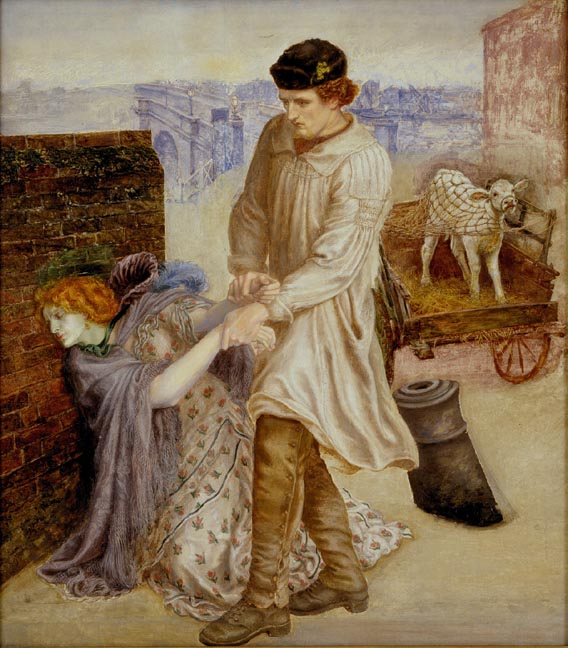
The picture is "Found" by Dante Gabriel Rossetti - a man finds out his childhood friend is now a prostitute, and she is ashamed.
In shame I was born,
in shame cast aside,
unwanted, unloved,
thrown out to die.
I was hopeless till you came,
I was helpless, I was nothing -
yet you saw past my shame
and lifted me.
You lifted me up,
up, up into glory,
a place of honour by your side.
You showered me with blessings,
you covered me with gifts,
you swore me your love:
you were mine, I was yours.
Ashes turned to beauty,
the waif became a queen -
but I forgot
what I had been.
Honour turned to pride,
beauty to a curse.
I abused your gifts,
I threw you aside.
Eagerly, hungrily I sold myself,
gave others what belonged to you,
turned honour in for shame.
I was falling,
falling down -
down, down without seeing
what I was doing to myself.
You made me look in the mirror,
you made me see my disgrace,
let me face the consequences
of my unfaithfulness.
Without you, I have nothing,
all my beauty falls away,
all the blessings turn to ashes,
all my glory becomes shame.
Without you, I am nothing -
a veneer of honour,
chewed up from inside,
a black hole of misery -
that is what's left of me.
In honour let me die,
head held high,
knowing it is right
to bear this punishment -
go on, I will take it;
let justice be done,
let me swallow the bitter dregs
I poured for myself.
But
my last vestige of pride
you banish to the wind
by lifting up my head
and saying I am free.
In shame I lie before you,
broken,
for I cannot comprehend
this painful grace.
Why do you stay faithful
when faithless I have been?
Why lift me back to honour,
forgiving me?
I see now
the glory is not mine.
I see now
all I have is yours.
I see now
my honour is you,
and being with you
the only way to keep it.
I am ashes at your feet -
but in your hands, I'm beautiful.
So take me in your hands,
mold me into something new -
make this unclean vessel pure
not to my glory
but to yours.
___________________________________________________________________
[March 2014]
This poem is about the "faithless bride Jerusalem" from a parable in Ez 16. After writing a paper on shame / honour cultures and the Bible last year, I still have the honour / shame topic in my head, and it hit me again when reading Ez 16, especially the last bit. The story paints a journey from shame (as an abandoned child left to die) to honour (being adopted and married by God) to shame (priding herself in her beauty, committing adultery and worshipping idols) where punishment reveals the shamefulness of her sinful actions. Jerusalem is even depicted as worse than Sodom (more shame). But then comes the turning point: new honour, a new covenant. And what does the bride feel at being forgiven and lifted back to honour? She feels shame:
And I will establish My covenant with you. Then you shall know that I am the Lord, that you may remember and be ashamed, and never open your mouth anymore because of your shame, when I provide you an atonement for all you have done, says the Lord God. (Ez 16:62-63)
I considered this: there's something honourable about accepting punishment (stanza 7) and something degrading about being forgiven. In a Chinese TV series I watched once, some of the characters kept insisting on being punished. They actually cried out, "Punish me!" Because they wanted justice to be done and they saw that as honourable. Choosing to suffer punishment is something you can do for yourself. Being reprieved makes you dependent. It makes you have to face what was wrong, and repent; you can't stick your head high anymore, you are not in charge. That's how I'd explain the bride's shame at this point. But it's also the shame of realising she has no honour of her own, but all her honour comes from God and is found in Him alone. She ran away thinking she could do on her own; now she has to realise that all she has comes from God and His great mercy and grace. In herself, there's only shame - in God is honour.
If you find the whole honour / shame topic interesting, you should check out this article about a theology based on shame / honour (particularly relating to Chinese culture).
The picture is "Found" by Dante Gabriel Rossetti - a man finds out his childhood friend is now a prostitute, and she is ashamed.
24 February 2014
Delilah: The Secret of your Weakness
Judges 16
Did they not warn you,
o Man,
that woman is dangerous?
Did they not tell you
she would lure you into her web,
wrap you round her little finger,
conquer you to be her slave?
Did they not warn you,
o Man?
But you thought yourself strong,
and thought womankind weak.
You thought you conquered me,
thought you possessed my heart,
thought I was yours,
trembling in your hand.
Did they not warn you,
o Man?
Tell me, o Man,
the secret of your strength,
and I will tell you
the secret of my weakness.
Tell me, o Man -
let it slip
like honey from your lips,
like the kisses you give
unsparingly -
they prove nothing,
they cannot prove your love.
Tell me, o Man,
if you truly love me,
the secret of your strength.
Did they not warn you,
o Man?
You thought yourself strong -
but you are weak.
You thought me weak -
but I am strong.
You thought you had me captured,
but I had captured you,
ensnared you in my web,
wrapped around my little finger.
You thought my heart
was trembling in your hand -
now you are trembling under mine,
stripped of your power.
O Man,
did they not warn you?
This is the secret
of your weakness:
that you forgot
the secret of your strength.
__________________________________________________________________________
[January 2013]
Don't overestimate yourself.
Don't underestimate women.
And be careful of anyone saying "you don't love me if you don't do (...)". It's what finally made Samson snap and tell Delilah his secret.
Though I think Samson's biggest mistake was that he overestimated himself and forgot that God gave him his strength, and that it didn't just grow on him with his hair. Growing his hair was a sign of belonging to God - by giving himself to Delilah he actually left that calling already, in a way.
The very last bit used to be "you forgot / the secret of my strength" - I changed it today (24. Feb 2014) because I think Samson was not only underestimating Delilah, but not estimating with God.
I must confess I had fun writing this. ;-)
Did they not warn you,
o Man,
that woman is dangerous?
Did they not tell you
she would lure you into her web,
wrap you round her little finger,
conquer you to be her slave?
Did they not warn you,
o Man?
But you thought yourself strong,
and thought womankind weak.
You thought you conquered me,
thought you possessed my heart,
thought I was yours,
trembling in your hand.
Did they not warn you,
o Man?
Tell me, o Man,
the secret of your strength,
and I will tell you
the secret of my weakness.
Tell me, o Man -
let it slip
like honey from your lips,
like the kisses you give
unsparingly -
they prove nothing,
they cannot prove your love.
Tell me, o Man,
if you truly love me,
the secret of your strength.
Did they not warn you,
o Man?
You thought yourself strong -
but you are weak.
You thought me weak -
but I am strong.
You thought you had me captured,
but I had captured you,
ensnared you in my web,
wrapped around my little finger.
You thought my heart
was trembling in your hand -
now you are trembling under mine,
stripped of your power.
O Man,
did they not warn you?
This is the secret
of your weakness:
that you forgot
the secret of your strength.
__________________________________________________________________________
[January 2013]
Don't overestimate yourself.
Don't underestimate women.
And be careful of anyone saying "you don't love me if you don't do (...)". It's what finally made Samson snap and tell Delilah his secret.
Though I think Samson's biggest mistake was that he overestimated himself and forgot that God gave him his strength, and that it didn't just grow on him with his hair. Growing his hair was a sign of belonging to God - by giving himself to Delilah he actually left that calling already, in a way.
The very last bit used to be "you forgot / the secret of my strength" - I changed it today (24. Feb 2014) because I think Samson was not only underestimating Delilah, but not estimating with God.
I must confess I had fun writing this. ;-)
23 October 2013
Potiphar's Wife: Seduction
Genesis 39
It is a strange feeling,
this power over men
- and I'm drunk with it.
I love it
how a single look
a single touch
a single word
can set them crawling at my feet
like worms.
I love it
being irresistible
dangerous
seductive,
turning them into grovelling dogs,
puppets.
It is a strange feeling,
this power over men
- and I'm drunk with it.
But what happens
when one says NO,
won't take the bait,
and runs away?
When my power fails,
abandons me?
Then I'm just a girl,
desperate for attention,
yearning for true love,
weak behind my mighty mask,
hiding my fears
beneath the blankets.
Lost,
so lost,
and so alone.
NO.
I will hide it,
put my mask on again,
make myself drunk with power,
and
lie.
____________________________________________________________
[December 2011]
Some time ago I realised for the first time how powerful we women can be - and how good that can feel! It's pretty dangerous. And I can imagine it can be a way we try to hide from ourselves our problems and weaknesses.
I think what we need to see first is that it's not the right solution. If I have self-esteem issues, or really need attention, then hiding it by temporarily feeling a bit powerful is not going to help. Problems are overcome when we face them, when we admit them, when we bring them before Jesus who can heal them. Because His love is real and permanent.
Another thing I think we need to see is that women who "sleep around" and look for men's attention all the time are not "evil", but people with needs which maybe they're trying to fill the wrong way. We should remember this before judging, and instead of putting them down as "bad people" give them the love they're looking for in the wrong places.
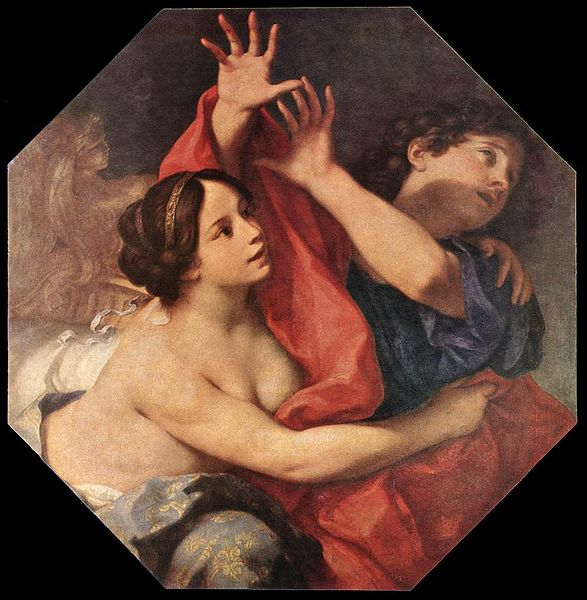
Picture by Carlo Cignani.
It is a strange feeling,
this power over men
- and I'm drunk with it.
I love it
how a single look
a single touch
a single word
can set them crawling at my feet
like worms.
I love it
being irresistible
dangerous
seductive,
turning them into grovelling dogs,
puppets.
It is a strange feeling,
this power over men
- and I'm drunk with it.
But what happens
when one says NO,
won't take the bait,
and runs away?
When my power fails,
abandons me?
Then I'm just a girl,
desperate for attention,
yearning for true love,
weak behind my mighty mask,
hiding my fears
beneath the blankets.
Lost,
so lost,
and so alone.
NO.
I will hide it,
put my mask on again,
make myself drunk with power,
and
lie.
____________________________________________________________
[December 2011]
Some time ago I realised for the first time how powerful we women can be - and how good that can feel! It's pretty dangerous. And I can imagine it can be a way we try to hide from ourselves our problems and weaknesses.
I think what we need to see first is that it's not the right solution. If I have self-esteem issues, or really need attention, then hiding it by temporarily feeling a bit powerful is not going to help. Problems are overcome when we face them, when we admit them, when we bring them before Jesus who can heal them. Because His love is real and permanent.
Another thing I think we need to see is that women who "sleep around" and look for men's attention all the time are not "evil", but people with needs which maybe they're trying to fill the wrong way. We should remember this before judging, and instead of putting them down as "bad people" give them the love they're looking for in the wrong places.
Picture by Carlo Cignani.
Subscribe to:
Posts (Atom)

.jpg)