Showing posts with label infertility. Show all posts

15 December 2019

Rachel: Give me Children or I Die


When Rachel saw that she bore Jacob no children,
she envied her sister; and she said to Jacob,
“Give me children, or I shall die!” (Genesis 30:1)

Give me children or I die -
die of yearning
after waiting all this time.
All my life
it was all I ever wanted,
taken for granted -
I never thought
it would be this hard,
never dreamed I might become
one of Those
whose arms stay empty
all their lives.

Give me children or I die -
die of envy,
surrounded by others,
my maid, my sister,
who become pregnant
if you but cough at them.
Why not I?
Don't I deserve
something good as well?
Why does she have four,
and I not even one?
Is that fair?

Give me children or I die -
die of frustration
at the remarks and the comments,
the stupid questions,
the useless suggestions,
unwanted advice.
"Your clock is ticking."
Believe me, I know.
"You gained weight -
could you be -" NO.
Don't people see
how much it's hurting me?

Give me children or I die -
die alone and destitute,
some day,
as yet far away,
but that day will come.
That day without a husband
and no son to support me,
no value to society,
just the poor barren woman
with no family to care.
If you loved me
wouldn't you provide?

Give me children or I die.
Yes, I wish it was in our control.
I wish I could blame,
I wish I could explain,
I wish there were
some four-step recipe,
one-size-fits-all solution.
I wish it really were
in your power
and cajoling you enough
could grant me my wish.
Instead, I go on,
month after month,
repeating my cry:
Give me children
or I die.

_____________________________________________________________________

[14. December 2019]

I have always found this proclamation of Rachel's intriguing. Even though I've written a poem for her already (here), I decided to write another one. :-)

Rachel desperately wanted children. She ended up having two (Joseph and Benjamin), but it was a long struggle getting there - and ironically, she ended up dying in childbirth. There are many reasons to want a child so desperately. In ancient times, children played an important social role, kind of like an "insurance" for old age. Childless women were at risk of ending up alone and poor if they were widowed.

I used to think the whole "childbearing contest" and Rachel's tantrum ("I shall die") were rather childish. In the meantime, though, I have come to know people who struggled similarly. We all need more compassion for people who have experiences different from our own. The Bible is one place where we can start, by reading about people who are different from us. I think sometimes we all too easily read the Bible with a "judging" eye already, trying to figure out which are the examples we're supposed to copy and which are those we should avoid. But the people we read about in the Bible are first and foremost people - and I think all of them have a bit of both in them, like all of us too. It helps me feel less alone when I find stories I can relate to. But I think it can also teach us compassion when we read stories we can't really relate to. That's part of why I write these poems. What happens when we try to put ourselves into these women's shoes just for a moment, and imagine what they feel, what they might want to tell us?


Art: William Adolphe Bouguereau

01 August 2018

Pharaoh's Daughter: Just Like Me


Exodus 2:1-10

Foreigners.
Outsiders.
With your strange religion,
your alien ways.
Taking our jobs,
threatening our culture,
hostile,
dangerous,
lazy ingrates.
Who knows what you're planning?
Who knows when you'll be more than us?
Who knows what you'll do?
What then?

Stereotypes
are like horoscopes:
broad enough to sound so true,
convincing enough
that you can't smell the lies.

But
I see you mourn your children.
You're just like me.

Stereotypes
are like horoscopes.
So easy to hate all of you,
for the actions of a few,
so easy to let fear
distort your features,
till you're no longer people
but monsters to be culled.

But
I see you mourn your children.
You're just like me.
Because
I've mourned my children too.

I know what it's like
when joy is replaced with emptiness.
I know what it's like
to have your hopes and dreams
smashed to smithereens
with your aching mother's heart.
I know what it's like
when your breasts weep milk
for a child no longer there.

I see you mourn your children.
You're just like me.

So you see,
I can't hate you,
can't watch them cull you like animals,
because you're not.
You're just like me.
I can't watch
as another child dies,
as another mother is left bereft,
because you're just like me.

We don't have to mourn this child.
You and I can both be mothers.
I can save us three.


______________________________________________________________________

[1. August 2018]

Some of what flowed into this:
  • Visiting my third home South Africa and experiencing the disconnect that still often remains between the races.
  • All the stuff here in Europe about refugees being turned away, deported, or talk about sinking boats on the Mediterranean to discourage more migrants from trying to cross over. The rhetoric is appalling.
  • Watching "Schindler's List" with my Ouma and seeing how horrible human beings can be (and they haven't changed one bit).
  • Islamophobic rhetoric which I often hear here in Switzerland (a lot of it from "Christian" circles which is sickening).
  • Reading a bit too many novels involving infertility / miscarriage / etc.
 Anyway I decided to look at Pharaoh's daughter from the angle of "What if she was desperate to have a baby but kept having miscarriages, and finding Moses for her was like an answer to that longing for a child?" Of course the Bible tells us hardly anything about her background; we only know she is Pharaoh's daughter, we don't know whether she has other children ("The Prince of Egypt" gives her a son), we don't know what moved her to adopt Moses except simply that she had pity for him (Ex 2:6). I played with the "what if" here. Thinking of how finding small connections to the people we're supposed to distrust or hate can open the door to compassion, break down stereotypes and remind us of their humanity.

There are so many stereotypes that you hear day by day. I included some common ones about immigrants in this poem. They sound correct enough that they're easy to believe. Stereotypes are often based on some aspect of truth which makes them so convincing. But they can make us forget the others' humanity, can blind us to the complexities of other people. It's all too easy to commit horrors against other human beings (see the Holocaust... the Nazis were normal people, not monsters) - and even to think it's okay or to think we're doing a good thing! (The people who killed Jesus thought they were doing God a service..)

We need to look beyond the stereotypes, generalisations and caricatures to the humanity of the people we're afraid of or being taught to distrust. In South Africa I heard a lot of things about all sorts of people but I saw all of them hanging out their laundry - and that to me was such a powerful reminder of how in the end, we are all human, with the same day-to-day hopes and fears. We need to stop generalising about each other and dehumanising each other, and start noticing the sufferings we have in common (e.g. child loss as I wrote about here) or the small details of life (like hanging laundry).

Pharaoh's daughter stepped beyond the stereotypes of her day and crossed a boundary by saving the life of a Hebrew child who her own father had commanded to be killed. She took a step towards dialogue by making the arrangement with Moses' mother that she should nurse him till he was weaned, and then let Pharaoh's daughter adopt him. What are the ways we can dare to dialogue with the people who are different from us?

Picture by Lawrence Alma Tadema.

31 December 2015

Shunammite Woman: Hoping against Hope


2. Kings 4:8-37

I.
A hole in my womb,
desperate to be filled.
A gap in my heart,
longing to be complete.
A space in my arms,
waiting to hold
a child of my own.

A dream unfulfilled,
turning into a nightmare,
as month after month
my hopes are dashed,
as year after year
my womb remains empty
and my wish retreats
into resignation.

So don't give me false hopes now,
Man of God,
for my faith has been stretched
beyond belief
and I couldn't take
another disappointment.


II.
A quickening in my womb -
the answer to my prayers!
Love in my heart
ready to be shared.
Complete at last,
for lying in my arms:
a child of my own.


III.
An ache in my womb:
childless again.
A stab in my heart
as it tears apart,
as in my trembling arms
he breathes his last:
the child of my own.

Is this the price
for becoming a mother:
to receive this precious gift,
then watch it slip away?
to be granted a miracle,
but only for a while?
to hold my own son,
only to watch him die?

So don't give me false hopes now,
Man of God,
for my faith has been stretched
beyond belief,
and I couldn't take
another disappointment.

And yet
you are the only one
I would still turn to now,
hoping against hope
that the hope you give me
is not false.


IV.
You gave me no false hopes,
Man of God:
Now my faith has been stretched
beyond belief,
as I have seen
miracle after miracle,
received gift after gift,
and in my arms lies again
this child of my own,
returned to me once more.


___________________________________________________

[31. December 2015]

The Shunammite woman was a rich woman who supported Elisha's ministry. Wanting to reward her, Elisha offered to give her what she wished for - she did not tell him directly, rather Elisha's servant Gehazi told Elisha that she wished for a son. I find her answer quite intriguing: "No, my lord, O man of God; do not deceive your servant." (2. Kings 4:16) I based the "don't give me false hopes" bit on that. The first section (I.) is about her barrenness and longing for a child.

The second section (II.) is about how the Shunammite woman's wish was fulfilled, and she had a son. However, one day the boy fell sick or something (he went around crying "My head, my head!", so probably had some pain in his head) and died in her arms (v. 18-21) (III.). His mother went to Elisha - and insisted that he help her, and no one else (though interestingly enough she didn't directly ask for help, but just alluded to something being wrong with her child). I find it interesting how in this story and in the story of Naaman, Elisha does not show very much interest in getting personally involved (he sends his servant instead). But on the woman's insistence, he goes himself. The child comes back to life - actually the second miracle this mother has experienced (IV.).

First she received a child against all hope - then she lost him, and received him a second time against all hope! Quite an experience!
I wanted to combine here the themes of longing for a child, faith when it's hard to believe, the woman's doubts ("do not deceive your servant" / "don't give me false hopes"), loss of a child, and how the woman experienced two miracles - receiving, losing, and receiving again.

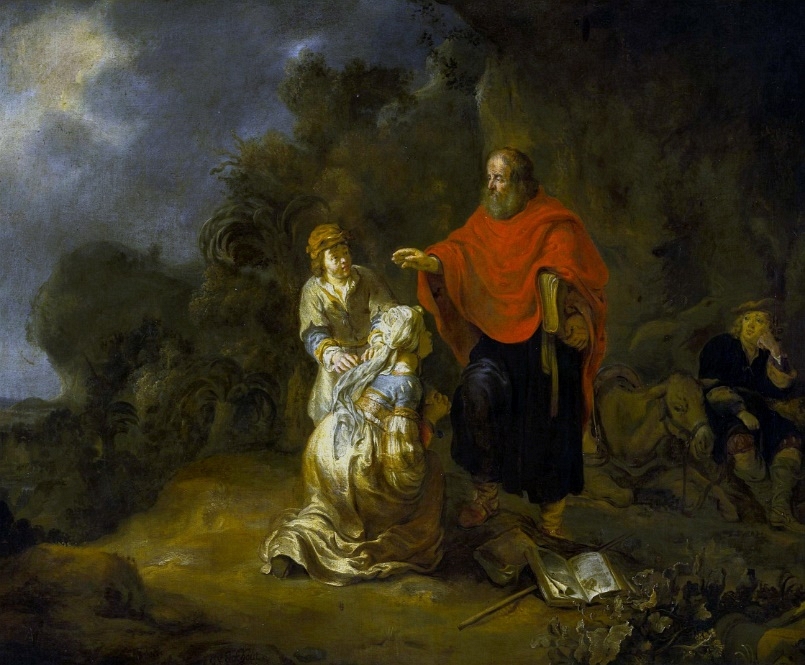
Picture by Gerbrand van den Eeckhout - the scene where the woman goes to Elisha and insists on him coming to help.

27 November 2014

Hannah: The Other Woman


1 Samuel 1:1-2:11

Forgive these tears -
I can't stop them anymore.
My sadness is an ocean
so deep I cannot eat,
so deep I cannot sleep.

Awake at night I hear them
sometimes, in the room next door -
him and her -
the other woman.
It had to be, he said.
And I understand.
But that doesn't help.
You'll always be my first love, he says.
And I believe him.
But that doesn't help either.
For my problem is not jealousy -
my problem is me.

Who is the other woman?
She, or me?
Who of us fulfills her purpose
as woman and as wife?
Who has done her duty -
and who has had to be replaced?
Are her tauntings true?
Sometimes I think they are
and I cry and I cry
and I can't tell him why
because he wouldn't understand.

Am I not more than sons? he says.
Of course he is -
but that doesn't help.
I love you even so, he says.
I know -
but that doesn't help either.
For nothing can help me -
nothing
but YOU.

Lord, you are the island
in my stormy ocean,
the rock I can hold on to,
the only hope for me.
You lift up the weak,
you feed the hungry,
you turn the barren woman
into a mother.
Your power can turn
the world upside-down.

Turn my world upside-down.
Change this sadness into joy,
and my begging into thanks.
Fill my empty rooms
with children's laughter
and give my life purpose again.
But not for me -
no, for your glory,
that your power can be seen
on a small, weak thing like me.
And I will give you all I have,
my greatest treasure,
my most valued gift:
the child
that you are giving me.

________________________________________________________

[January 2012]

I was trying to imagine what it might feel like for Hannah to be one of two wives - especially because she was the one who couldn't have children. In those days, a central part of a woman's life was bearing children. There's still cultures where women mainly exist as "baby machines" (extremely said). I can imagine that Elkanah married Peninnah because Hannah couldn't have children, and sort of "added" her so that he'd have heirs. Anyway, those were my background thoughts to this poem. ^^

I based a lot around Hannah's prayer in 1 Sam 2 - which is very similar to the Magnificat (Mary's prayer) in the Gospel of Luke: God turns the world around, He does things differently from our expectations, He is not like us. To the world, Hannah was a failure: a woman who couldn't fulfill her purpose in life, namely that of bringing children into the world. But God loved her - and He loves all of us too, even if the world does not accept us. God loves broken people - and He can make them whole.

15 September 2014

Sarai: Jealousy

WARNING: sexual content


Genesis 16:1-6

By now
she will be in his arms.
I dare not think it,
but I do.
I wonder,
will she be as scared
as I was the first time?
I wonder,
will he whisper
the same sweet words into her ear,
that he likes to say to me?
I dare not think it,
but I do.

Tempted, so tempted,
to sit outside his tent
and listen
to every rustle of the sheets,
to every moan from her lips -
I dare not think it,
but I do.

No, no, no.
It should be me,
and me alone.
What if he falls
for this younger girl,
for her beauty,
for the energy
I no longer have?
I dare not think it,
but I do.

This was my choice,
done for his sake,
done out of love,
the last desperate measure
to grasp at a promise
far out of reach.
This was my choice,
but was it right?
I dare not think it,
but I do.

Tempted, so tempted,
to storm right in
and drag her off his body,
far away from him.
But if this is
the only way
to make him happy -
so be it.

_____________________________________________________________________

[10. October 2013]

While reading through Sarah's story again, and trying to imagine things through her eyes, I felt like writing this: her thoughts about giving Hagar to Abraham, so Hagar could have the son promised him by God.

Why did Sarai do this? Did she lack trust in God? Was she trying to "help things along" a bit? Maybe she felt she was getting in the way of God's promise and Abraham's happiness because she was unable to have children. So she decided to let Abraham sleep with her slave and have a child with her - a decision which probably wasn't so easy, and one which led to all sorts of conflict in the family, Hagar being banished twice because of Sarai's jealousy. If Sarai had trusted and waited, maybe things would have been different. Still, God remains faithful, and He did let Sarai have a son in the end. Our mistakes have consequences, like Sarah's did... but still they don't get in the way of God.

(Next challenge: write the same thing from Hagar's perspective... I don't suppose she was too keen to be given away like that to an old man)

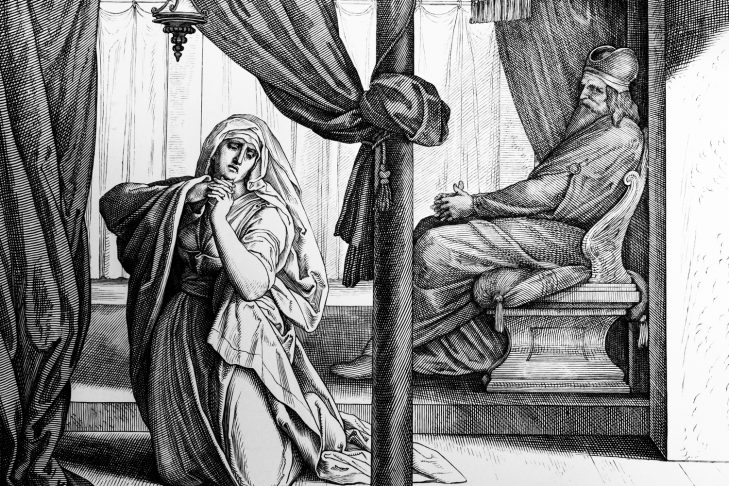
Picture by Matthias Stom.
I find interesting how Sarai has an almost empty look in this picture, like she's trying not to think too much about what it is she's doing. 

13 March 2014

Samson's Mother: Where Are You, God?


Judges 13

Where are you, God?
The world seems void of you.
The time you lived in our midst
is gone like a dream;
you seem so far away.
Holy places feel empty;
your silence echoes there,
and the ominous question:
do you even care?

Each does as he pleases
and chaos is king,
your people oppressed -
forsaken by you?
Other gods take your place,
gods of gold,
gods of pride -
we are locked in sin's cluthes.
Oh God, where are you?

Where are you, God,
in my little life?
In this world full of problems,
do you have time for mine?
Do you see my dreams of motherhood,
are you there to hear my prayers,
tear-stained whispers
in the silent night -
do you even care?

Where are you, God?
We seek and we wait.
Where are you, God?
Are we hoping in vain?
Few hear your voice -
are we deaf?
are you dumb?
Show us we're not forsaken.
Oh God, where are you?

Praise be to you, God,
for here you are!
You step out of the shadows -
you draw aside the veil -
you break your silence -
you show that you care:
for your people
and for me.
You give me a son -
you give us new hope -
you give us a sign:
you have always been here.

______________________________________________________________________

[28. February / 11. March 2014]

Did you know that Samson was also one of those children born to a barren mother? Samson's mother could not have children - then one day an angel appeared and told her she would have a son. I could have written about the rather interesting exchange between her and the angel, then her husband and the angel, but I ended up focusing a bit more on what I think is the general feeling in much of the book of the Judges. More than once, this kind of comment appears in Judges: "In those days there was no king in Israel; all the people did what was right in their own eyes." (Judges 17:6, 21:25) Israel had their land, but it was in a mess, there were attacks from all sides, people were not faithful to God but did terrible things (as e.g. the story of the Levite's Concubine shows), picked up bad customs from the other peoples around them, etc. And sometimes God must have seemed far away, also to those who were faithful to Him and saw everything going crazy around them. "The word of the Lord was rare in those days; visions were not widespread." (1 Sam 3:1)

What also influenced this poem was watching Prince Caspian recently. The movie (more strongly than the book) shows a situation of confusion where Aslan seems absent, and the question is: "Do we act without him, or wait?" Acting without Aslan leads to disaster. But waiting and wondering where he is and why he doesn't show up and what he wants to be done, while everywhere around people are doubting, pushing, criticising, giving alternative solutions... that is hard too. And that somehow reminded me of the situation in the book of Judges.

Just because God sometimes seems distant, with things going wrong and us not feeling His presence, does not mean He is distant. He is always here, even if we don't see Him, don't feel Him, don't hear Him. Sometimes we just need to be ready to look, to listen, and to wait for Him. Sometimes we need to look at our lives, and ask ourselves whether it isn't our actions and our way of living that creates distance between ourselves and God (by hurting others, by taking idols i.e. putting other things above God, etc). And sometimes we just need the faith that God cares, and God is here, even when He seems invisible.

Picture by Rembrandt.

10 March 2014

Naomi: Bitter

Ruth 1 | Isaiah 54

Call me no longer Naomi, call me Mara, for the Almighty has dealt bitterly with me. I went away full, but the Lord has brought me back empty; why call me Naomi when the Lord has dealt harshly with me, and the Almighty has brought calamity upon me? (Ruth 1:20-21)

Call me Bitter.
Bitter is the cup
the Lord gave me to drink,
and I drank it
down, down,
down to its shuddering dregs.

Call me Bitter,
no longer pleasant and sweet,
for all my worth
is stripped away,
and I am nothing now:
childless and barren,
widowed and poor.
Bitter and bitterer
the dregs of my days.

If a woman's worth
lies in having a man,
somebody to love her;
if fulfillment can be found
only in his arms,
then what am I?

If a woman's worth
lies in having children
and bringing up sons,
if she can be complete
only as a mother,
then what am I?

In a world
where the worth of a woman
is measured by her men
- father, husband, sons -
there is no place
for me.
Call me Bitter.

And yet
o Lord
YOU are my Saviour
and you have seen my need.
And I can hear you whisper
my worth is elsewhere:
not in circumstances,
not in wealth and not in man,
not in husbands, nor in sons,
not in love, or duty fulfilled.

YOU, o Lord, are my worth.
You, o Lord, are my fulfillment.
In you, o Lord, I have husband and sons,
you are my riches and finery,
you make me sweet and pleasant again,
for you alone can satisfy.

_____________________________________________________________________

[September 2013]

Naomi = "pleasant"
Mara = "bitter"

Actually I wrote this coming from Isaiah 54. Isaiah 54 hit me as a text which is all about "women's problems", actually: barrenness, widowhood, etc. It's actually talking about Jerusalem personified as a woman, but reading it I felt it can also speak to women who feel disgraced because of their circumstances - women like Naomi.

I think often we seek our worth in outside things: having a boyfriend or getting married, getting good grades, etc. In Naomi's days, being married and having children was what brought good status, as well as security. Nowadays a woman's worth is no longer as dependent on men as it used to be - but still I get the feeling that many of us (encouraged by the media) think we need a boyfriend, or need to be beautiful, or need to be successful and make a career, to be worth anything. What if you can't? What if something gets in the way and your plans are dashed, like Naomi's were?

We need our priorities straight. Of course, there's nothing wrong with depending on other people, or getting a confidence boost when it turns out a guy likes you. But I think we need to remember that our worth, our value as a person, does not depend on our circumstances or attainments - our worth comes from God who created us in His image. It's a worth that does not go away.

Picture by Thomas Matthews Rooke

01 December 2013

Elisabeth: Barren as a Desert


Luke 1:5-25

I'd come to terms with it.
No longer cried about it,
though I still felt the pain.
Nor did we talk about it,
though we still felt a pang
every time we saw them:
pregnant women, babies, children.
I'd come to terms with it,
but it still hurt.

It hurt to wonder:
WHY?
It hurt to hear my friends
gossipping behind my back,
questioning why someone
who lives by faith
and walks with God
can go without blessing,
barren
as a desert.

I'd come to terms with it.
We no longer even tried.
We hardly even prayed -
it was too late anyway.
I'd come to terms with it -
I had no other choice.
I trusted you knew
what you were doing,
though I could not understand.

How much greater the wonder,
how much greater the joy,
to see you turn this barren desert
into blossoming spring!
You have answered the prayers
I forgot that I said,
and in such a way
as I'd never imagined.
In me grows
the fulfillment of promise,
the beginning
of more wonders to come.

A voice cries out in the wilderness:
Prepare the way of the Lord!
He turns a desert into pools of water,
a parched land into springs of water.


_______________________________________________________________________

[December 2011]

Verses quoted at the end are Isaiah 40:3 and and Psalm 107:35. Isaiah 35:1 and 51:3 would also have done very nicely here. Actually the whole desert image comes pretty often in Isaiah, and it's what I suddenly had to think about while writing this. :)

Written while I was supposed to be listening to a lecture on Bultmann (well, I half listened...)

Note: the first two stanzas are hinting at the common belief back then that if someone lives a godly life, it shows itself in blessing; i.e. people expected God to answer a good person's prayers, and bless that person.

Picture by Louis Jean François Lagrenée

03 October 2013

Sarah: He Who Laughs Last

Genesis 18:1-15

I laughed:
What a ridiculous notion!
Me: a mother?
At my age?
Yeah right.
We've been waiting for years,
and always: nothing.
You said and you promised,
but always: nothing.
Believe you now?
Not gonna happen.

We laughed:
What a wonderful moment!
Me: a mother!
At my age!
And yet -
after waiting for years,
and always: nothing,
I laughed at your promise,
and now, there's something!
Now this has wiped
the grin off my face...

I guess
you're laughing now
at this gobsmacked woman -
me - who laughed
at you.
You left us waiting for years,
and we saw nothing,
but you've done as you promised,
because nothing
is impossible for you.
And now, I am sure
you're laughing much louder
than I did before.

__________________________________________________________

[October 2011]

Here's one thing you find out if you learn Hebrew: Isaac is, in Hebrew, Yizchak, which means: "He laughed." But who was laughing here? It was Sarah, wasn't it? So my Hebrew prof likes to say that Isaak should have been called Tizchak ("she laughed").

But maybe not only Sarah laughed. Writing this poem I had to think of the saying, "He who laughs last laughs loudest."

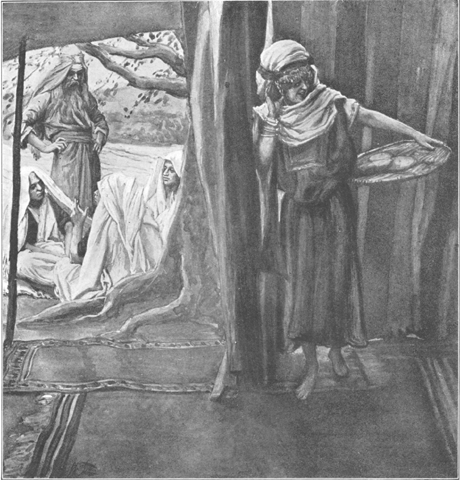
Picture by James Tissot.