30 May 2014

Joanna: Finished


Luke 23:50-24:10

It is finished
- over,
our hopes as broken as your body.
There's nothing you can give me now.
Your healing hands are pierced and torn,
your loving heart - cold.

There's nothing you can give me now,
no benefit in staying here -
but here I am
by your side
not taking anymore,
but giving
a last gift to you.

It is finished
- over,
or
 complete?
We wrap you in linen -
one last look at your face.
We roll the stone before your grave -
finished?

The seed has fallen
into the ground.
Will it awake
to bring forth fruit?
Lord, is it finished -
or has it just begun? 

____________________________________________________________________

[30. May 2014]

Actually this is long overdue; I was going to post this on the Saturday just before Easter, but was really busy and not happy with the first draft, so now more than a month later here it is... I suppose other things I've written go a bit deeper but I dunno. Was focusing on the double meaning of "finished": over, or complete. "Over" would mean it's the end, there's nothing more, this is where it stops. "Complete" means fulfillment, that something has been done. To many of Jesus' disciples, seeing Him die must have made them feel all was over. But when Jesus said it is finished, He meant complete: He had fulfilled what He came to do. It was not the end though.

The "setting" of this poem, or the scene in the background, is supposed to be the burial (because Joanna was probably one of those present). Might be visible in the third stanza.

Maybe the second stanza is a bit of a "mistake" in the sense that it makes a point which does not appear in the rest of the poem... so maybe I should either have left it out or elaborated the thought somewhere. But I'd find it a pity to cut it and I don't know how to elaborate so I'll just leave it for now. The thought there is that at Jesus' grave, we have a powerless Jesus. Those who stayed with Him there knew that they could not "get" anything out of Him, because He was dead. What do we stay with Jesus for - the things we get from Him? Or His own sake? I believe that we should not just believe in Jesus and follow Him because He promises us eternal life, or because we might get good things and blessings from Him, but believe in Him just because of who He is. Because even if He does not give us what we want or expect, e.g. if He leaves some prayers unanswered, that does not change anything about who He is, or change the fact that He is worthy of glory just because of who He is.

Last part is a reference to John 12:24 - "Very truly, I tell you, unless a grain of wheat falls into the earth and dies, it remains just a single grain; but if it dies, it bears much fruit."

Because this is a "passion" poem for Holy Saturday, it only hints at Easter, doesn't directly talk about the Resurrection yet. But for us it is certain: Jesus rose again~ So we already have the answer to Joanna's uncertainties.
But even after the Resurrection, when we have a powerful, living Jesus, not a dead and helpless one, I think we need to ask ourselves: do we stick with Jesus because of the benefits we expect to get, or do we stick with Him for His own sake? Do we believe in Him in order to get something out of Him, or do we submit to the true Lord just because He is the true Lord?


Picture by Caravaggio... my favourite depiction of this scene actually (so far).

21 May 2014

Maranatha

 Revelation 12

A cry
piercing through the night:
Maranatha!
Voices,
praying, calling, wailing:
Maranatha!

In anguish, with uncounted tongues,
the Earth screams out her labour cry;
a cacophony of sighs
clamouring unceasingly,
longing for the end,
the end,
the new beginning,
a moaning murmur of pain:
Maranatha!

Innocent blood
cries out from the ground
as nature laments
and weeps and waits
for the night to end,
for strife to cease,
for peace to come -
will it ever come?
Maranatha!

So much noise
from a little speck
somewhere in the universe.

Lord, come!
For hatred still reigns.
Lord, come!
For every day
your name is blasphemed
by those who think they serve you
by causing others pain.
Lord, come!
We are enchained
in sin and death
and cannot escape.

You who added your cry to ours,
you who made our pain your own,
you who suffer with the hurting,
you who died to save us all -
come,
come and change this world
that preaches hatred in your name;
come,
come and dry all tears
and let us find joy
in you.

________________________________________________________________________

(Technically not a "Bible women" poem because - despite the William Blake pic of Rev 12 up there - I was not thinking of a particular lady while writing it [except for the woman in labour, taken from some judgement texts but now I realise it doesn't fit too badly to the Rev 12 lady] but this made me want to post it here. And yes the original background and "point" of the poem is very different - as you'll see from the original commentary below - but when certain things happen in the world, I often think "Maranatha" so I suppose this isn't all that unfitting.)


[17. March 2014]

"Marana tha" = o Lord, come!
Though I just read that it could also mean "the Lord has come" - hm, I wonder what the double meaning does to the poem... (you tell me)

I just watched Agora and was pretty moved, and shocked at the un-Christian behaviour of certain "Christians". Whether the film is historically accurate can be debated, but it is a fact that there are many so-called Christians doing evil things in the name of God even now, retaliating with violence instead of answering evil with good, keeping grudges instead of forgiving, causing wars (in God's name - which I think is a worse abuse of God's name than saying "oh my God", by the way), and excusing harsh judgement with "standing up for truth". In the city where I live, famous reformers (Zwingli and Bullinger) had other Christians (anabaptists) drowned just because of doctrinal differences. In the Central African Republic, Christians are killing Muslims and one hardly even hears about it. And it is no excuse saying elsewhere Christians are being persecuted too. The Christian response to evil should always be love, non-retaliation, forgiveness, because that is Jesus' example: He even forgave those who nailed Him to the cross, which is more than some Christians have done (who e.g. used the fact that Jews contributed to Jesus' death as a reason for persecuting them - argumentation that ultimately led to the Holocaust).

This kind of thing does not make me lose faith in God, because I know God is different and what some "christians" are doing runs contrary to the Scriptures. But it does make me depressed about humanity. This world is full of evil. BUT that does not mean there is no hope. Jesus is coming again to make all things right - and that is why if the world makes us hopeless, we can turn with hope to His return, when all this hatred and pain and sin will be over. I believe this kind of hope is not a passive retreat from the world, hiding away from all the overwhelming evil and sorrow - Jesus taught us that waiting for His return means being prepared, being found doing that which He sent us to do. Which means following in His footsteps, being ambassadors of reconciliation (2 Cor 5).

Anyway those were the thoughts behind this poem...


- This was inspired in particular by one scene in Agora: Christians are killing Jews (in retaliation for a Jewish attack), and then everything zooms out and you see the Earth floating in space, and keep hearing the screams. And I thought: God hears this all the time. And not just from a distance, but right up close, because He hears right into our hearts even when we don't raise our voices. Imagine God having to hear all this screaming all the time.

- The "labour" image was inspired by some judgement texts in the prophets / Psalms where a city hit by God's judgement is compared to a woman in labour; also, Jesus compared the signs that come before His second coming with labour. Labour is pain but half-way positive, in that it works towards something, and there's hope at the end (child being born).

- The bit with nature weeping and longing too is from Romans 8: "We know that the whole creation has been groaning in labor pains until now; and not only the creation, but we ourselves, who have the first fruits of the Spirit, groan inwardly while we wait for adoption, the redemption of our bodies."

- I often "need" a last stanza that ties everything together with Christ, in particular the suffering Christ. I see Jesus on the cross as the one who suffers with us as well as for us, who knows our pain, who bore it Himself to the utter point of God-forsakenness. The strongest comfort, for me, is knowing that whatever pain we go through, Jesus knows it because He feels it too.


Jesus is coming soon and that is a good thing!
Christians, remember that "repent!" means you too.

18 April 2014

Mary Mother of James and Joses: Calvary

Mark 15:21-41


"Come down off the cross!
Save yourself!"
I hear them jeering from afar,
as I watch from a distance
in agony
how you suffer, forsaken by all.

They taunt and they jeer,
they gamble for your clothes;
no one shows pity,
no compassion anywhere.
Nails have pierced
your hands, your feet,
and blood runs down
your thorn-crowned brow.

If I could but cling
to that cruel cross,
and kiss those blood-stained feet,
and show you someone loves you still -
why am I too afraid?

Come down off the cross -
save yourself!
Why don't you?
I know that you can.
Why do you let them do this to you?
Why do you suffer, forsaken by all?

So many hopes,
so many dreams -
what of them now?
Weren't you the Messiah?
Weren't you the King?
Now you are helpless,
crying in pain,
broken, thristy,
dying.
What becomes of us
when you are gone?

"My God, my God,
why have you forsaken me?"
Jesus, Jesus,
why are you forsaking us?
Why now, when everything was just beginning?
Why do you let them do this to you?
Why do you suffer, forsaken by all?
Come down off the cross -
save us
because without you
what can we do?

A final cry -
you die
and all is lost.
The sky is dark,
the ground is shaking -
this is the end
of the world.

Or am I wrong
and this is the beginning,
and this is where life
and salvation spring?
Did you not promise
that death would not win?
Can I hope,
can I believe
that this is the start
of something new,

that if I cling
to that cruel cross
and quietly believe,
you show me that you loved the world
so much you would not save yourself
but died,
saving me?

____________________________________________________________________

[18. April 2014]

There were three Marys at the crucifixion... Mary Magdalene, Mary Jesus' mother, and this Mary. They were watching from a distance (according to Mark - John situates some people under the cross). I tried to write from their pre-Easter point of view, where they actually had Jesus' hints about resurrection but probably were still confused - though I also didn't want it to be only depressing and hopeless and "let's all give up now, we must have been wrong", but to have an outlook towards Easter...

Also was playing with the whole "saving" thing: people wanted Jesus to save Himself, but He didn't - because by staying on the cross, He saved us. Though before the resurrection, people didn't understand yet - that's why Mary for a while thinks by getting off the cross He'd save them because He wouldn't be dead but could go on being the Messiah the way they expected. But Jesus brought salvation in a different and unexpected way; His death was not the end but the beginning.

Hope you don't mind the irregular repeats - I like working with refrain-like stanzas, or "mirroring" (similar wording / structure but different words / direction of thought), but usually I just have one. Here there were two, the "come down off the cross" one and the "clinging to the cross" one. Seems to have worked, though....

Picture by Gebhard Fugel.

17 April 2014

Daughters of Jerusalem: Cry

Luke 23:27-31

I cry
for you -
for those scars on your back.
I cry
for you -
for the cross that you bear.
I cry
for you
and for what's soon to come.

I can't bear to look,
and yet I'm staring,
horrified,
as blood and sweat
pour down your face.
I cry and cry,
I cry for you.

I cry
for you -
they say you're innocent.
I cry
for you -
they said you'd save us all.
I cry
for you
and all those dashed hopes.

You pass - you stop.
You look at me,
pityingly,
as streaming tears
flow from my eyes.
Why do you cry?
Don't cry for me.
Cry for yourselves -
cry for your sins.

I cried
for you -
because of their cruelty.
But do I ever cry
when I'm cruel myself?
I cried
for you -
for the wrong they were doing.
But do I ever cry
for the wrongs that I've done?
Do I ever see
the wrong path that I'm walking
and cry
for the death I am bringing
on myself?

In your suffering,
in your pain,
you thought first of me.
As they lead you
to your death
you want life for me.
How can I comprehend
this crazy love
that turns a day of mourning
into the key to joy -
as you bleed and sweat
and cry and die
for me.

________________________________________________________________

[17. April 2014]

The "daughters of Jerusalem" are women who were crying as Jesus was led through the streets to Calvary. Jesus told them to cry about the impending judgement rather than cry for Him.

I tried to bring together two things. One was the fact that Jesus, even while He was suffering, thought not of Himself first, but of the people. This comes out especially in the last stanza. The other was something I read in a prayer by Michel Quoist on this text. Michel Quoist linked this scene to the verse on first taking the beam out of one's own eye before helping the other with a speck of dust (Lk 6) - i.e. it's easy to pity other people's sufferings and pass blame, and harder to see one's own sins.

I find it important, when we think of Jesus' suffering, that we don't just get angry at the Pharisees and Romans and all those people who called for Jesus' death. We might imagine ourselves being the ones who stick with Jesus and - like these women - cry for Him, side with Him, in His suffering. But He doesn't really want people to side with Him and feel sorry for His suffering: He wants us to realise that we are sinners like the rest, He wants us to repent. Not because we are so "bad", but because we are not better. We are not holier. We are no less needy. We need to recognise our need for reconciliation and salvation, our need for Jesus.

I am aware that nowadays some people find it hard to live with being called a "sinner"; it has such negative connotations and people have been pressurised and hurt with that word before. The way I see it, though, we all have a brokenness, we all have parts of ourselves that we realise are not right, there's things we are ashamed of. And the thing is we need to recognise it, bring it before God, and let Him heal it. He does not condemn. He goes to the cross. And on the way to the cross, He cares first for us with all our sin-load and shame, and His reminder to us on the way to the cross is: cry first for your sins. Recognise and admit what is broken in your life. Not in order to break down under it, but in order to finally let it go and let it be healed.

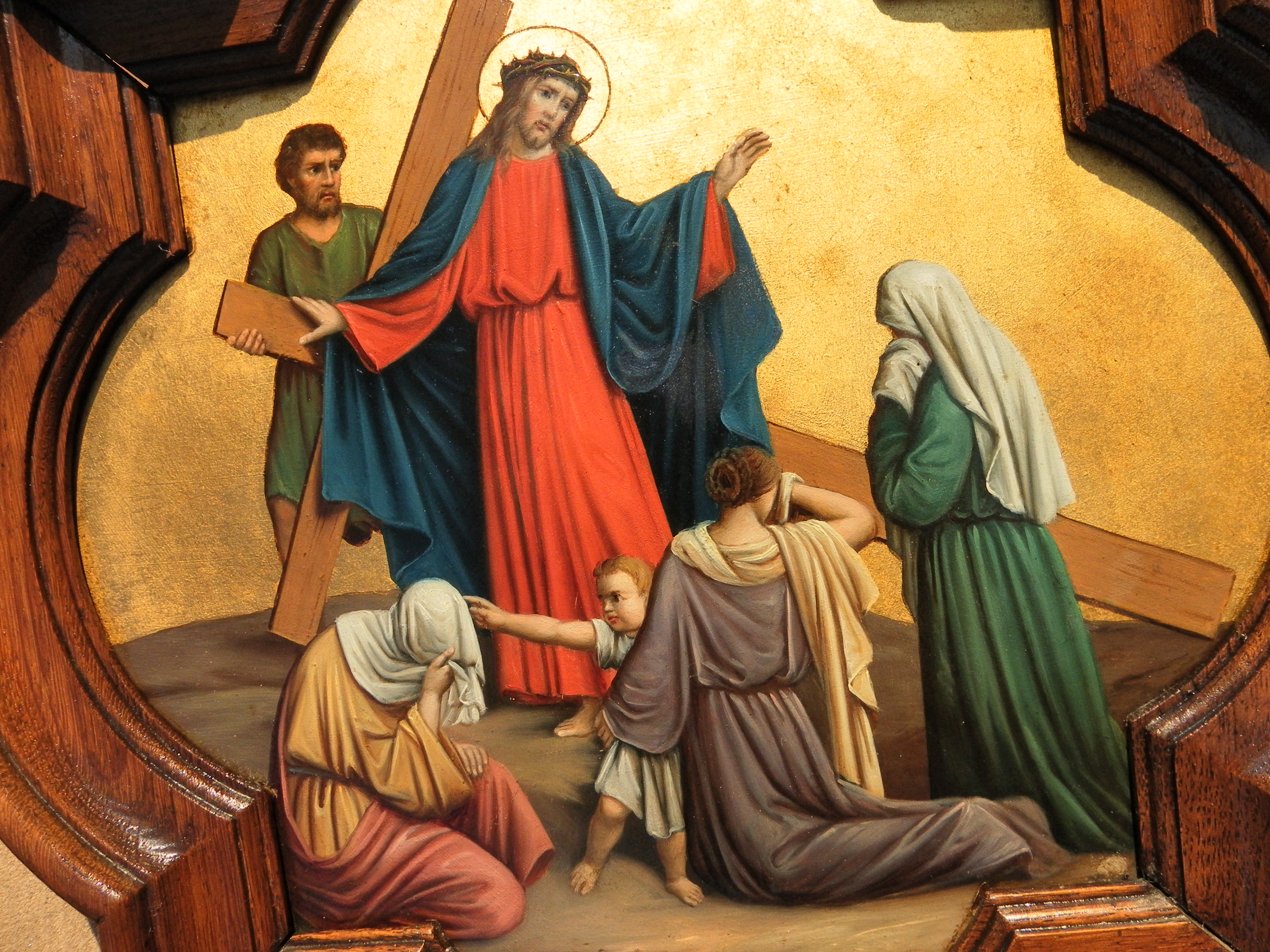
The "daughters of Jerusalem" also make up stage 8 of the "Via Crucis" or Way of the Cross.
Picture is from the church of St. John Nepomucen in Brenna (wherever that is o.O)

16 April 2014

Mrs Pilate: I Will Not Be Silent

Matthew 27:15-30

While Pilate was sitting on the judgment seat, his wife sent word to him, "Have nothing to do with that innocent man, for today I have suffered a great deal because of a dream about him." (Matthew 27:19)


I could say that wrong is right,
do injustice to have my way,
close my eyes and close my ears
to truth and justice.

I could join in the injustice,
just because all others do it,
shout along with all the crowd:
CRUCIFY HIM.

I could stand there doing nothing
in the face of open wrong,
wash my hands in innocence,
refuse responsibility.

What can I do?
I'm powerless.
The powerful
do nothing, or ill.
What can I do?
I'm only a woman.
What can I do?

I can speak up for what is right,
stand up for justice, for this righteous man.
I will speak, though it be pointless.
Silent is what I will not be.

___________________________________________________________________

[24. April 2013]

On reading Matthew 27:15-30, what I noticed were different people's reactions to the injustice that was happening: Jesus, an obviously innocent man, being sentenced to die. Everyone let the injustice happen - one person spoke up: a heathen woman. I think that's showing something. Yes, Jesus HAD to die, He came to die. But what happened there, all the injustice, was not okay and it's shocking how everyone just let it happen. It's shocking how in the world today injustices still happen, innocent people still suffer, and no one does anything against it. Let's be like Mrs Pilate: even if you are just one lonely voice, and even if no one listens to you and nothing changes, be the one to stand up against injustice and say something.

Each stanza (except for the "what can I do" one) represents one of the groups or people appearing in the text, and their way of dealing with injustice:
1. The chief priests and elders, who did injustice out of self-interest (v.18)
2. The crowd - people in the crowd are just doing what everyone else is doing (v.20-23)
3. Pilate, who knows Jesus is innocent, but doesn't stand up for Him although he has the power, and who doesn't take responsibility (v.23-24)
4. Pilate's wife, who warns her husband and speaks up for Jesus (v.19)

Picture by Alphonse François

14 April 2014

Woman who Anointed Jesus: Precious Pearl


Mark 14:3-9 | Matthew 13:45-46

Many things
are precious to me,
treasures collected
over the years.
Fulfillment of wishes,
my heart's desire -
I love them,
would not let them go.

But you, o Lord,
are so much more -
I see it day by day:
your love to me
is worth so much
that I could never pay.

So what can I do?
You've covered me
with blessings so abundantly,
undeserved.
The most precious pearl.

So I let it go
and give all up
to have only you,
for you are enough.
I pour out on you
all that I have,
this precious oil,
my sign of love.

___________________________________________________________________________

[8. April 2012]

Based also on the parable of the precious pearl.
I was thinking about how difficult it can be to convince people to leave behind their previous beliefs and follow only Jesus. When I read the parable, I realised that (at least in the translation I was reading) the man was described as a collector of pearls. He had quite a few pearls! A bit like many people nowadays who mix and match their religion? But when he found the most precious pearl, he gave up everything. Jesus is worth giving up everything we own, everything we know, everything that was precious to us before.

Picture by Frank Wesley.

06 April 2014

Susanna: The Fire

Additions to Daniel / Daniel 13

Was it I who set fire
to the lust in your soul?
Is it the way I look,
the way I dress,
the way I undressed
that day in the park,
right before your eyes?
Was it I who made you
cast your eyes on me,
because I am a woman,
seductress,
set to bewitch
poor innocent things
like you?

Who set the fire
and tended the glow?
Did not you fan the flames
every day, coming here,
obsession growing
as you looked upon me?

You fought with yourselves -
but was that enough?
Was it I who made you lose
to yourselves?
Is it the way I look,
the way I dress,
the way I undressed
before your eyes
that should not have seen?

Who set the fire
and who tended the glow?
Who threw down their weapons
and gave up the fight?
Who hungered for a sight
not meant for their eyes,
turning blind
to what's wrong and right?

Overpowering desire,
obsession and lust -
the way I undressed,
that day in the park,
where you should not have been.
Who took you there
but your own pairs of feet?
Who fanned the flames
until they consumed
all sense,
all truth,
all fear of God?

So easy
to place the blame
on woman - on me.
So easy
to accuse me
of what you would have done.
So easily they believe
all that you say -
while I can't speak a word.

I will go to my death,
knowing it is not death.
I will carry this shame,
knowing it is not mine
but yours
and it will be revealed
when God puts all to right.
Though I must suffer
injustice, shame and death,
blame for a crime I did not do,
I'd rather suffer
than give in to you -

for I fan no flames
and set no fire;
my only desire
is to be true
to my husband,
to myself,
and to God.
No matter my plight,
I'll do what is right -
I'll quench your fire
with God's pure light.

____________________________________________________________________

[4./6. April 2014]

I find this story is very much about lust, temptation, and giving in to temptation. What I really like about it is that it throws out all the lame excuses some men make that "it's the woman's fault" if they can't hold themselves back. So many people think the Bible paints women as seductresses or saints - here, it clearly criticises attempts by men to put the blame for temptation on women. The elders who were lusting after Susanna were actively fanning the flame of their temptation. When you read the story, look at what they did: they actively turned away from Heaven and righteous judgement (v.9), they actively watched her (v.12 - different from v.8 when they only saw her, which is more passive), they actively watched out for an "opportune day" to catch her (v.15). Temptation is not the same as sin - but it can turn into sin if we don't watch out, and if we allow it to take hold of us the way it took hold of the elders. "Just one look..." can turn into more. And blaming the woman (or whatever's tempting you) for your lack of control is not the way to go. It happens way too often. Sure, some women can try to dress a bit less scantily. But men should learn to control themselves too. Don't distract from the main problem!!

The elders falsely accused Susanna of committing adultery (in a scene reminiscent of Joseph and Potiphar's wife) - actually, they tried to make a deal with Susanna: sleep with them and all would be okay, refuse and they'd accuse her - which would mean a sure death sentence. What would you do in such a situation?? Susanna chose what was right, even though it meant certain death. In the end, her prayers were answered and she was saved. Unlike the elders, she did not give in. She did not even give in to save her own life.

So:
- Don't shift the blame on others when you are tempted. Instead, make sure you don't give in to the temptation. Shifting the blame just makes you blind to what's going wrong inside your own heart.

- Stick to what is right - no matter how hard. "I am hemmed in on every side. For if I do this thing, it is death for me; and if I do not, I shall not escape your hands. I choose not to do it and to fall into your hands, rather than to sin in the sight of the Lord." (v.22-23)


And before anyone protestant (note: I'm protestant) makes a fuss: yes, her story is from the apocrypha, i.e. additional texts to the Old Testament that the Reformers decided not to include (main reason: they were written in Greek, not in Hebrew, likely written later). Martin Luther said they were good to read nonetheless, though, so while reading Daniel I took a look at the added bits and THIS story is VERY GOOD so go read it if you haven't yet!
By the way: the early Christian Bible was the Greek translation of the OT, the Septuagint, which included apocrypha like Susanna's story. It became so much the "Christian Bible" that Greek-speaking Jews abandoned it and had other translations made. So don't make the mistake some protestants do and use the fact that catholic Bibles include the apocrypha as an argument against catholicism.


[Picture by Etienne Dinet]