21 August 2016

Michal: The Love is Gone

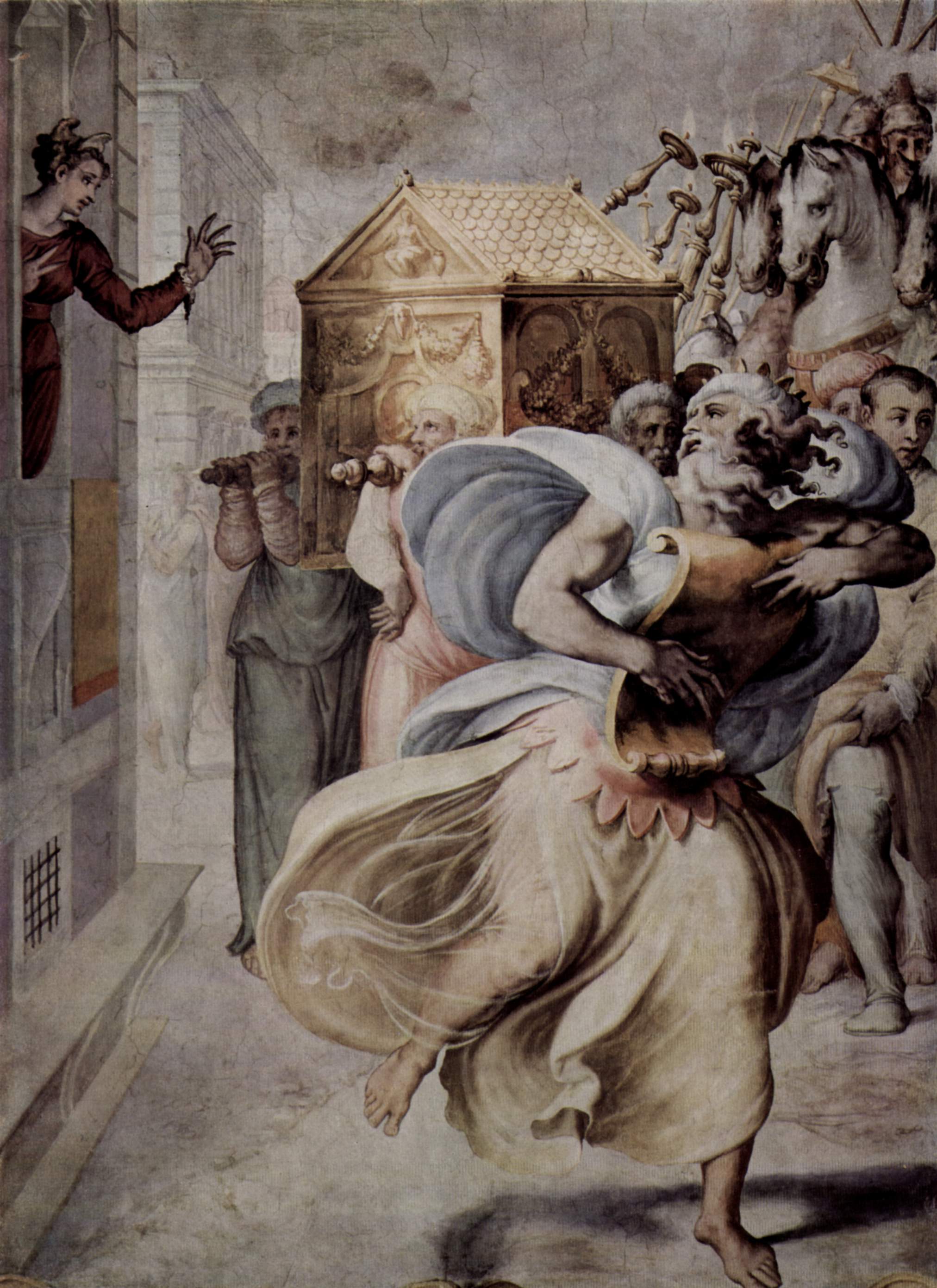
"Now as the ark of the LORD came into the City of David, Michal, Saul’s daughter, looked through a window and saw King David leaping and whirling before the LORD; and she despised him in her heart. (...) Then David returned to bless his household. And Michal the daughter of Saul came out to meet David, and said, 'How glorious was the king of Israel today, uncovering himself today in the eyes of the maids of his servants, as one of the base fellows shamelessly uncovers himself!'" (2. Samuel 6:16+20)

The world has lost
its rose-tinted hue.
The butterflies
have flown away.
What I once felt for you
has gone.
I don't know where.

Now
when I look at you
I feel only resentment
and pain;
regret
at having been so stupid
to fall in love with you.

You were my hero,
you were my hope.
I gave everything for you.
I lied for you,
I would have died for you.
All these years
I waited for you,
I pined for you,
I wanted to stay true to you -
But what did you give to me?

I thought
that you loved me too,
as strongly and dearly
as I loved you -
was it asking too much
to expect you to be
faithful to only one woman - me?

The world has lost
its rose-tinted hue -
I see you now
as you truly are,
and can't believe
I ever loved
this womanising man
for whom I'm just a trophy,
something you paid for
to add to your collection,
one among many -
you disgust me.

I look at you
and all the love is gone.
I look at you

and despise you.

____________________________________________________

[23. / 24. November 2012] - one of the very old ones

Michal was David's first wife. She was in love with him (1 Sam 18:20); he "won" her from Saul by killing 200 Philistines and bringing back their foreskins (ew). When Saul wanted to kill David, she saved him. (1 Sam 19) Later when David was in hiding, Saul married her off to someone else (1 Sam 25:44). Once David became king, he fetched her back (2 Sam 3).

I've noticed people often view Michal negatively. Probably mainly because of her reaction in 2 Sam 6:16-23 to David's dancing in front of the Ark of the Covenant:
"Now as the ark of the LORD came into the City of David, Michal, Saul’s daughter, looked through a window and saw King David leaping and whirling before the LORD; and she despised him in her heart. (...) Then David returned to bless his household. And Michal the daughter of Saul came out to meet David, and said, 'How glorious was the king of Israel today, uncovering himself today in the eyes of the maids of his servants, as one of the base fellows shamelessly uncovers himself!'" (2. Sam 6:16+20)

But isn't her reaction understandable? She was David's first wife. He had how many other wives after that - and then danced around (half?)naked in full view of everyone. Sure, he said it was for the Lord (v.21) - but after all the womanising she'd seen I think it's understandable that she did not accept that for an answer.

So this poem is basically about "falling out of love". At first we see only this perfect image of our partner - and with time, that perfect image gives way to who he really is. Question is: do I like it, can I forgive him, can I live with it? Michal's answer was: no.


Picture by Francesco Salviati

20 August 2016

The Poor Widow's Offering: Generous

Mark 12:41-44

Generous God,
you have given me
all that I need -
not very much,
but it is enough.
Open my eyes
to see all you've provided -
more than possessions,
a wealth more than wealth.
I want to give thanks
for the riches you've given:
the breath in my body,
enough food to eat,
my beautiful children,
the knowledge of You.

Mysterious God,
it is true
my cup was not always sweet,
and much bitterness
has stained my years.
And I've cried and complained,
not understood your ways -
except this: you are love
and you understand my pain.
I have swallowed the dregs
of loss and poverty,
of loneliness
and a mother's worry.
Daily I struggle,
yet stubbornly believe,
though you lead me rocky ways,
that you care for me.

Bountiful God,
all I have is yours -
that's so easy to say,
yet so hard to do.
Give me the peace
to share generously -
just like You.
Let me live out the love
you have given to me,
with no fear of tomorrow,
with no fear of suffering.
Let me open my hand
knowing that yours
is always open to me.
You have covered my needs -
how can I not seek
to cover those
of others I meet?

Loving God,
I know my gift is small,
disappearingly small
beside the greater gifts
greater people can bring.
It shames me
as they give me looks
as though I were stingy,
whisper of "impertinence"
or say, "The more you give
the more you shall receive."
You see my gift,
worthless in their eyes -
worthy in yours,
for you see my heart
and what this means to me.
So here I bring
everything,
though to them it's nothing,
and I won't be ashamed,
for it's not their approval I seek.

Take my silver and my gold,
not a mite would I withhold -
and if I have no silver nor gold,
take my mite - take them both.

___________________________________________________

[20. August 2016]

Italicised bit at the end is from Frances Ridley Havergal's hymn "Take my life and let it be" (an old favourite of mine).
Parts of this poem were inspired directly by yesterday's "3 minute retreat" from Loyola Press - highly recommended; it's an app too, try it out (Apple / Android)!

A widow gives two small coins as an offering in the temple (the temple offering would probably have been for supporting the Levites / priests working there - they had no land to farm so were dependent upon tithes etc - and upkeep of the temple). Others give a lot more. Jesus, who is watching, says that the widow in fact gave more than those who brought big gifts, because she gave all she had while the wealthy gave just a portion. I believe she is a perfect example of what Jesus taught about giving in Mt 6. She received no admiration for her gift - and yet it was a big move for her (and God saw it).

There's a lot of (false) preachers pushing for congregations to give money. A huge deal is made out of tithing - often with the tagline "give and you will receive". Giving is good - that "tagline" is dangerous. Because if you give in order to get back, you are in fact acting like an idol-worshipper. A principle I have watched often when I grew up in Taiwan was "give and get back". In traditional religion, you give sacrifices so that the god will give his services to you. It's basically a "business contract". I believe this is the "natural" human way of living religion. But Jesus has taught us a new way. Which means giving is no longer part of a "business contract" with God, where God is "indebted" to give us something back, and where God's blessing is in proportion to the size of our gifts. We are in a relationship with God, welcomed to freely give out of love, not because we "must" and not because we "get something" out of it.

And that's how I view this widow's actions here. She gave out of the generosity of her heart (and possibly out of the experience of God's generosity despite her hardships), gave what she had (trusting in God's provision), and was brave enough to give what must have looked pretty measly to onlookers. Generosity is not giving with the hope of getting something back... it's also not something only possible if you have a lot to give. Generosity (not only when it comes to money, but also e.g. in treatment of others, giving time, giving kindness) takes courage - the trust that we are not going to "lose out" by giving to others.

I have discussions with my boyfriend about tithing sometimes (because he doesn't really believe in it, or the way some people do it). If we're tithing because "it's what one does", or because we "ought to", or because we think we'll "get something back", then I believe we are not tithing in the right way. The size of our gifts doesn't matter, the frequency of our gifts doesn't matter, what matters is our attitude. What matters is our relationship with God. So I believe ultimately it's better not to tithe regularly (but e.g. give randomly when we see a need) than to tithe out of a wrong attitude of legalism (just keeping the rules) or because we want to look good to others.

Picture is by Frederick Goodall.

17 August 2016

Mrs Peter


He comes home
in the middle of the night -
his birthday; I'd cooked
and waited, as it got cold.
He comes home,
shouting, "Darling! Pack! We're leaving!"
And off we are again
to I-don't-know-where.

He comes home
just before lunch -
I'm in the kitchen, cooking
for two, but he
brings a crowd, because
"John's got nowhere to go,
and here's this guy we met today,
and here's his wife,
and look - our new brother!"
(Don't ask me how
our food multiplied.)

Or he doesn't come home
for days on end,
and I wonder:

Is he in prison?
Is he dead?
Or at the other end of the world?
He comes back a month later
with all sorts of news,
lots of dirty washing,
and here and there a souvenir.

Impossible?
Maybe.
Sometimes I miss home,
or times of just us together,
or simply normal life
without faces at the window,
without twenty guests a day,
without fear for his safety.
He doesn't smell of fish now -
which maybe is a good thing -
but some days he comes back bloodied,
and I no longer clean the nets
but his wounds.

But this is my service
of love to him,
and this is my service
of love to the Lord.
Cleaning wounds,
cooking for armies,
meeting the strangers he drags in,
moving so often,
visiting him in prison,
fearing for his life -
all this is worth it,


because
I get to meet so many people,
I get to share in so much joy,
I get to see so many places,
I get to shine for Christ my Lord.
I would not exchange this life
for comfort or riches or normality -
would not exchange the experience
of watching reconciliation bloom,
of seeing broken lives made new,
of seeing hope rise where there once was despair,
of being a puny cog
in the marvellous work of God.


______________________________________________________

[17. January 2012 - edited 17. August 2016]

I'm a second generation missionary kid, so I've seen and heard a bit about the lives of missionary wives. I have for instance heard the story that my grandfather (missionary in Sicily) used to bring people to lunch unannounced quite regularly. And I know of missionary families where they had to move from one moment to the next because there was a war, or they were being kicked out of the country, or similar. Not easy.

But missionary wives are not just tag-alongs or behind-the-scenes workers; they are also missionaries in their own right, or should be. In fact, hospitality and cooking for whoever the husband brings home can be a really important way in building relationships and helping people come closer to Jesus. Because often what people experience or see in our family life or our relationships to each other will convince them a lot more than any words we preach! They want to see that Christianity works.

Anyway, the wife of the Apostle Peter probably didn't have it very easy - those days it was a bit harder again than it is now, after all. For instance: we have internet and telephones now, but just a hundred years ago, leaving one's friends and family to become a missionary meant not seeing them or hearing from them for ages. Letters took months to arrive! In ancient times it was even worse. Travelling was harder too, and took longer. No planes, no trains, no cars. And even now, being a missionary is not always easy - depending of course where one lives, and how one lives.

BUT it's worth it. Because there's more to life than comfort, and we have heaven before us with all eternity to catch up on good things we're missing now.


By the way: we don't really read about Peter's wife in the Bible, but we do know he had one. Jesus healed Peter's mother-in-law (Mt 8:14-15), i.e. Peter was married, and Paul mentions Peter taking his wife along with him on his mission journeys in 1. Cor 9:5.

Picture is "Fisherman's Wife praying for a happy return" by Henri Jacques Bource - I felt it was quite suitable.

15 August 2016

Euodia and Syntyche: Of One Mind

" I urge Euodia and I urge Syntyche to be of the same mind in the Lord." (Philippians 4:2)


How can I agree
with one who is so worldly,
accepts and serves
at expense of God's own truth?
Leaving that out
which is the most important:
salvation and change,
obedience to God?

How can you love God
and yet accept what's sinful?
How can you just preach
what people want to hear?
How can I agree
to what I see you doing?
I cannot be
of one mind with you.

But if my mind is Christ
and if my heart is love
He opens up my eyes,
I see in you
the same passion for Him.

And as we break this bread
and as we share this cup
we are one body, we
are One in the Lord,
Sisters in Christ.


How can I agree
with one who's so one-sided,
obeying the rules
at expense of those God loves?
Talking so much,
not standing up for justice,
not loving the lost
or the marginalised?

How can you love God
and yet not love your neighbour?
How can you condemn
with words that hurt his soul?
How can I agree
with what I see you doing?
I cannot be
of one mind with you.

But if my mind is Christ
and if my heart is love
He opens up my eyes,
I see in you
the same passion for Him.

And as we break this bread
and as we share this cup
we are one body, we
are One in the Lord,
Sisters in Christ.


He gives us gifts,
He gives us love,
He sends us out
to be His light.
The gifts we have
are different
yet incomplete
when separate.

So may our minds be Christ
and may our hearts be love
and may His Spirit work
through gifts that He
has given to us.

We may be different
yet we are meant to share;
we are one body, we
are One in the Lord,
Sisters in Christ.


___________________________________________

[23. June 2013]

Inspired by an awesome ecumenics course (June 2013). ^^

I suddenly had the idea that this would make a good "duet" - since it's about two people. And the idea is that they go from disagreeing to seeing that Christ unites them. So this turned into a song and yes it has a melody (but due to my music theory being really crappy I have still not written it down 3 years later).

I opposed two viewpoints in this poem; I'm not sure I chose the right positions to pit against each other, but since I had a melody in my head this was what fit the melody... ^^; (Yes melody sort of came first for this one.)

Both of these things are important (loving God and loving one's neighbour) but I get the feeling that certain (mostly theologically conservative) churches put more focus on loving God, sometimes to such an extent that they don't think so much about actually going out and changing the world, or even hurt people in the process of trying to teach them truth, while others (generally more "liberal" / "progressive" churches) put more focus on serving people, sometimes to such an extent that they bend the Bible a little or become selective so as to be more accepting of marginalised groups (e.g. concerning the homosexuality issue).


The Bible makes it clear that Jesus wants both love of God and love of neighbour from us, since He says the greatest commandment is both (Mt 22:36-40). And it's a sad thing that it's so easy to get one-sided and emphasise one thing so much that the other side gets neglected. We need both.

But this poem is not just about "balancing out" the viewpoints or which is "right". It's about church unity. Who are Euodia and Syntyche? They are two co-workers of Paul who disagreed about *something* (doesn't say what), and he exhorted them to be "of one mind" (Phil 4:2). I took them here as examples of disagreement, differences and unity in the church.

Recently I realised the beauty of being brothers and sisters in Christ, about how Jesus actually breaks down boundaries between people (story here). And I think denominational boundaries shouldn't block us from each other either. I sometimes see certain Christians venting against certain other Christians, and I think often the problem is that when we act like that, we fail to see the other person as someone just as passionate for Jesus. Last week I was with people I did not always fully agree with theologically. But I had the impression with most of them that they really have a genuine relationship with Jesus. In the end, only God knows who the "true believers" are - and those are scattered, in my opinion (and Augustine and Luther thought the same haha :D) throughout the different churches of the world (in the universal "invisible church"). We don't need to all think the same way - but we need to recognise others as our brothers and sisters even if we don't always agree with them 100%, and let ourselves and our way of thinking and doing be challenged by theirs. This past week I learnt that each denomination has its strengths which we can learn from. God has given us different gifts, different points of view, different areas of focus - and I believe we're meant to combine all this as one body, to His glory, instead of rejecting one another.


A true Christianity is in the end both positions together (i.e. loving God and loving our neighbour). Because we can't love and serve God without loving and serving our neighbour. I wouldn't compromise at all on that. If people use "serving God" as an excuse to trample on people, they are in the wrong and behaving in a non-Christian manner. Most of the time, though, where churches have a different "focus", we can learn from each other or be reminded by each other of certain aspects we are weaker on. Differences in theological detail do not mean that "something's wrong"; we should be open to working with and learning from other denominations, and recognising in them our brothers and sisters for whom Jesus is just as important as for us! (More here - from ages ago though)

Picture by Théodore Chassériau

14 August 2016

Nympha: Make This House Your Own


"Give my greetings to the brothers and sisters at Laodicea, and to Nympha and the church in her house." (Colossians 4:15)

O Lord our God
who has brought us together,
turned this hodge-podge mix of people
into a family -
take this house, we pray,
and make it your own.


May this be a place
that strangers call home;
an open door
to the far and the near,
the lost and the seeking,
sinners and righteous,
Gentile and Jew.

May this be the place
where we can show our true face:
be ourselves without fear,
confess and find forgiveness,
be radically accepted
into bottomless grace.

May this be the place
where we learn to love each other
as you have loved us,
where enemy becomes brother
and stranger becomes friend.


O Lord our God
who has brought us together,
take this house, we pray,
and make it your own.

Save us from the temptation
of making it a fortress,
fenced off from the world,
from which we defend
our values and beliefs.

Save us from the temptation
of shutting ourselves in
and keeping for ourselves
what we were meant to share.

Save us from the temptation
of trying to create
a perfect kingdom here on Earth
at the cost of the broken
whom you have come to heal.


O Lord our God
who has brought us together,
take this house, we pray,
and make it your own.

May it be a refuge
from the storm of persecution,
a safe haven
in a world that's torn apart,
a rock for the castaways to cling to.

May it be a greenhouse
where your children can grow
ever deeper in the fullness
of your love and your mercy,
bringing fruit to feed
those who hunger for you.

May it be the table
at which we are strengthened,
prepared for the task you have set us to do,
from which we carry your gifts
to a waiting world.

O Lord our God
who has brought us together,
take this house, we pray,
and make it your own.

______________________________________________________________

[14. August 2016]

A prayer for a church...
In the early church, Christians met in each other's houses. More well-off people offered their houses to be used as meeting places. Nympha is one such "benefactress" who opened her house - probably quite a challenge, because the Church was and is truly a "hodge-podge mix of people", not all of whom would have been pleasant house guests.

Writing this poem, I had to think about what the Church is, or is meant to be. I believe that Jesus came to reconcile us to God and to each other, to heal broken relationships and begin reconciliation in this broken world. Jesus came to save everybody. The consequence of belonging to Jesus is, then, that I will be part of a very mixed group of people (the church), PLUS I have the call (together with this community) to bring reconciliation and the love of God into the world - to people who are different from me and whom I might prefer to avoid. A major challenge in the early church, for instance, was a cultural / racial one: overcoming the gap between Jews (the "original Christians" were all Jews) and non-Jews (Gentiles).

I believe the church is meant to be a community, like a new sort of family - but a family that is open to all, not just self-obsessed and closed off to strangers, or so tight-knit it's hard for people to get into. (Sometimes, I've realised, we Christians have developed a kind of language that non-Christians don't understand. We talk about the Gospel but our explanations make no sense because we don't speak the way non-Christians do; we throw around vocab that they don't really know the meaning of - and maybe we don't know the meaning either!) I have experienced church most strongly there where I was a visitor and felt completely adopted into the community. E.g. this April I visited an Anglocatholic church with a friend (beautiful church service with incense!! Loved it! Will go again!). In the prayers, people from the congregation were mentioned by name. When the priest found out that my friend and I are getting ordained later this year, he said they would pray for us. That's what I call Church. It doesn't matter whether your worship service has a band or incense or flashing lights or whatever, but it matters that we care for each other as the worldwide Christian family, no matter whether we know each other "personally" or not.

Another thing about church as family is that it is open for all. We need to learn to accept all the way Jesus accepted us - no matter the background, political leaning, race, "sinfulness", etc. The great miracle of the Church is that it is the place where "enemy becomes brother / and stranger becomes friend". Our old enmities or boundaries that we had in our "worldly thinking" no longer should count! Because Jesus wants us to love others the way He loved us.

And that is a challenge! But I believe that is what Jesus is calling the church to... not just to celebrate our salvation in comfortable groups of like-minded people we get along well with, but to go where it's dirty and invite more people into the embrace of Jesus, and to celebrate together with people who are different from us - an even greater celebration, don't you think?

One more thing: Church is where we can "show our true face". I realise that is not at all easy. Churches are often the first place we expect to be judged in. Why, though? Why has the church become a place where we feel the need to "fake ourselves"? I'm not saying there should be no reaction to sin in the church - where we hurt each other or make choices damaging for ourselves and others, it is right for the church (and with that I mean the people, the members, the "family", not "church leadership") to step in and say something. But any correction should be done carefully and in love. The Church needs to be a place where we are not afraid to be ourselves, where we can also be open about our mistakes and sins. I think a first step is to take away the pressure to be "perfect"... then also, to take away the fear of being shamed. Best way to do this is precisely by being the loving family I believe the Church is called to be. We are not the perfect elected, but people growing towards Jesus - and all supporting each other on this way, not punishing each other for every slip-up.

For me, the Church is the community of reconciled people who have come into touch with Jesus and want to follow Him. We are all at different stages of our walk with Him, we all come from different backgrounds, we might even be "natural enemies" if not for Jesus. It is a challenge to overcome old assumptions and old boundaries, but that is a first thing Jesus calls us to when He calls us into the Church. The second thing is the call that goes to the Church as a whole: we are to be messengers of reconciliation. I believe we do that by living the love of Jesus (by fulfilling the first calling of accepting each other within the church) and by sharing it in the world through word and deed. That is my personal "ecclesiology" for you, in a nutshell... ^^;

27 July 2016

Abishag: Pity is not Love

[Warning: mild sexual content]

1. Kings 1:1-4

Here I lie,
afraid, ashamed,
in the arms of a man
who can no more;
trying to give you
what you cannot take,
caught in an embrace
that cannot satisfy.

Ashamed of my thoughts.
Ashamed of my feelings.
Ashamed that I recoil
at the sight of your body.
Ashamed that I flinch
at the feel of your touch.
Ashamed of my daydreams
of younger men,
the temptation to seek
my fulfillment elsewhere.

I want to be a good wife,
to make you happy -
but it's trapping me
in unhappiness.
It hurts to watch you
frustrated with yourself,
trying and failing
to be a husband again.

It fills me with revulsion,
it fills me with pity -
how I wish I could respect you
and love you instead!
But pity is not love,
and it can't help me endure.
Pity is not enough
to keep me true to you.

How I wish
they could just let you be old
and live out your days
calm and at peace.
How I wish
you must not bear this pressure
of being a king,
a potent man to the last.
How I wish
we could just admit weakness,
that failure must not be a shame.
How I wish
we could just be friends,
talking, playing games,
not trying every night
to do what we cannot.

Here I lie,
afraid, ashamed,
in the arms of this man.
Pity is not love.

__________________________________________________

[25. July 2016 above the South China Sea]

I've read a few interpretations about Abishag (including a feminist one I rather liked according to which Abishag had some power in government). I based this poem mainly on a quote from the Interpreter's Bible which I found on Wikipedia:
[T]he Hebrews...believed that the fertility of the soil and the general prosperity of the people were bound up with the fertility of the king. David by this time was old and decrepit and his sexual vigor is called into question. Attempts are made to remedy the situation. The first cure is to heap clothes upon his bed in order to secure such physical heat as might render him capable. When this fails a search is made for the most beautiful woman in the land. Great emphasis is placed upon her [Abishag's] charms. The LXX supports this by translating in vs. 2, "and let her excite him and lie with him." The fact that the king did not have intercourse with her is decisive in the story. If David was impotent he could no longer be king.
I also felt (after having read the story of someone who married an old man she was caring for out of pity, and then felt guilty for feeling disgusted, unsatisfied or attracted to other men) that I wanted to write about this situation of being a young woman with many opportunities (Abishag was said to be very beautiful), in an unhappy relationship with an older man.

What I realised while writing (and it comes out in the second-to-last stanza, "How I wish...") was that the attempt to keep David potent, and the belief that he could only be a proper king if he was, is once again the kind of human thinking that won't allow for weakness - a way of thinking that is not (from my understanding of the Bible) God's way.

In an ethics class I read a book by Wolfgang Huber (German bishop and ethicist) in which he differentiates between the "olympic man" and the "Jesus man". Human thinking wants the "olympic man", the athlete, strong and able, healthy, successful. This is what David's people were going for when they tried to keep him sexually fit to the last. You're not allowed to get old and decrepit and weak - and if you do, in today's Western culture, you all too often get pushed out of society e.g. into an old-age home. Contrast to that the "Jesus man": Jesus on the cross, weak and suffering. Jesus on the cross means that we are allowed to be weak, that there is nothing wrong about not being completely fit, active and capable of everything. God allows us to be weak and to fail, it is not "bad" or sinful to fail. In fact Jesus' failure on the cross was His victory!

So we ought to change our thinking... David's and Abishag's relationship could have been so different, if he had been allowed to be old and impotent. And I believe this also says something about how men need to be liberated and emancipated too from wrong ideas about manhood (an issue which - some of you might be surprised - feminism has started touching upon) which focus too much on strength and power. There is nothing "unmanly" about weakness - and thinking it is will only cause difficulty when, like David, you are stuck in a position where you are weak and there is no way out. We need to accept ourselves instead of trying to fit some human standard. Because that human standard is not God's standard...

Picture by Pedro Americo

14 July 2016

Gomer: Looking for Love

Hosea 2:2-25


Looking for love
in all the wrong places -
feels like I'm wandering
blind through a desert,
chasing mirages,
consumed by my thirst -
never satisfied.

I once had love
but I did not see it -
didn't recognise what I had.
Instead I set to wandering
towards the greener grass
only to find a desert
on the other side.

So burn me now,
my cuckold husband:
destroy me with your love
that I've turned into hate!
You loved me with a fire -
now it's a flame of rage.
So burn me with the anger
of your jealous revenge!

I once had love
and I threw it away,
looking for love
in all the wrong places.
Why should you accept me
into your arms again?
Why should you lead me
back out of this wasteland?
I know the power
of a man's jealousy -
I cannot expect you to love me again.

So what is this love
greater than jealousy?
What is this love
that overcomes revenge?
What is this love
that comes looking for me
out in this void that I lost myself in?
What is this love
that chases after me
drawing me back
into its arms again?

This is the love
I was looking for:
the love I had all along.
This is the love
I was looking for:
I see you - and I am complete.

______________________________________________________________

[14. July 2016]

"And I will take you for my wife forever; I will take you for my wife in righteousness and in justice, in steadfast love, and in mercy. I will take you for my wife in faithfulness; and you shall know the Lord." (Hosea 2:19-20)

Gomer is the wife of Hosea - an unfaithful wife. At the same time, she is a parable for the unfaithful people of Israel, who have turned away from God to idols, and away from the life God meant for them to a life that harms and oppresses others. The book of Hosea is full of calls back to the relationship with God and to a life of mercy and justice towards others (e.g. Hosea 12:7).

I find interesting how the book of Hosea portrays God's reaction to His people's sin to the reaction of a jealous husband to the wife who was unfaithful to him. Jealousy can be very powerful... I guess the greater the love, the greater the hurt when you find out you've been cheated on. The book of Hosea describes strong feelings of anger. And yet again and again it shows: God is not man; He won't be controlled by anger and jealousy, but goes beyond righteous anger to grace and mercy, giving new chances again and again. God overcomes the pain we cause Him, and invites us back where a human husband probably would have balked (and had a right to - the Bible allows and in places even encourages divorce from an unfaithful partner).

God does feel righteous anger and jealousy - because He loves us, and our unfaithfulness causes Him pain, and seeing us hurt ourselves in our fruitless search for love elsewhere pains Him too. But God is not fixated on anger. He wants to draw us back. That is why He has spoken again and again through the prophets: because He never forsakes us, but wants to win us back to Him again. It's up to us to recognise this love and return to Him. The doors are open!