23 June 2015

Sulamith: Desiring You


Song of Songs

I want to get drunk
with you,
with the sweet, heady wine of your love.
I am starving for you;
my whole body aches
with desire like a fire
consuming me until
I am satisfied in you.
Intoxicate me,
let this love go to my head;
take me now
and fill me up with you.

I want to drown
in you,
in the endless depths of your love.
Parched in the desert I cry for you;
all of my being needs you.
How can I exist
apart from you?
I want to spill myself out
and be consumed by you.
Surround me,
drag me down into the floods;
take me now
and make me part of you.

I want to hide
in you,
in the cool, quiet shade of your love.
Let me lie in your arms
entranced by your presence,
dreaming in the comfort
of your warm embrace.
Cover me with your mantle,
hide me beneath your wing,
take me,
marry me,
make me your own.
Take me now
and make me one with you.

_____________________________________________________

[22. June 2015]

In case you didn't notice, this is about God. ;-)
I got inspired to write this while reading Everything Belongs by Richard Rohr (really good and thought-provoking book!). In one chapter, he speaks of the connection between divine love and human love. In that chapter, Rohr says on prayer: "Often the imagery becomes sexual, because it is the only adequate language to describe this contemplative experience." - "Religious images were once 'sexual': passionate, suffering, naked, bleeding, familial, and relational."

So if you're thinking I was "pushing boundaries" with the imagery here: it was intentional (sorry, not sorry). If you have a problem, go read Song of Songs.

In general, Song of Songs gets interpreted in these 2 ways:
  1. It is about the love of a couple.
  2. It is a parable of God's love.
I find it interesting to consider how we can actually speak of our relationship with God like we speak of a human relationship... not just in the "best friend" sense but even, as in Song of Songs, with (pretty strongly) sexual imagery. Of course, in religious circles we have become so used to hushing up sex or speaking of it only in connection to sin, that this can be difficult to accept. We tend to relativise or "soften" certain images that pop up all over the place in the Bible, e.g. the marriage imagery that appears really often to describe God's relationship to His people. Maybe we need to let these images challenge us anew, instead of making them "child-safe" and palatable for our feeble constitutions.

Some references in this poem: Psalm 42 and 63 (thirsting for God), and the "mantle" and "wings" imagery from Ezekiel 16 and the Book of Ruth. Covering with a mantle is a symbol for engagement.


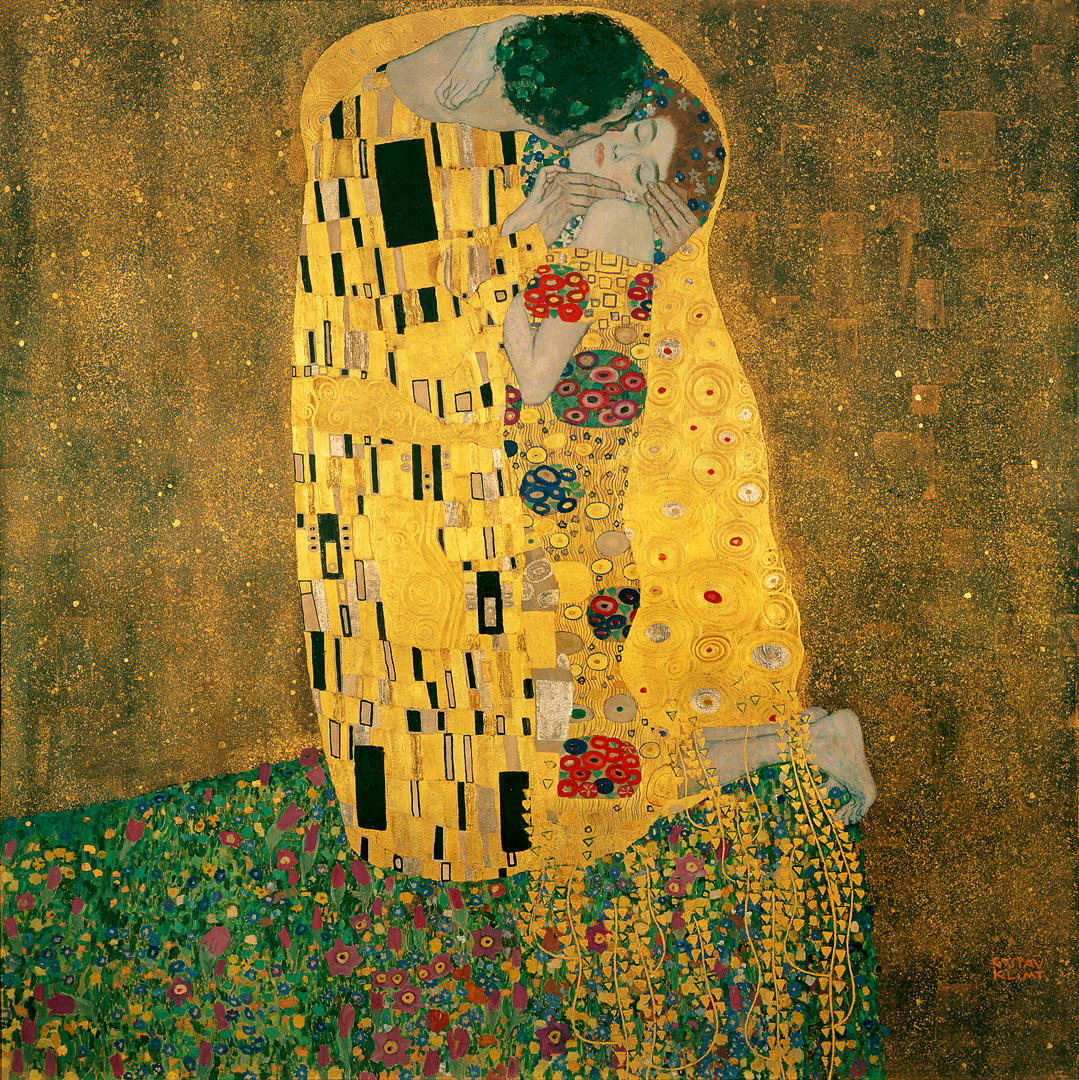
Picture by Gustav Klimt.

07 June 2015

Asenath: Stranger

Genesis 41:45

He burst into my life,
a stranger
with strange ways
and strange dreams,
a strange story
of a god who led him
through shame into glory -
and I loved him.

He burst into my life,
and brought into question
all the things I held on to,
everything I believed.
He opened the door
to a world I never knew,
frightening and new -
and I loved him.

He broadened my horizons,
stretched my imagination;
he was my piece of foreign land,
here to see,
here to touch,
my very own glimpse
beyond my borders
into the wider world.
And I'll never be the same,
because, with him,

You burst into my life
and turned it upside-down.
You challenged my beliefs,
and drew my love on you -
on you, the strange God,
whom I saw in all he did,
whom I heard in all he said,
whom I loved in loving him.
I love him
but what I love was made by you -
so how could I not love you too?

______________________________________________________________

[15. May 2015]

Asenath was Joseph's wife and daughter of an Egyptian priest (Gen 41:45).

There is an intertestamental / apocryphal book (what I like to call "ancient biblical fan-fiction", because in a sense it is) about Joseph and Asenath, and in particular about her conversion to Judaism (of which we don't read in the Bible). I read it last year - for fun, further study and in preparation of this poem (which has taken me half a year to write...). It's very interesting (the inter-testamental apocryphs all are, if you take them as fan-fiction and not as authoritative like the Bible); you can read it [here] if you like.

What struck me about the apocryphal story - and ended up flowing into this poem - is how it is about someone coming to faith through seeing the life of her husband. The Bible does not mention Asenath ever accepting Joseph's beliefs, but she would have been faced by them. So in this poem I focused on the one hand on the "meeting of cultures" in what was a cross-cultural marriage, and on the other hand on how through knowing Joseph, Asenath may have come to know God.

18 May 2015

Jael: I Am No Man


Judges 4-5

And [Deborah] said [to Barak], “I will surely go with you; nevertheless, the road on which you are going will not lead to your glory, for the Lord will sell Sisera into the hand of a woman.” (Judges 4:9)

I am no man,
I am no soldier,
but today I won your war.
Not with the sword,
nor the strength of horses -
today I won your war.

With a sip of milk
and a comfortable bed
I brought your foe to his knees.
There he lies dead -
a tent peg through his head.
Today I won your war.

Who says a housewife
cannot be an assassin?
Who says hospitality
can't be battle strategy?
Who says household items
cannot become weapons?
Who says a great man
cannot die at woman's hands?

I am no man,
I have no sword,
but today God won your war.
Through the hands of a woman
and the weapons of a housewife
today God won your war.

What is low in your eyes,
what you would have ignored,
the Lord has made high
and used for his work.
The mighty are shamed
at the hands of the weak,
as God shows forth his glory
in a woman like me.

___________________________________________________

[18. May 2015]

And yes, the Éowyn references are deliberate. ;-) "I am no man!"

What I find really interesting about the Deborah/Barak/Sisera/Jael story is that all the men in the story get away rather badly and appear pretty weak, while the women are the ones keeping a clear head and being in charge. Though that happens way more often in the Bible than certain people like to admit (just some examples: Tamar, Rebecca, Rahab, Ruth)!

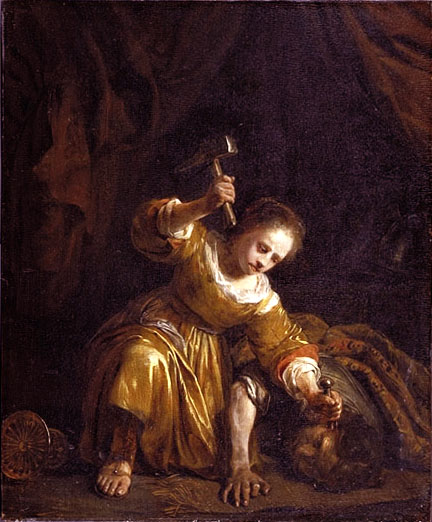
Quick sum-up of the story: the Israelites are being oppressed by the Canaanites, so through the leading of the prophetess Deborah they fight back. While Barak's army fights the Canaanites, Sisera (the Canaanites' commander) runs away and Jael (who by the way is not an Israelite but a foreigner) invites him into her tent, gives him milk when he asks for water (i.e. very hospitable) and covers him with a blanket. When he goes to sleep, she takes a tent peg and hammer and WHAM.

What fascinates me about Jael's story is her hospitality - and how she ended up using hospitality as her "secret weapon". Which shows to me that God can work through anyone, through any means - women don't have to "act like men"; we can use our own gifts, our own ways of doing things. Or rather: let God work through them.

As I was writing this poem (dwelling in particular on Judges 4:9), I had to think of all those instances where God uses what society would think "weak" or inconsequential to bring about his victory. His glory is shown all the stronger in those "unexpected" places which put our all-too-human expectations to shame.

A few texts were at the back of my mind while writing:
  • Not by might, nor by power, but by my spirit, says the Lord of hosts. (Zechariah 4:6)
  • The song of Hannah (1. Sam 2:1-10): The bows of the mighty are broken, but the feeble gird on strength. (v.4)
  • The Magnificat (Luke 1:46-55): He has brought down the powerful from their thrones, and lifted up the lowly. (v.52)

 Picture by Jan de Bray

07 April 2015

Dinah: Stop Me

Genesis 34

Stop me, he said,
if I go too far,
and that put me at ease
for I thought that I could,
knew well my boundaries -
I'm a principled girl.

Stop me, he said,
if I go too far.
He held me,
and I let him.
He kissed me,
and I let him.
Was it not innocent?

Stop me, he said,
but I never wanted to -
it felt too beautiful -
and I always thought:
When it comes to it
I'll say no.

Stop me, he said,
and I gave in to his kisses,
and I gave in to his touch,
and I knew that I should stop him,
but I never wanted to.
Stop me, he said -
Don't stop, said I.

Stop me, o Lord,
I'm going too far -
Stop me, o Lord,
I cannot say no.
How can I say no
when my body screams YES?
Stop me,
stop me,
stop me -
I've gone too far.

_____________________________________________________________

[29. November 2012]

Written with Dinah in mind a bit... also as a sort of "reply" to my other poem, "Say No".
The Dinah story is traditionally interpreted as a rape - other interpretations though (e.g. in the novel The Red Tent by Anita Diamant) suppose the possibility that Dinah was in love with Shechem and wasn't being forced to anything.

My earliest memory of the Dinah story is my parents citing her as an example of why you shouldn't talk to strangers / get into a stranger's car / etc. XD

I wrote this one after hearing someone tell me that a guy told her to "say stop when I go too far" - which of course didn't work. We might tell ourselves we'll say no. We might be certain that we want to say no. But will we be able to? I get the impression that many guys expect the girl to set the boundaries and keep control. But it's a bit unfair to expect her to be the only one keeping a control. What if she can't?

My personal impression is that giving in is far easier than it may seem. So don't trust yourself to say no when the moment comes. Don't put yourself into a dangerous / tempting situation in the first place.

And: it's not only the girl's problem. I think in a relationship one needs to help each other in this area. Both need to keep watchful of themselves and not expect the other to be the controlling instance and stop them. Girls aren't necessarily more controlled than guys, despite common opinion.

Picture by Joseph Noel Paton... not really of Dinah of course, but there aren't really any good pictures of her... ;-; After my thesis I might try to revive my art skills...

28 March 2015

Tamar: Shame


2. Samuel 13:1-22

Ashes.
Dust.
Don't look at me.
I am nothing now.
Why this?
Why me?
Don't look at me.

Don't tell me
it was all my fault -
I ask myself already
what I could have done,
why I didn't see.
Ashes.
Dust.
Don't look at me.

Don't tell me
it was not my fault -
it changes nothing,
does not take the shame.
I could confess,
though it's his sin.
My shame would stay.
You could show pity,
say you forgive,
though it's his sin.
My shame would stay.
Call me innocent -
it will not change
the truth of my shame.
Don't look at me.

I feel dirty.
Nothing can wash me.
I feel hurt.
Nothing can heal me.
I feel lost.
No one can find me.
I don't want them to,
don't want them to see
my shame.

Lord -
are you like those
who avoid me now?
Are you like those
who pretend I am fine,
or those who condemn,
denying relief?

Or
are you the listening ear
that lets me scream,
the one who covers
my shame with clothes,
the God of vengeance,
the God who forgives,
who sees my shame
but honours me?

________________________________________________________

[September 2013]

Tamar, David's daughter, was raped by her half-brother Amnon. Not to be confused with Judah's daughter-in-law. There's a second (older) poem about David's daughter, here.

This was influenced by my "homework" for the paper I'm writing about shame / honour cultures. Western theologies often look at the Gospel in terms of guilt, when what bothers people in most other cultures is not guilt but shame. And at some point I had to think of Thamar (though I've written a poem for her already...), and victims of abuse. You can feel terrible about what happened to you, even though it was not your fault. Even if you know it was not your fault, you can still blame yourself, feel broken, and what helps people in such a situation (I think) is not so much someone telling you Jesus died to take your guilt away, but knowing that He died also to take your shame away. Because I think one can feel ashamed even if one is not guilty.

The part with the clothes is based on Genesis 3, where God gave Adam and Eve (who were ashamed after having taken the fruit) clothes to cover them. Shame has a lot to do with the feeling of exposure. I was thinking also of all those verses in the New Testament (and also some in the OT) about putting on salvation and righteousness and putting on Jesus "like clothes".

Tamar: Dirty Laundry


2. Samuel 13:1-22

Unclean.
I want to SCREAM,
to tear my clothes -
but that's what HE did,
tore them clean off me,
and then -

DON'T.
Don't remind me.
Don't take me back there,
don't let him touch me,
don't you touch me either -
I'm afraid,
so afraid
of every look
   every touch
   every man ogling my way,
   every brother
   even Father -
Don't want to trust again.
I can't,
CAN'T.

He said
he was sick with love.
Then he used me
like dirty laundry
and threw me away -
is that what love is?
Forcing.
Over powering.
Not heeding cries of NO.
Is that what love is?
Then let me die
                         die
                              die -

I'm already dead,
wish I were dead,
he killed me,
killed my love
          my trust
          everything
and I'm dirty,
so dirty -
just throw me away,

like he did -
threw me away,
one-time-use,
like a worthless piece of rubbish.
And that's how I feel
because that
is what he's made of me.

Oh GOD.
Are you here?
Were you there
when it happened?
Why didn't you stop him
with some lightning from heaven
or send down an angel
to whisk me away?
WHY must I live
with this shame that's killing
                                          killing
                                                killing me?

Oh GOD.
Do you care?
Or am I dirty
in your eyes too?

He's a man.
He'll get away with it
again.
Father won't say a word,
of course.
While I bury myself in shame
and hope
that YOU
who comfort the suffering
are
  on
    my
      side.

_______________________________________________________________

[2011]

Not to be confused with the daughter-in-law of Judah, whose poem is right here.
David's daughter Tamar was raped by her own half-brother, Amnon, who for a long time moped about how he was so in love with her and couldn't bear it, then pretended to be sick, tricking her, and raped her. Afterwards he lost interest and sent her away - which to her was almost the worse shame. (I feel Amnon really had no clue what love is...) And one of the many many terrible things in this story is that Amnon just gets away with it; David doesn't move a finger. I have a feeling this episode contributed to Absalom's later uprising against David - Tamar was Absalom's sister. 

What I tried to focus on here was Tamar's feelings of shame - as well as the inequality which enabled Amnon to do what he wanted, without even getting in trouble, while her life was probably ruined for ever ("violated women" carry huge stigma even now in some cultures, even though what happend wasn't their fault).

There's another (newer) poem for Tamar over here if you want to compare... see if I've improved or de-proved over the past few years... ;-)

Picture by N. Regnier

26 March 2015

Widow of Nain: Job was not a Woman

Luke 7:11-17

Lord, you have given;
Lord, you have taken.
Like Job, I should
bless your name
anyway.
But the words
stick to my throat
and I can't speak them.

For Job
was not a woman,
not a widow
defenceless and alone,
dependent
with no one to depend upon.
He lost all he owned -
but not the pillars holding him,
for he was a man
and could stand on his own.

Lord, you have given
such wonderful years,
such a kind, loving husband,
such a beautiful child.
But why have you taken?
Praise should cross these lips -
they bring forth tears instead,
for I don't know how
to trust in you
when all my life
has crumbled away.

But what is this?
He holds my tears,
He takes my fears
and frightens them away.

You care, o Lord -
o Lord, you care.
I'm not a speck
of passing dust
to you,
my fate's not meaningless -
you do not look away.
No -
you bring hope,
you bring life,
unexpected -
and teach me
faith and trust again.

For the Lord hears
the cries of the afflicted
and has compassion
deeper than death.

______________________________________________________________

[28. February 2012]

Might not be so obvious in the poem, since I'm trying to show her feelings rather than what happened, but Jesus came and raised the widow's son back to life. :)

In those days, widows didn't have it easy. I tried to show that a bit... as well as the inner battle between knowing one should praise God, and the feeling of not being able to because of all the bad that's happened. I think there are times when our grief or our problems can make it hard to accept what's happened, and make it hard to trust in God. And I think in such moments, God knows and understands. Jesus came and changed things for this widow. Sometimes, He helps in other ways as well, by letting a kind stranger speak a kind word, or by sending people to give help and support...

I think when people are really upset, sometimes it's important just to let them vent. Like Job; he vented! His friends tried to argument with him, but in the end it was they who got told off, and not Job who was venting! The Psalms are full of venting! Compassion is more helpful than trying to talk people into accepting what happened or trusting God again. Compassion will convince them much faster to trust in God again. And compassion is what Jesus did, right here.

Don't throw doctrine on a grieving person - throw love on them instead.