Acts 18
You left your home
and I left mine,
beginning something new.
We met, we loved -
hands intertwined,
which fingers are yours,
which fingers are mine?
Now I belong to you
and you belong to me,
no longer I,
no longer you,
but one.
Together
not only to delight in one another
or in this feeling that awakes
each time I know you're mine.
Together
not only to fill the gap
of longing in my heart
that needs another.
Together
not only for the lives
this union will produce,
little Yous and little Mes.
Together
not only to live side-by-side,
you with your cares,
I with mine.
You left your home
and I left mine.
God brought us together,
and we are one.
Now I belong to you
and you belong to me,
sharing more than our bodies
and more than our home:
sharing one calling,
sharing life.
Together
let us pursue one goal,
and help each other draw the yoke,
for two are better than one.
Together
let us run this race,
support each other when we fall
and pick each other up.
Together
let us serve the Lord,
unite our strengths
and work for Him.
Together
let us walk this road,
of one flesh
and of one mind.
No longer I,
no longer you,
but one
in Christ.
_____________________________________________________
[September 2013]
So... a single girl tries to write about marriage... heh ^^;
Recently
I heard that there are Christians (including pastors) in China who have
difficulties in their marriage because many Christian women are married
to non-Christian men (in case you did not know: more women than men are
Christians in China). That makes it hard to really live marriage as
partnership, supporting each other. Hearing that I decided to write
Priscilla's poem - because Priscilla is an example of a woman in the
Bible who worked together with her husband, so much so that they are always
mentioned together (and what's really interesing is that she's even
mentioned first, as though she were the one "wearing the trousers" in
that relationship haha)
Anyway PRAY for those marriages in China plz~
Genesis 2:24 - Therefore a man shall leave his father and mother and be joined to his wife, and they shall become one flesh.
We
once had to discuss this in Greek class (because Jesus also quotes it
once in the NT). What does "one flesh" mean? To me the thought of
"belonging to each other" is a very beautiful one. I once read somewhere
that becoming one flesh means no longer being two individuals, but
becoming like "one person". Which is why Jesus uses this verse against
divorce. Being "one person" to me means sharing absolutely everything,
sharing your body (1 Cor 7:4), but also not just living next to each
other but caring for each other's well-being and each others wishes and
dreams.
And yes, sharing absolutely everything can be a bit of a
freaky thought, which is why I think marriage (i.e. total commitment) is
important. You need to really be able to trust each other. You make
yourself extremely vulnerable - and for this to be fair, both have to do
this, and be faithful, and commit. It might be really scary, and I
think many people nowadays prefer just living together because really
"becoming one" and sharing everything is a very risky thing and demands
all of you. But I think there's more potential in hurting each other if
we do not open up to each other this way, and I think we totally miss
the point and purpose of sex if we do not fully commit, if we only
"become one" physically and forget about the rest. I think sex without
commitment, and without the total sharing of becoming one, is ultimately
damaging, and not fair to the other person or to yourself.
Ecclesiastes 4:9-12 - Two
are better than one, Because they have a good reward for their labor.
For if they fall, one will lift up his companion. But woe to him who is
alone when he falls, For he has no one to help him up. Again, if two lie
down together, they will keep warm; But how can one be warm alone?
Though one may be overpowered by another, two can withstand him. And a
threefold cord is not quickly broken.
I just discovered this
verse as a perfect verse for describing marriage as partnership. It's
more than just "being in love", it's about really sharing each other's
goals and dreams and supporting each other. Not just a selfish thing all
about "my feelings" (because feelings go away after a while, believe it
or not, and that fact is NOT a reason to divorce and find someone else)
but about the other, and about working together for each other.
2 Corinthians 6:14 - Do not be unequally yoked with unbelievers.
I
picked up the "yoke" image. The way I understand this is: it's better
to have the same goal. A non-Christian will not have the same ultimate
goal / aim as a Christian. That will really hamper partnership. This is
not saying that non-Christians are somehow "inferior", but that it will
cause difficulty in marriage because you will not be working for the
same end. If your aim is to glorify God with your life, and your husband
does not care, it will be hard to reconcile the wishes of your husband
and the wishes of God. I think one can even get that among Christians!!
So check what your guy's (or girl's) life aims are, and see if they are
compatible with yours, otherwise it will only cause you dilemmas later.
Oh yes and the "fingers" bit I "borrowed" from Thomas Hardy; I'm reading Tess of the d'Urbervilles
and after she and Angel get married that image comes up, which I find
really beautiful although in the book the one-ness did not last very
long... very good book btw.
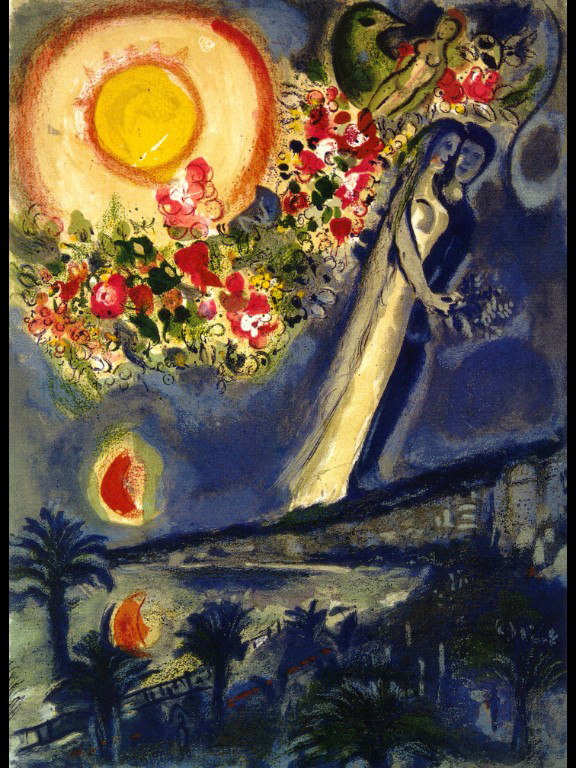
Picture by Marc Chagall
16 September 2015
13 September 2015
Eve: Bitter Fruit
Genesis 4:1-16
Only now do I taste
the full bitterness
of the fruit that I chose.
Only now do I feel
the full consequence
brought not only on myself
but those I love.
What could I have done?
What did I do wrong?
Why is my son a murderer,
why is my son his victim?
Why must I see repeated
in the lives of my children
the same mistakes I made?
O if only
I had been struck dead
the moment I reached out
and sealed all our fates.
O if only
You had put an end
before this began.
O cruel mercy
to grant us life
and let us watch
as we destroy it.
Only now do I taste
the full bitterness
of the fruit that smelled so sweet.
Only now do I feel
the disappointment you felt,
that cold, cruel pain
as you watched your children
destroy each other and themselves
and fall.
O God, if only
it were me, buried first -
the natural order of things.
How can a mother
bury her child?
How can she banish his brother?
Is this how you felt
as you sent us away,
sent us away to our deaths?
O cruel mercy
to grant us life,
to grant us children
and take them away.
O bitter fruit
that festers and grows
and spreads its roots,
breaking apart
all bonds of love.
Now brother kills brother
as mother weeps,
cast out from paradise
all over again.
__________________________________________________________
[12. - 13. September 2015]
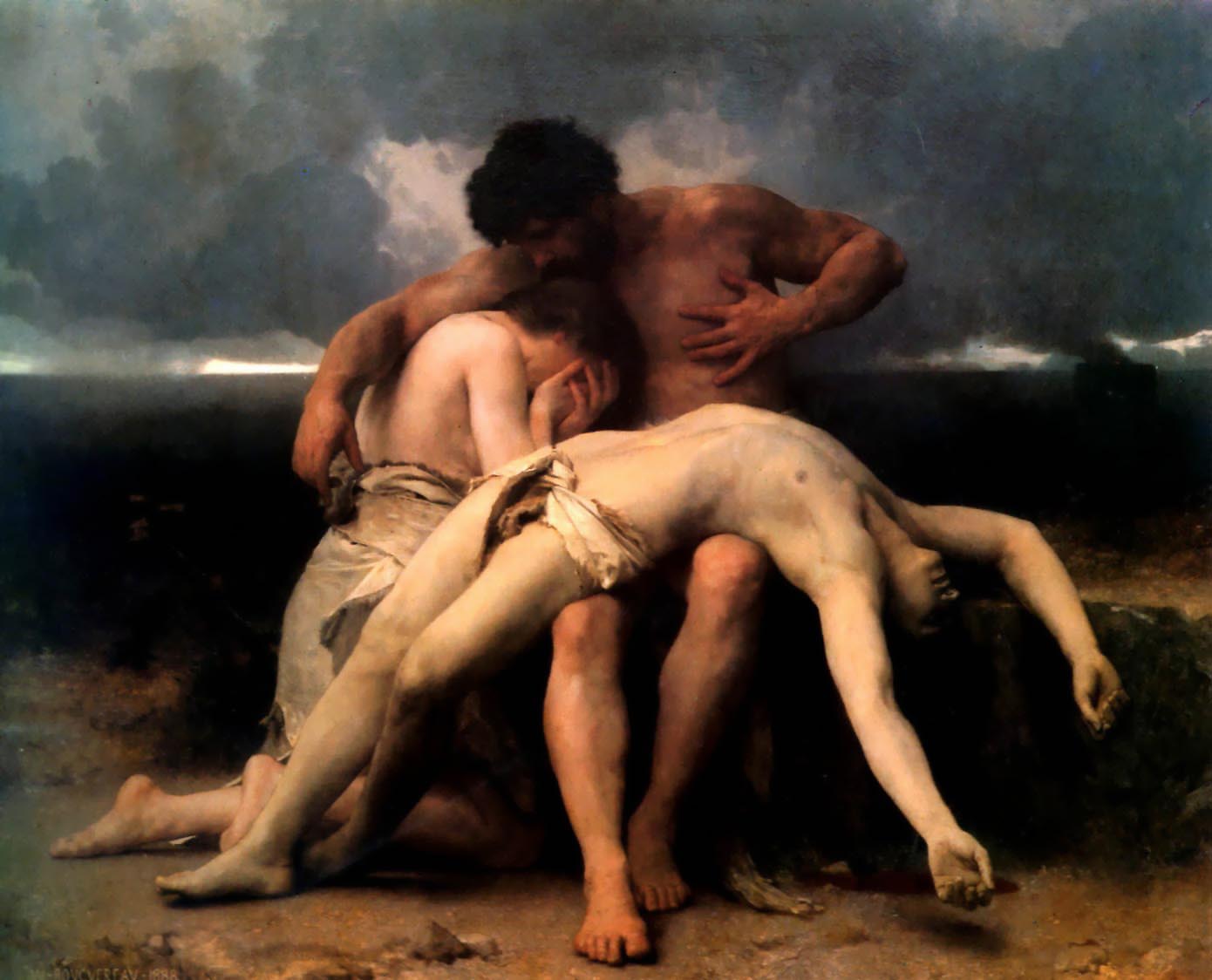
I was looking for another picture when I stumbled over "The First Mourning" by William-Adophe Bouguereau (above), depicting Adam and Eve mourning the death of Abel, who was killed by his brother Cain. I had never before thought of the story of Cain and Abel from the point of view of their parents. Adam and Eve lost both sons in one go: one was killed, the other fled. Like all parents, they probably did not expect their children to die before they did. The death of Abel was the first death. I had not realised that before.
I'm not one to put all the blame on Eve when talking about the "Fall of Man". Kierkegaard made some good points about the fall, namely that it's not just something "historical" that happened way back, but something that happens again in each of us. So my sin is not Eve's fault, but my own, because I fell my own fall.
In this poem I did want to think about what might be going through Eve's head, though. She would probably have felt a lot of guilt ("What did I do wrong, for my son to turn out a killer? Is there not something I could have / should have done that would have prevented it?"), and felt more acutely than before the consequence of the fall, since it affected not just herself and Adam, but her children.
The way I view the fall, it is primarily a break in relationship (more than a rule being broken): Adam and Eve started to distrust God, and as a consequence ended up distrusting each other and blaming each other. The break in relationship with God leads to a break in relationship with other people. And that is what we see in Cain and Abel's case... If Adam and Eve viewed eating the fruit as a sort of "bid for freedom" (free to do what they like / take what they like), that sort of selfish freedom led to Cain feeling he need not be his "brother's keeper". Sin destroys relationships, brings distrust and jealousy. It completely broke up the first family!
True reconciliation is only found in Jesus, who restores human relationships to what they ought to be: accepting each other, loving each other, forgiving each other. I believe ideally the church should be the place where we relate to each other as we should, not destroying each other anymore, or through our selfishness hurting others in our own bid for freedom...
Picture by William-Adolphe Bouguereau
05 September 2015
Junia: Hidden
Salute Andronicus and
Junia, my kinsmen, and my fellow-prisoners, who are of note among the
apostles, who also were in Christ before me. (Romans 16:7)Give me no fame, o Lord.
I need no glory, no applause,
for what good is it?
Instead,
let me stay hidden,
like foundations underground,
like the backstage hands,
like wallpaper no one sees
until it is missed.
Unseen, unnamed,
melting into the background,
hidden from view
but nonetheless there,
essential
like the spices in a curry,
like stitches in embroidery,
like the threads of a rope.
Let me work in patience
for love alone,
in the shadows, unnoticed,
holding the strings.
Let me do what is needed,
though none know my name,
though no one says "thanks",
though I am ignored.
I will be satisfied,
for I seek no renown,
and my work is for you
and for your eyes alone.
_______________________________________________________
[20.6. - 20.7.2012]
Ever tried reading through the "greetings" at the end of a Pauline letter? All those names... can one learn anything out of texts like that?! I think the greetings show us quite a few interesting things. They show us the relationship ties between early Christians, how they worked together and supported each other. Also, they give us a small glimpse into the kind of things Paul's addressees were up to. For instance, we find out a lot about women in ministry. People who skip the greetings don't realise that women were active in ministry in Paul's day, and Paul supported them (despite those famous "women be silent" texts which people like to quote at me when I say I'm going to be a pastor, heh...).
In Romans 16, we read about Phoebe, a female deacon (and deacons were people like Stephen and Philipp who did quite a bit of preaching and evangelising). Phoebe was involved in ministry in a way certain Christians say women shouldn't be (read Phoebe's poem here). Romans 16 also mentions a couple, Prisca and Aquila, who are mentioned together as working together with Paul for the church. Plus, Prisca is mentioned before her husband, which I believe shows she definitely was not a subdued little wife letting her husband do everything. They were a team, in ministry together.
And then we have Andronicus and Junia in Romans 16:7. This verse has an interesting story because, due to Greek grammar confusion, some people translated (female) Junia as (male) "Junias". Might also have ideological reasons because no way could there have been a female apostle! Or?! The word "apostle" has two uses in the New Testament. Often it is applied only to the 12 selected by Jesus. However, Paul also uses it to describe his own role, which gives the word a broader application. "Apostle" comes from the verb "apostello" which means "to send". In this way it means someone sent by God (not only the 12 disciples who were close to Jesus). The word "apostle" does, however, carry quite "high" connotations. And here we have a woman apostle, Junia! Why not?
I wrote this poem thinking of the many women working in the background, not fully recognised because they are women and because of the belief that women can't take on a full ministry. In the 19th century, people were still fighting over whether women should be allowed to be missionaries / evangelists at all, because "women are not supposed to teach men", or because "women should put their family first". People have told me that it's wrong for me to become a pastor, because women should not take leadership positions and whatnot. People have mistranslated Romans 16:7 and hidden Junia for centuries, and I think some would still rather have "Junias" than Junia, because they don't want to let the Bible change their theology. But it's all right - because we don't need to be acknowledged by people in order to serve God.
Picture shows (from left to right): Andronicus, Athanasius (an important saint in the Orthodox Church), and Junia.
26 August 2015
Vashti: Museum Piece
Esther 1
What is a wife?
An ornament?
A pretty vase
to look at,
polish,
play with,
and then put away
till another day?
What am I to you?
A decoration?
I don't exist
until you want me
or want to show me off
like a rare artefact,
a prized possession.
Why can't you see me?
Why can't you see
that I don't want admiration
but love?
I don't want to be
your museum piece,
don't want to be
a picture on your wall
or a statue
to grace your halls.
I want to be
etched into your heart,
a part of you
you can't live without.
I want to be more
than my lovely face,
for when my beauty fades,
what will I be then?
A moth-eaten garment,
a crumbling masterpiece,
a faded painting
worth nothing to you.
Why can't you see me?
So tonight
I'll put my foot down
and stand up for myself
and for women everywhere.
Disobedience? Who cares -
it has to be said,
it has to be done.
We are not your ornaments,
your pretty little things,
collectors' items,
fine rare gems.
We are people
with hearts and souls,
with needs and wishes.
We want more.
Treat me like a human being.
Love me,
see me,
hear me.
Rather than be called a beauty
I would have you look
when I'm my ugliest
and say you love me
for me.
I put my foot down.
I disobey.
I'm your museum piece
no more.
______________________________________________________
[January 2012]
Vashti was the wife of King Xerxes before Esther became queen to replace her. The king called her to show her off to guests at a feast - and she refused to come. It's interesting how some interpreters admire her for it, while others see her actions as wrong, an act of disobedience. Here's my take on the story.
The whole idea of wives being treated like ornaments or pretty vases comes very much from the influence of my very feminist best friend, who I am certain used those exact words once. Also, the "masterpiece" idea came from A Room with a View, where Cecil (a rather unlikeable guy haha) likes to call Lucy (the main character) "my Leonardo". If I remember right she also stands up to him about that once.
It is nice to be called pretty, but in the end we are more than that. If someone likes you for your looks, they won't like you for very long. Because unless we die early we all end up wrinkled and crinkled (which I find really beautiful and cute btw). We're all more than our looks - men and women both. We can't prevent attraction to looks (I think that's quite natural), but it shouldn't be all.
And I think an important verse for this poem is Ephesians 5:25. "Husbands, love your wives, just as Christ also loved the church and gave Himself for her." It's not right to place a wrong emphasis on the part about wives submitting to their husbands while ignoring this second, equally important part!
Picture by Gustave Doré
What is a wife?
An ornament?
A pretty vase
to look at,
polish,
play with,
and then put away
till another day?
What am I to you?
A decoration?
I don't exist
until you want me
or want to show me off
like a rare artefact,
a prized possession.
Why can't you see me?
Why can't you see
that I don't want admiration
but love?
I don't want to be
your museum piece,
don't want to be
a picture on your wall
or a statue
to grace your halls.
I want to be
etched into your heart,
a part of you
you can't live without.
I want to be more
than my lovely face,
for when my beauty fades,
what will I be then?
A moth-eaten garment,
a crumbling masterpiece,
a faded painting
worth nothing to you.
Why can't you see me?
So tonight
I'll put my foot down
and stand up for myself
and for women everywhere.
Disobedience? Who cares -
it has to be said,
it has to be done.
We are not your ornaments,
your pretty little things,
collectors' items,
fine rare gems.
We are people
with hearts and souls,
with needs and wishes.
We want more.
Treat me like a human being.
Love me,
see me,
hear me.
Rather than be called a beauty
I would have you look
when I'm my ugliest
and say you love me
for me.
I put my foot down.
I disobey.
I'm your museum piece
no more.
______________________________________________________
[January 2012]
Vashti was the wife of King Xerxes before Esther became queen to replace her. The king called her to show her off to guests at a feast - and she refused to come. It's interesting how some interpreters admire her for it, while others see her actions as wrong, an act of disobedience. Here's my take on the story.
The whole idea of wives being treated like ornaments or pretty vases comes very much from the influence of my very feminist best friend, who I am certain used those exact words once. Also, the "masterpiece" idea came from A Room with a View, where Cecil (a rather unlikeable guy haha) likes to call Lucy (the main character) "my Leonardo". If I remember right she also stands up to him about that once.
It is nice to be called pretty, but in the end we are more than that. If someone likes you for your looks, they won't like you for very long. Because unless we die early we all end up wrinkled and crinkled (which I find really beautiful and cute btw). We're all more than our looks - men and women both. We can't prevent attraction to looks (I think that's quite natural), but it shouldn't be all.
And I think an important verse for this poem is Ephesians 5:25. "Husbands, love your wives, just as Christ also loved the church and gave Himself for her." It's not right to place a wrong emphasis on the part about wives submitting to their husbands while ignoring this second, equally important part!
Picture by Gustave Doré
23 August 2015
Mahalath: Seventy-Seven Times
2. Chronicles 11:18-23
I was the first,
and in daydreams I thought
that I'd be your Only One.
(Stupid daydreams
of a foolish girl.)
Maybe it meant nothing
to you,
those first kisses,
those times you came to me
and murmured sweet words
as we fell asleep.
Maybe it was too much
to expect you to love me,
when love was not
what you married me for.
You have replaced me
seventy-seven times.
Now when you come
I wonder why you do.
I want you to leave,
take your dirty hands off me,
hands that have touched
too many others
who lie awake now
like I have done,
crying bitter tears
because
you have betrayed us
seventy-seven times
and being loved by a poor man
is better than this.
He was your first,
and in daydreams I thought
that he would be king.
(Stupid daydreams
of a foolish girl.)
For you chose another:
you loved her more than me,
and her son more than mine.
Maybe it is too much
to expect you to love me,
but wasn't he
what you married me for?
You have replaced me
seventy-seven times;
now you replace
your first-born son.
I don't want your love -
it is worth nothing now,
when your son suffers
because you can't love me.
You have betrayed me
seventy-seven times;
now you betray him,
and being a poor man's son
is better than this.
_____________________________________________________________
[23. August 2015]
I did not know Mahalath until this morning... she was the first wife of Rehoboam, son of Solomon, the king under whom the kingdoms of Israel and Judah divided. Reading 2. Chronicles 11, I noticed that although one of Mahalath's sons would have been the fist-born son, Rehoboam chose another to follow him as king - Abijah, the son of his favourite wife, Maacah (V. 21-22). I can imagine that this could have caused considerable conflict and jealousy between the wives. That's how this emerged... this is on the one hand about the consequences of polygamy (jealousy, feeling betrayed), on the other hand about the "replacement" of the firstborn with a later-born son of a preferred wife.
Rehoboam had 18 wives and 60 concubines - in total, 78. That's where the "seventy-seven" comes from: 77 other wives after Mahalath. Mahalath's first son was Jeush; he probably was the first-born.
Picture by Michelangelo.
16 August 2015
Adah: The Curse
Genesis 4:19-24
"Your desire shall be for your husband,
and he shall rule over you." (Genesis 3:16b)
Why do I keep coming back to you?
Why do I seek what causes me pain?
Why do I rush into the arms of my prison?
Why do I repeat the same mistakes?
So many times I could have left -
what made me stay?
So many times I had had enough,
enough of your violence,
your senseless cruelty.
What drew me back?
What keeps me here
with a vengeful man,
a cruel man,
who repays manifold
the smallest injury,
who sows anger
and reaps hate,
perpetuates this darkness
we're already living in?
Why do I not
take my children by the hand,
turn my back,
run far away?
What keeps me here
under your thumb,
dirt beneath your feet,
flesh to be used and cast aside,
the brunt of your fury?
Is it hope that you'll change,
or that I might change you?
Is it desire for the father of my sons?
Is it pure stupidity,
or fear, paralysing me?
Or is this a curse,
running through my veins,
binding me to my pain?
I want to love you,
but loving you is pain.
I want to leave you,
but find myself trapped
in a web of dependence,
of responsibility.
I want to be your helper,
surrounding you with love -
but love is not enough
and it's destroying me.
_____________________________________________
[July/August 2015]
I have been wanting to write a poem about Gen 3:16b for years. Mainly because it's the verse that comes to my mind every time I allow a man to hurt me and get away with it. Of course not as an excuse for not standing up against him, but as a description of the tendency to pretend whatever upsets you about him is "not so bad" because of your feelings for him. Caring for someone can blind against his faults, sometimes to the extent that one even accepts some pretty bad treatment before realising it doesn't have to be that way.
Anyway, I put myself in Adah and Zillah's shoes a bit... (whose situation is way more extreme than anything I experienced.) Lamech is described as a violent man, swearing vengeance on anyone who causes him the smallest hurt, so I imagine he would not have been the kindest of husbands either. Since he proclaims his "oath" before his wives, I suppose it's a warning to them too, not to come against him. So this is basically about how despite suffering under her husband, Adah finds herself unable to leave...
I do believe it would be better for her to leave. Also, I don't think Gen 3:16b "binds" anyone to an abusive relationship. But leaving is not easy - and those days it was even harder, since women were so dependent on men for protection. Sometimes it's clear what one should do (e.g. in this case: leaving an abusive husband), but other things like fear, dependence, responsibility etc. get in the way or make decisive action harder!
(Often for lesser-known Bible women I write a "shared poem", since writing two points of view on the same thing - especially if it takes a lot of imagination to figure out the story behind women who are mentioned only by name, with little or no additional info - doesn't always work out. This time, though, I'm splitting the pair because I had two ideas. Zillah's poem might follow soon.)
Picture by Jan Sadeler.
15 August 2015
Mary: Profane Temple
Solomon brought
Pharaoh’s daughter from the city of David to the house that he had built
for her, for he said, "My wife shall not live in the house of King
David of Israel, for the places to which the ark of the Lord has come are holy." (2. Chronicles 8:11)And the Word became flesh. (John 1:14a)
I am darkness.
I am earth.
I am body
giving birth.
Life and death
bleed out from me.
I am chaos,
liminality.
This far, no further -
no nearer to God.
For what has body
to do with spirit?
What has earth
to do with sky?
What has the profane
to do with the holy?
What has darkness
to do with light?
I am darkness.
I am earth.
Unclean, unholy,
separated by a wall
from the presence of God.
This far, no further
than the boundary line.
What has light
to do with darkness?
What has the holy
to do with the profane?
What has spirit
to do with body?
What has the Word
to do with flesh?
And yet
You
became flesh.
And yet
You
chose woman
to be your temple.
You chose darkness.
You chose earth.
You chose body.
You chose birth.
You chose this lowly maiden,
my earth-bound body;
You filled this profane vessel
with You.
From now on all
will call me blessed,
and all will be blessed
through me.
_________________________________________________________________
[15. August 2015]
A few things flowed into this...
- Upon reading 2. Chron 8, I got stuck on v.11: Solomon removing his wife from the palace because that would be too near the temple, and a woman shouldn't be so near. In the time of Jesus, the temple was in fact split in different sections, and women could only go as far as the women's court (hence "separated by a wall"). This has to do with menstruation (during which a woman would be "unclean") - alluded to with the line "Life and death / bleed out from me".
- (Unbelievably) I still remember something from a religious studies class 4+ years ago, when we were looking at Mary Douglas' Purity and Danger. Mary Douglas studied concepts of ritual purity, and the idea of "liminality" (being on the borderline, neither "out" nor "in") was quite important there. If I remember correctly, menstruation is a liminal phase, which is why it is seen as "unclean" in the Old Testament (and other cultures even today!) and possibly why women were kept at a distance from holy things.
- In Chinese philosophy there is the dualist concept of yin 陰 and yang 陽 which you might have heard of. Yin is the feminine principle, yang the masculine. Yin is associated with the dark, cold, wet, negative, passive, female, earth, and things hidden. I decided to pick that up ("I am darkness" etc.), since it fits to the idea of the feminine belonging to an "unholy" or liminal sphere. Originally, yin and yang were meant to be complementary and equally important - still, the masculine (yang) elements are generally seen as more "positive" and valued higher. Interesting: the whole yin/yang division is not just Chinese, but occurs in Western thought too, where the spiritual was often given more worth than the physical, and where women were looked upon as less worthy to concern themselves with religious things due to their being more "physical" (Greek philosophy and medieval thinking goes in that direction).
- I have referred a bit to "chaos" and "this far, no further"... In Ancient Near Eastern religion, the world was divided into "cosmos" and "chaos". Symbol for chaos was the sea. Some of this thinking is visible in the OT where it speaks of God setting boundaries for the sea, conquering ancient chaos monsters like Leviathan and Rahab (e.g. in Job, Psalms). I decided to sprinkle in these references too, since the feminine is sometimes also associated with uncontrollable nature and stuff like that.
God became flesh. And God was born from a woman. In fact He spent 9 months in a womb. Pretty extreme stuff! And I think: what privilege! For Mary, who became God's temple, the house within which God's presence dwelt, during the time of her pregnancy. But also for all of us, because every Christian is given the immense honour of becoming a temple of the Holy Spirit. When I read Old Testament texts about the temple, I can only marvel at the privilege God has given us. Because direct access to the holy used to be pretty complicated, especially for women, what with all the rules about clean/unclean.
We women no longer have to be kept at a distance from the holy. We can go to church normally. We can partake of Communion / the Eucharist (the real presence of Jesus!) and no one asks us whether we're having our period. God pours out His Spirit upon men and women (Joel 2). Because God showed us in Mary that the female body can be a temple too.
Subscribe to:
Posts (Atom)